Artificial intelligence can both support and strain mental health. While AI tools offer therapy access, stress monitoring, and emotional assistance, excessive reliance on digital interactions may heighten isolation, anxiety, and comparison pressure.
Algorithmic bias and social media amplification can distort self‑image and emotional stability. Balancing innovation with ethical design and human connection is vital to prevent AI‑driven mental health challenges.
Explore how AI contributes to anxiety and mental health challenges in modern society, from social comparison and job fears to digital overload and emotional stress.
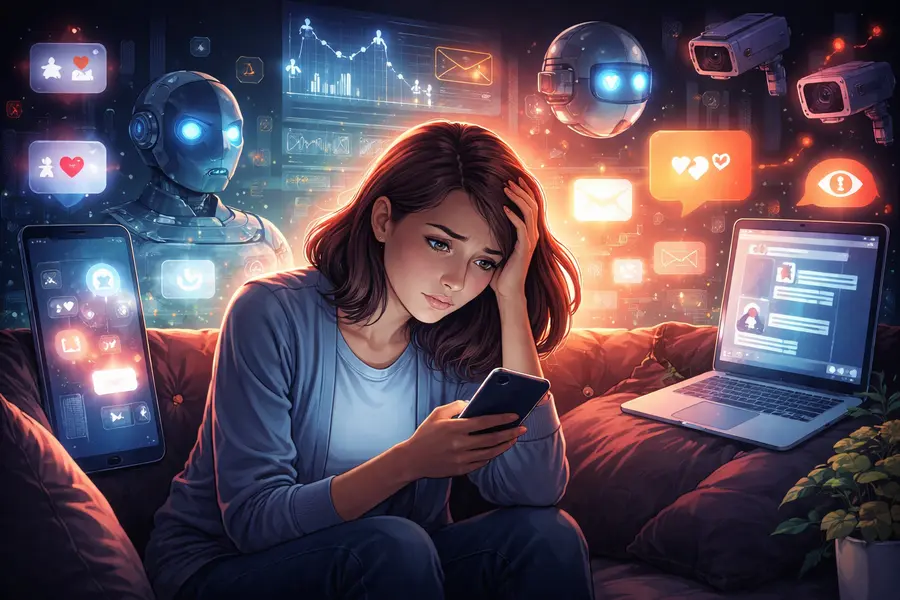
How Does AI Contribute to Anxiety and Mental Health Challenges in Modern Society?
Artificial Intelligence (AI) has rapidly become a part of our everyday lives in 2026—from personalized recommendations to automated workplaces and even emotional chatbots.
While these advancements bring convenience and efficiency, they also introduce new psychological pressures that many people are still learning to navigate.
The constant presence of AI can blur the boundaries between human interaction and machine-driven responses, leaving individuals feeling disconnected or overwhelmed.
For some, it fuels comparison, job insecurity, and information overload, all of which contribute to rising anxiety levels.
Mental health challenges linked to AI are not always obvious, but they are increasingly significant in a hyper-connected digital world.
Understanding how AI contributes to these issues is essential for building healthier relationships with technology.
Let’s explore the subtle and direct ways AI impacts mental well-being and offers insights into why awareness matters now more than ever.
Constant Exposure to AI-Driven Content
AI algorithms curate endless streams of content tailored to individual preferences, keeping users engaged for longer periods. While this personalization feels convenient, it can lead to mental fatigue and overstimulation.
People often find themselves scrolling endlessly without realizing how much time has passed. This constant exposure reduces opportunities for mental rest, increasing stress and anxiety.
Additionally, AI tends to prioritize emotionally charged or attention-grabbing content, which can amplify negative feelings.
Over time, the brain becomes accustomed to rapid stimulation, making it harder to focus on slower, real-world activities. This imbalance can lead to burnout, irritability, and reduced attention span.
When individuals are continuously connected to AI-powered platforms, they may struggle to disconnect mentally, creating a cycle of dependency that impacts overall emotional well-being.
Social Comparison and Unrealistic Standards
AI-enhanced platforms often present highly curated and idealized versions of reality. Filters, deepfake enhancements, and algorithmically promoted “perfect” lifestyles can create unrealistic expectations.
As people compare themselves to these polished digital personas, feelings of inadequacy and low self-esteem can emerge. This is particularly common among younger users who are still forming their identity.
AI intensifies this issue by showing content that aligns with personal insecurities, reinforcing negative self-perceptions. Over time, this constant comparison can contribute to anxiety, depression, and body image issues.
The illusion that everyone else is happier or more successful creates pressure to meet unattainable standards.
Without conscious awareness, individuals may internalize these comparisons, leading to long-term mental health struggles and diminished self-worth.
Read Here: How AI is Influencing Family Structures and Relationships
Fear of Job Displacement and Economic Anxiety
One of the most significant concerns surrounding AI in 2026 is its impact on employment.
Automation and AI-driven tools are replacing or transforming many traditional roles, creating uncertainty about the future.
This fear of job displacement can lead to chronic stress and anxiety, especially among workers in vulnerable industries. Even those who remain employed may feel pressure to constantly upskill or compete with AI systems.
The unpredictability of job markets makes it difficult for individuals to feel secure, which directly affects mental health.
Financial instability and career uncertainty can also strain personal relationships and reduce overall life satisfaction.
As AI continues to evolve, this underlying anxiety becomes a persistent challenge for many individuals trying to adapt to a rapidly changing economic landscape.
Reduced Human Interaction
AI-powered communication tools, chatbots, and virtual assistants are replacing many forms of human interaction. While these technologies offer efficiency, they can reduce meaningful social connections.
Human relationships are essential for emotional well-being, and a lack of genuine interaction can lead to loneliness and isolation.
People may rely more on AI for companionship or problem-solving, which lacks the emotional depth of human support. Over time, this shift can weaken interpersonal skills and make real-world interactions feel more challenging.
The absence of empathy and authentic connection in AI-driven communication can leave individuals feeling misunderstood or emotionally unfulfilled.
This growing gap between digital and real-life relationships contributes significantly to mental health challenges in modern society.
Information Overload and Decision Fatigue
AI systems provide vast amounts of information at incredible speed, making it easier to access knowledge but harder to process it.
Constant notifications, recommendations, and updates can overwhelm the brain, leading to information overload. When individuals are faced with too many choices, they experience decision fatigue, which increases stress and reduces productivity.
AI often presents multiple options without clear guidance, forcing users to make frequent decisions throughout the day. This continuous mental effort can be exhausting and lead to burnout. Over time, individuals may feel mentally drained and less capable of making important decisions.
The pressure to keep up with AI-generated information can create a sense of urgency and anxiety, making it difficult to relax or disconnect from digital environments.
Loss of Privacy and Surveillance Stress
AI technologies rely heavily on data collection to function effectively. While this enables personalization, it also raises concerns about privacy.
Many individuals feel uneasy knowing their behaviors, preferences, and conversations are being tracked and analyzed. This sense of constant surveillance can create psychological stress and anxiety.
People may become more cautious about their online activities, leading to reduced freedom of expression.
The fear of data misuse or breaches adds another layer of concern. Over time, this awareness can lead to a persistent feeling of being watched, which negatively impacts mental well-being.
The lack of transparency in how AI systems use personal data further contributes to mistrust and discomfort, making privacy a significant mental health concern in the AI-driven world.
Dependency on AI for Decision-Making
As AI becomes more advanced, many people rely on it for everyday decisions—from navigation to financial planning and even emotional advice. While this can be helpful, excessive dependency reduces critical thinking and self-confidence.
Individuals may begin to doubt their own judgment and rely on AI validation before making choices. This reliance can create anxiety when AI tools are unavailable or provide conflicting information.
Over time, people may feel less capable of handling challenges independently. The loss of autonomy in decision-making can weaken problem-solving skills and increase stress levels.
Building a healthy balance between AI assistance and personal judgment is crucial to maintaining mental resilience in an increasingly automated world.
Emotional Manipulation Through Algorithms
AI algorithms are designed to maximize engagement, often by tapping into human emotions. This can lead to subtle emotional manipulation, where users are exposed to content that triggers strong reactions such as anger, fear, or excitement. While this keeps users engaged, it can also destabilize emotional well-being.
Continuous exposure to emotionally charged content can heighten anxiety and create mood swings.
Individuals may feel emotionally drained without understanding why. AI-driven platforms can also reinforce negative thought patterns by repeatedly showing similar types of content. This creates an echo chamber that intensifies existing fears or insecurities.
Over time, emotional manipulation by AI systems can significantly impact mental health and overall emotional stability.
Sleep Disruption and Digital Addiction
AI-powered apps are designed to keep users engaged, often leading to excessive screen time. Late-night scrolling, binge-watching, and constant notifications can disrupt sleep patterns.
Poor sleep is directly linked to increased anxiety, depression, and reduced cognitive function.
AI systems often encourage continuous engagement through personalized recommendations, making it difficult for users to disconnect. This can lead to digital addiction, where individuals feel compelled to stay online even when it affects their well-being.
Over time, lack of quality sleep and excessive screen exposure can have serious mental health consequences.
Establishing boundaries with technology becomes essential to prevent these negative effects and maintain a healthy balance between digital and real-life experiences.
Unrealistic Expectations from AI Solutions
AI is often portrayed as a solution to complex problems, including mental health challenges. While AI tools can provide support, they are not a replacement for human care.
Unrealistic expectations can lead to disappointment when AI fails to deliver perfect results.
Individuals may expect instant solutions to emotional issues, which is not always possible. This gap between expectation and reality can increase frustration and anxiety.
Additionally, relying solely on AI for mental health support may delay seeking professional help. It is important to recognize the limitations of AI and use it as a supplementary tool rather than a primary solution.
Understanding these boundaries helps individuals maintain realistic expectations and protect their mental well-being.
Read Here: How Social Media Shapes Youth Mental Health
Conclusion
As AI continues to shape modern society, its influence on mental health is becoming increasingly complex and unavoidable.
While it offers convenience, efficiency, and innovation, it also introduces new sources of anxiety that many people are still learning to manage.
From constant digital exposure and social comparison to job insecurity and reduced human interaction, the psychological effects of AI are deeply intertwined with daily life.
The key challenge is not to reject AI, but to use it mindfully and responsibly. Building awareness about its impact allows individuals to set healthy boundaries, prioritize real-world connections, and maintain control over their digital habits. At the same time, society must encourage ethical AI development that considers emotional well-being.
If we strike a balance between technology and human needs, we can reduce the negative effects of AI and create a healthier, more supportive environment for mental well-being in the years ahead.
Read Here: Why Do So Many People Feel Lonely in Remote Work Environment?