Paper leak scams in India have become a recurring crisis, shaking the very foundation of educational trust.
When exam papers are leaked before the scheduled date, millions of aspirants—who dedicate years of preparation—see their efforts devalued. This not only impacts their morale but also raises doubts about whether merit truly determines success.
Paper leak scams in India erode student confidence, disrupt careers, and weaken trust in education. Explore their impact on merit, fairness, and institutional credibility.
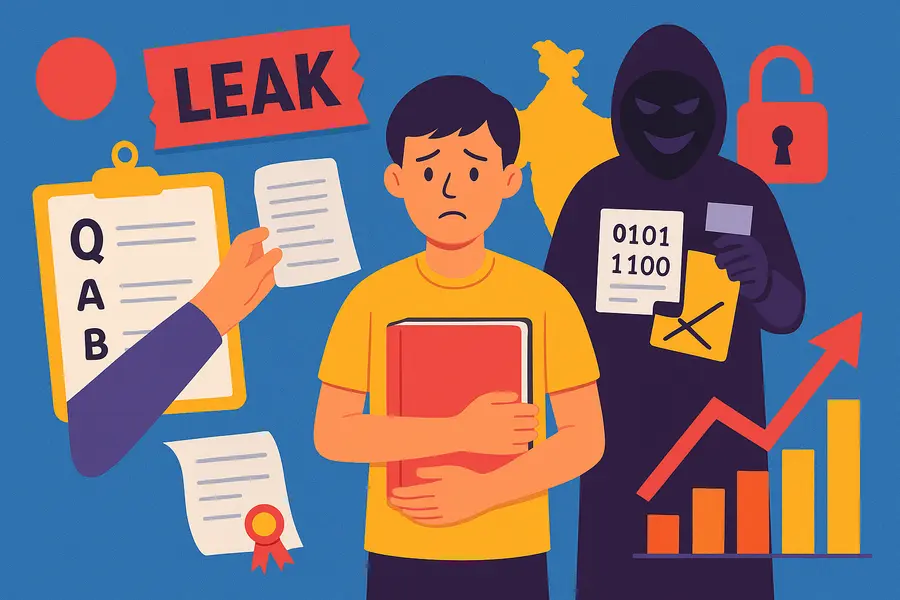
How Do Paper Leak Scams Affect Education Trust in India? Decoded
Competitive examinations play a central role in India’s education and employment system. From school board exams to national-level tests like NEET, JEE, UPSC, and SSC, these exams are designed to identify talent and ensure fair, merit-based selection.
For millions of students, competitive exams represent opportunity, social mobility, and trust in a system that rewards hard work over privilege.
Merit-based selection is crucial not only for academic institutions but also for building a skilled and credible workforce.
However, in recent years, India has witnessed a troubling rise in paper leak scams. Repeated exam cancellations, delays, and investigations have raised serious concerns about transparency and integrity. Such incidents do not only disrupt schedules; they weaken public confidence in examination authorities and the broader education system.
In this article, we will examine how paper leak scams affect trust in India’s education framework. It explores key questions: How do repeated leaks undermine institutional credibility? What social, psychological, and economic consequences do students, families, and society face as a result?
Let’s address these issues and highlight why exam integrity is essential for restoring trust and fairness.
Understanding Paper Leak Scams
Paper leak scams refer to the illegal disclosure of examination questions before the scheduled exam time, giving unfair advantage to a selected group of candidates.
A paper leak can involve sharing the full question paper, key sections, or answer patterns through physical copies, mobile phones, or digital platforms. Even partial leaks are enough to compromise the fairness and credibility of an examination.
The mechanisms behind paper leaks vary. In many cases, digital hacking of exam databases or servers allows unauthorized access to question papers.
Printing press leaks occur when papers are photographed or copied during printing and packaging stages.
Insider involvement is another major factor, where officials, invigilators, or third-party contractors misuse their access for financial or personal gain.
Messaging apps and encrypted platforms further enable rapid and discreet circulation of leaked content.
Paper leak scams affect a wide range of examinations in India. School-level board exams often face leaks at regional levels, impacting young students.
National competitive exams such as NEET, JEE, UPSC, SSC, and state Public Service Commission tests are frequent targets due to their high stakes.
University entrance tests and government recruitment exams are also vulnerable, making paper leaks a widespread threat to educational integrity.
Historical Overview of Paper Leak Scandals in India
Over the last two decades, India’s competitive exam ecosystem has been repeatedly shaken by paper leak scandals that highlight deep procedural and governance flaws.
One of the earliest major cases occurred in 2002, when a railway recruitment exam paper was leaked and later led to convictions of employees involved in selling the paper, marking a stark betrayal of public trust.
Perhaps the most notorious fraud in Indian examination history was the Vyapam scam in Madhya Pradesh, unearthed in 2013. It involved politicians, officials, and intermediaries manipulating multiple entrance and recruitment exams, using imposters and forged answer sheets to benefit select candidates
More recently, between 2017 and 2024, dozens of exam paper leaks were recorded across states, affecting school boards, recruitment tests, and national-level exams like NEET-UG, UPTET, and police constable exams.
In this period alone, data shows 65+ major paper leaks across 19 states, leading to cancellation or postponement of dozens of tests and impacting millions of aspirants.
Geographically, states like Uttar Pradesh, Rajasthan, Gujarat, Bihar, and Maharashtra have experienced the highest frequency of leaks, suggesting institutional vulnerabilities vary regionally.
These patterns illustrate that paper leaks are not isolated events but recurring crises undermining educational credibility nationwide.
Impact of Paper Leak Scams on Trust in the Education System
Paper leak scams in India have deeply damaged trust in the education system, with real-world consequences that go far beyond delayed exams.
Over 70 confirmed paper leak incidents in the past seven years disrupted the schedules of around 1.7 crore aspirants across board, recruitment, and competitive exams, raising serious doubts about fairness and transparency.
First, repeated leaks erode institutional credibility. When examination outcomes can be influenced by leaked papers, the core principle of merit-based selection is compromised. This leads students, parents, and employers to question whether scores reflect true ability or privilege, undermining confidence in boards and testing agencies.
Second, the psychological impact on students is significant. Honest aspirants face heightened stress, anxiety, and loss of motivation when exams are cancelled or rescheduled due to leaks. The uncertainty and disruption of years of preparation can negatively affect mental health and academic performance.
Third, the social and economic consequences are profound. Frequent leaks contribute to unequal opportunities, as access to leaked papers often favors those with financial means, widening existing disparities. Delayed admissions and repeated exam attempts also add financial strain on families and burden public resources.
These effects have weakened trust not only in specific exams but in the broader education system, prompting calls for stronger safeguards and more transparent governance to uphold merit and fairness.
Psychological Impact of Paper Leak Scandals on Students
Paper leak scandals have a serious psychological impact on students, especially those who prepare honestly for competitive examinations.
According to reports by the National Institute of Mental Health and Neuro Sciences (NIMHANS), exam-related stress and anxiety among Indian students have increased significantly in the last decade, with uncertainty and repeated exam disruptions being major contributors.
When exams are cancelled or reconducted due to leaks, students experience acute stress, sleep disorders, and emotional exhaustion after months or years of preparation.
Honest students often suffer a loss of motivation. A 2023 survey by a national coaching association found that nearly 60% of aspirants felt demoralized after exam cancellations caused by paper leaks, believing that merit no longer guarantees success. This perception weakens faith in hard work and encourages feelings of helplessness.
The long-term effects are equally damaging. Repeated setbacks can lower self-esteem and create self-doubt about academic ability.
Career confidence also declines when admissions and job opportunities are delayed. Over time, this psychological toll affects not only academic performance but also students’ mental well-being and professional aspirations.
Social Consequences of Paper Leak Scams
Paper leak scams reinforce inequality by giving unfair advantage to those who can access leaked papers through money or networks, while honest students are left behind.
Studies on examination fraud in India show that beneficiaries of leaks often come from economically stronger backgrounds, deepening the gap between privileged and underprivileged aspirants.
According to education analysts, repeated exam irregularities weaken the idea of equal opportunity, a core promise of India’s competitive exam system.
Economically weaker and rural students suffer the most. They usually lack access to expensive coaching, travel options, or alternative attempts when exams are cancelled.
A delayed or cancelled exam can mean dropping out altogether due to financial pressure. Over time, repeated scandals also normalize unethical behavior.
When leaks occur frequently and punishments are slow, students begin to believe that cheating is a practical survival strategy. This gradual erosion of ethical values harms not just education, but society’s broader commitment to fairness and integrity.
Economic and Career Implications of Paper Leak Scams
Paper leak scandals have serious economic and career-related consequences for students and institutions.
When exams like NEET, SSC, or state recruitment tests are cancelled or postponed, admissions and job appointments are delayed by months or even years.
Government data shows that millions of vacancies remain unfilled due to exam disruptions, directly affecting youth employment and workforce planning.
Students also face heavy financial burdens. Repeated exams mean additional spending on application fees, travel, accommodation, and coaching.
A 2024 education survey estimated that competitive exam aspirants spend between ₹1–3 lakh annually on preparation, costs that multiply when exams are reconducted. Families from middle- and low-income groups are hit hardest.
Public resources are also wasted. Reprinting papers, redeploying staff, conducting investigations, and organizing re-exams strain government budgets.
These factors slow career progression, reduce productivity, and weaken confidence in India’s education-to-employment pipeline.
Role of Technology and Digital Vulnerabilities
Technology has transformed India’s examination system, bringing both efficiency and new risks. Digitization of exams—such as online applications, computer-based tests (CBTs), and digital question paper storage—has reduced paperwork and improved speed.
Agencies like NTA shifted many exams online to manage scale, with CBTs handling over 2 crore candidates annually across major tests. However, this digital shift has also expanded the attack surface for leaks and manipulation.
Cybersecurity gaps remain a major concern. In several investigations, leaked papers were traced back to poorly secured servers, shared logins, or outsourced vendors with weak data protection protocols.
A 2023 parliamentary response acknowledged that many exam bodies still rely on third-party IT systems without uniform cybersecurity standards, increasing vulnerability to hacking and insider misuse.
Messaging apps and encrypted platforms further worsen the problem. Platforms like WhatsApp and Telegram allow rapid, hard-to-trace sharing of leaked papers and answer keys within minutes.
Law-enforcement agencies have reported that many paper leak rackets now operate entirely through encrypted groups, making detection and evidence collection difficult.
While technology enables scale and convenience, weak digital safeguards have turned it into a critical risk factor in exam integrity.
Legal and Institutional Responses, Media Influence & Global Lessons on Exam Integrity in India
India’s response to rampant exam paper leaks has taken a legal and institutional turn with the Public Examinations (Prevention of Unfair Means) Act, 2024, a pioneering law targeting malpractices in public exams.
Under this Act, offences such as leaking question papers, tampering with answer keys, or aiding unfair access are cognisable and non-bailable, with offenders facing 3–5 years’ imprisonment and fines up to ₹10 lakh.
Organised cheating or involvement of senior officials can attract 5–10 years in jail and a minimum ₹1 crore fine, and service providers may be barred from conducting exams-related activities and held liable for examination costs.
Some states have also enacted their own anti-leak laws that mirror these punitive measures to discourage insiders and external agents from compromising exam integrity.
Effectiveness of Enforcement: Despite statutory muscle, conviction rates remain low as investigations often lag and evidence is hard to secure, especially when leaks circulate on encrypted platforms.
Institutional accountability gaps continue to erode confidence, with many aspirants feeling that punishment comes after the damage is done rather than acting as a true deterrent.
Media & Public Trust: The media plays a dual role: exposing scams sharpens public scrutiny and fuels demand for reform, but sensational reporting and viral social media claims can also deepen distrust even before facts are verified, sometimes spreading misinformation and anxiety among students and families.
International Perspective: Globally, countries such as China employ layered anti-cheating measures including biometric checks, signal jammers, and surveillance during high-stakes tests, and criminalize exam fraud at law to heighten fairness. Other nations prioritise strict invigilation, non-disclosure agreements for test creators, and randomised question pools to secure examinations. These practices suggest that India can learn from holistic strategies combining legal deterrence, advanced security technology, and proactive transparency to strengthen exam credibility nationwide.
Restoring Trust in India’s Education System: Key Steps Forward
Restoring trust in India’s education system requires coordinated reforms that address both structural weaknesses and public confidence. Repeated paper leak scandals have shown that isolated fixes are not enough.
A long-term, transparent approach is essential. The following measures are crucial for rebuilding credibility and fairness.
- Strengthening Exam Governance: Independent examination authorities with clear accountability can reduce political and administrative interference. Regular audits and third-party oversight should become mandatory.
- Robust Technological Safeguards: End-to-end encryption, secure question paper storage, and real-time monitoring systems can limit digital vulnerabilities. Technology must be paired with strict access controls.
- Severe and Swift Punishment: Fast-track courts and time-bound investigations can ensure offenders are punished quickly, creating real deterrence instead of delayed justice.
- Transparency in Communication: Exam bodies should openly share investigation updates and corrective actions. Clear communication helps reduce rumors and rebuild student confidence.
- Support Systems for Affected Students: Counseling, fee waivers, and age-limit relaxations can reduce the emotional and financial burden on honest aspirants.
- Ethics and Integrity Education: Promoting ethical values among students, officials, and service providers helps prevent normalization of cheating.
These steps can restore faith in merit-based selection, ensuring that India’s education system rewards ability, effort, and integrity rather than unfair advantage.
Conclusion
Paper leak scams pose a serious threat to the credibility of India’s education system, as this study has shown.
The analysis highlights how repeated exam leaks weaken trust in merit-based selection, harm students’ mental well-being, deepen social inequality, and create economic losses for families and institutions.
Technological gaps, weak enforcement, and delayed accountability have allowed such incidents to recur across school, university, and competitive examinations.
Ignoring paper leak scams carries long-term risks. Continued failures can normalize unethical behavior, discourage honest effort, and push talented students away from public institutions. Over time, this erosion of trust can damage India’s human capital and undermine confidence in education-driven social mobility.
Addressing this crisis requires collective responsibility. Governments must enforce laws strictly, institutions must strengthen security and transparency, the media must report responsibly, and society must reject unfair shortcuts.
Rebuilding trust will not happen overnight, but with consistent reforms, ethical commitment, and student-centric policies, India can restore fairness and ensure that education remains a true measure of merit and opportunity.