Artificial Intelligence (AI) is no longer just a concept in sci-fi stories — it has become an integral part of modern life. From voice assistants helping with daily tasks to algorithmic matchmaking systems reshaping how we find love, AI impacts families in profound and evolving ways.
Let’s explore how AI is influencing family structures and relationships — socially, emotionally, economically, and ethically.
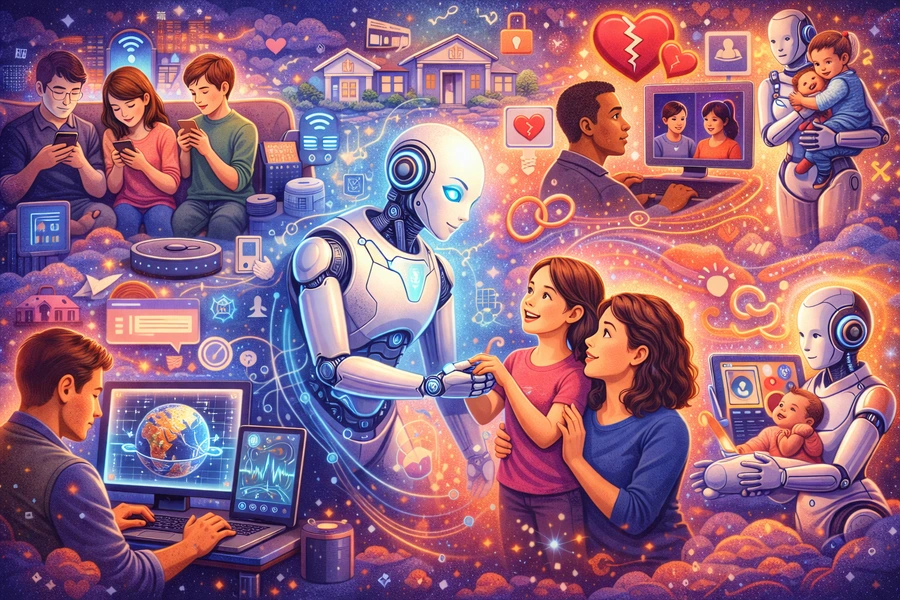
How Artificial Intelligence Is Influencing Family Structures and Relationships
Artificial Intelligence (AI) is rapidly transforming everyday life, and its influence is increasingly visible within families and relationships.
From smart home assistants managing daily routines to AI-driven platforms shaping how people communicate, learn, and form emotional bonds, technology is quietly reshaping the structure of modern family life.
Parents rely on intelligent tools for education and safety, couples use digital platforms to connect and strengthen relationships, and children grow up interacting with AI as a normal part of their environment. These changes are not just technical—they affect emotions, responsibilities, and social roles within households.
Understanding how AI is influencing family structures and relationships helps us see both the opportunities for stronger connections and the challenges that come with balancing human values and intelligent technologies in an increasingly digital world.
1. Redefining Communication and Togetherness
AI Enhances Everyday Family Interactions
Families today often juggle busy schedules, work commitments, and geographic distance. AI-powered communication tools — like smart speakers (Alexa, Google Home), automated scheduling apps, and real-time translation features — are reshaping how family members stay connected.
For example:
- Voice assistants can remind kids to finish homework,
- Smart calendars sync activities for parents and children,
- Translation tools help multilingual families bridge language barriers.
These technologies add convenience, yet they also influence deeper patterns of interaction.
Strengthening Connections Across Distance
International migration, work relocations, and educational travel mean families are often spread across cities or countries. AI-assisted video calls with automatic noise suppression, facial enhancements, and real-time subtitle features make virtual reunions more natural and intimate than ever before.
Instead of feeling “digitally filtered,” many family moments now feel genuinely close—almost like being together physically.
Risks: Tech Interference in Family Time
However, the same AI tools that connect families can also distract them. Smart devices and algorithm-driven notifications can intrude during family meals, conversations, or weekend downtime. When machines demand attention more than people, it challenges the core of human relationships.
So while AI enables presence across distances, it also risks creating presence without attention.
Read Here: The impact of technology on family communication patterns
2. AI, Parenting and Child Development
Personalized Parenting Support
AI systems are helping parents with tailored guidance. Apps analyze a child’s behavior, learning pace, and emotional cues to provide customized recommendations. For instance:
- Adaptive learning platforms suggest reading materials based on a child’s progress,
- Safety apps monitor online activity for age-appropriate content,
- AI-driven baby monitors detect irregular sleep patterns or movements.
These tools act as “digital co-parents” — offering insights grounded in data rather than intuition alone.
Opportunities for Children’s Growth
Children today grow up surrounded by intelligent systems — educational games, voice-activated tutors, and interactive storytelling devices. These platforms adapt to a child’s preferences and cognitive level, enabling:
- More engaging learning experiences,
- Early detection of learning difficulties,
- Enhanced creativity through personalized interaction.
This promises more equitable learning opportunities, especially where educational resources are limited.
Challenges: Emotional Intelligence and Screen Dependency
While AI tools support cognitive development, they cannot replace human empathy, nuance, or judgment. Over-reliance on AI for emotional comfort or socialization may affect how children form interpersonal bonds.
Key concerns include:
- Reduced face-to-face interaction,
- Blurred boundaries between digital and human relationships,
- Potential overexposure to screens.
AI should be a supportive companion, not a substitute for human care, affection, or social learning.
3. Love, Dating and New Relationship Dynamics
AI-Driven Matchmaking
Algorithmic dating platforms like Tinder, Bumble, and OkCupid analyze user behavior and preferences to suggest compatible partners. AI takes into account:
- Interests, values, and communication styles,
- Messaging patterns and engagement data,
- Personality indicators from bios and photos.
This deepens matchmaking beyond superficial traits and has expanded possibilities for connection in an increasingly individualized world.
How Digital Matching Affects Relationships
AI enhances the efficiency of finding partners, but it also changes expectations. Some effects include:
- Rising emphasis on “perfect matches” rather than imperfect human chemistry,
- Greater diversity in relationship choices,
- Some experience “choice fatigue” due to endless alternatives.
AI does not create love — it simply guides who we might consider, based on patterns and probabilities.
Impact on Marriage and Commitment
Long-term relationships are also influenced. Couples increasingly use tools for:
- Conflict management and emotional tracking apps,
- Relationship counseling bots,
- Shared journals or digital planning assistants.
These can improve understanding and communication — but they are supplements, not replacements, for genuine emotional labor and personal responsibility.
4. Changing Family Roles and Economic Pressures
AI Reshapes Work and Household Roles
As automation transforms labor markets, traditional family roles are shifting. Some jobs decline while new tech-oriented roles emerge, affecting:
- Who earns and who manages household duties,
- Flexibility in schedules (remote work),
- Economic contributions of each family member.
For example, remote or hybrid jobs made possible by AI tools can allow parents to spend more time with children — but they also blur the boundaries between work and home life.
Redistributing Domestic Labor
Smart appliances and home automation reduce the physical workload of everyday chores:
- AI-controlled robot vacuums or lawn mowers,
- Smart dishwashers or laundry assistants,
- Voice-activated grocery ordering.
These tools increase efficiency, but they also raise questions about which tasks remain human responsibilities, and how families redefine roles and expectations.
Economic Inequality and Family Dynamics
Access to AI technologies isn’t evenly distributed. Families with resources can adopt advanced tools, while others may lag behind.
This creates:
- New forms of economic inequality,
- Pressure on parents to maintain competitive advantages for their children,
- Anxiety around future job market readiness.
To ensure healthy family development, communities and policymakers must address accessibility so families are not divided by a digital divide.
5. Emotional Well-Being in the Age of AI
AI as Emotional Support
AI isn’t just logical and analytical — it also plays a role in emotional life. Some applications include:
- Mental health chatbots (e.g., Woebot, Replika),
- Mood-tracking apps paired with recommendations,
- Voice assistants that offer soothing responses and reminders to relax.
For individuals dealing with stress, anxiety, or loneliness, these tools can feel like a supportive presence.
Balancing Data and Intuition
While AI can detect patterns of emotional distress (through typing speed, keywords, or biometric data), human relationships thrive on unpredictability, vulnerability, and nuance — qualities machines can observe but not fully comprehend.
Family communication and emotional support require:
- Active listening,
- Genuine empathy,
- Shared lived experiences.
The value of AI in emotional spaces lies in assistance, not replacement.
Risks of Emotional Dependence on AI
When individuals turn to AI for emotional comfort:
- There’s a risk of decreased real-world social interaction,
- Some may prefer predictable machine responses over complex human emotions,
- AI may normalize emotional automation instead of authentic connection.
So while AI tools can support mental well-being, they work best when integrated with real conversations and family support systems.
6. Ethical and Cultural Impacts on Families
Data Privacy and Trust
Families share an enormous amount of personal data:
- Conversations with smart speakers,
- Health and well-being logs,
- Child usage patterns and learning data.
AI systems often store and analyze this data. This raises serious questions:
- Who controls the data?
- How is it used?
- Can family privacy truly be safeguarded?
Privacy is a foundation of trust — in families, in relationships, and in society.
Cultural Shifts and Identity Formation
Different cultures approach AI in diverse ways:
- In some regions, AI adoption is swift and seen as a status symbol,
- In others, there is resistance due to tradition or ethical concerns.
AI systems themselves may encode cultural biases — from gendered suggestions in educational tools to normalized norms in matchmaking algorithms.
Families must negotiate:
- What cultural values they preserve,
- What values evolve with technological change,
- How children interpret identity in a world shaped partly by machine logic.
Moral Questions About AI-Enhanced Children
As AI participates in education and development:
- Should children rely on AI companions?
- What ethical limits should govern AI tutoring, language learning, or emotional assistance?
- Who decides what’s appropriate for a child’s digital interaction?
These questions have no single answer, but they are central to how future generations will navigate family life, personal identity, and moral complexity in an AI age.
Read Here: How Unemployment Affects Family Dynamics in India
Conclusion: A Future Shaped by Choice, Not Determinism
AI is influencing family structures and relationships in profound ways — but it doesn’t define them. Instead, it provides tools that can:
- Strengthen connections,
- Expand emotional support,
- Enhance learning and communication,
- Distribute household responsibilities more equitably.
At the same time, AI introduces challenges:
- Distracted attention,
- Privacy concerns,
- Emotional dependence,
- Cultural and ethical dilemmas.
Ultimately, families shape AI as much as AI shapes families.
The critical questions going forward are not whether we can use these tools, but how we use them — intentionally, ethically, and in ways that deepen human connection rather than weaken it.
Read Also: Changing Dynamics of Family Structures in Modern Society