Understanding the Dynamics of Power in Local Communities
(With reference to Delbert C. Miller and Robert A. Dahl)
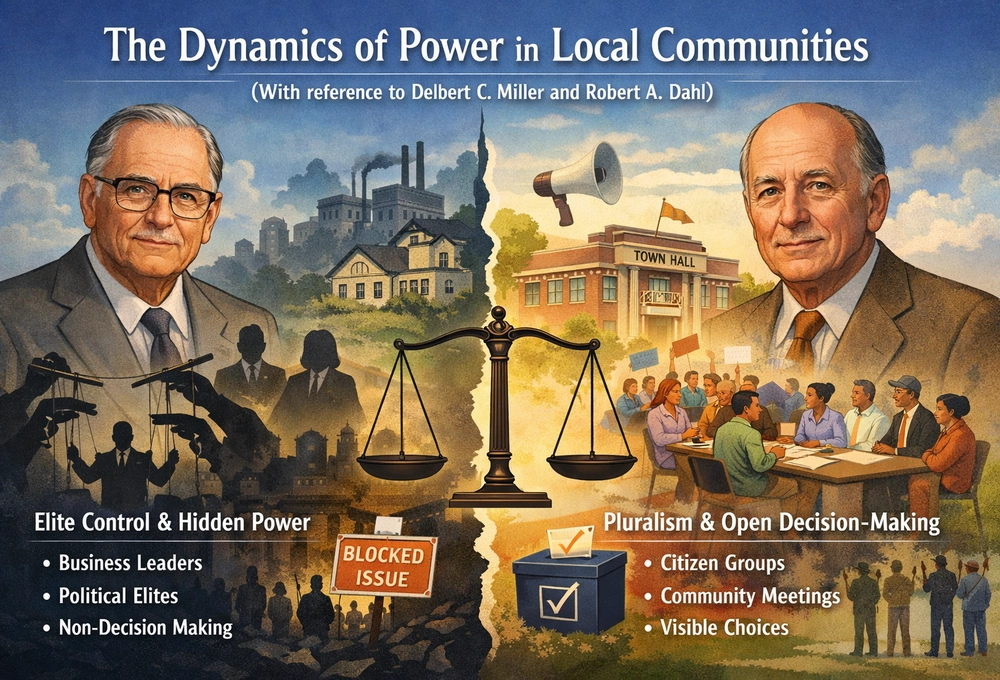
Miller and Dahl’s perspectives on local community power highlight two contrasting but complementary views.
Miller emphasized the contextual, often elite-driven nature of local decision-making. He shows how local elites can dominate through informal influence. Dahl argued for pluralism, where multiple groups compete and share influence.
They show that local power is neither monopolized nor evenly distributed—it is dynamic, situational and contested.
1. Understanding Power at the Local Level
Power in local communities is not always visible, yet it shapes decisions that directly affect everyday life—such as schooling, infrastructure, and governance.
Sociologists and political theorists have long debated who really holds power in these communities.
Two influential perspectives come from Delbert C. Miller and Robert Dahl, whose works offer contrasting but complementary views.
While Miller focuses on the structures and social hierarchies that influence power distribution, Dahl emphasizes decision-making processes and observable behavior.
Their frameworks provide a comprehensive understanding of how power operates at the grassroots level.
2. Delbert C. Miller: Power as Social Structure
2.1 Power Embedded in Social Hierarchies
Miller views power as something deeply rooted in social structures. According to him, power is not just about visible decisions but also about who has the capacity to influence outcomes consistently. This often includes elites such as business leaders, political figures, and influential families.
In many communities, these elites form a network of influence that controls resources, information, and opportunities. Miller argues that power is often concentrated rather than evenly distributed, challenging the idea that communities function democratically at all levels.
2.2 The Concept of Elites
Miller’s approach aligns with elite theory, which suggests that a small group dominates decision-making. These elites may not always hold official positions but exert influence through:
- Economic control (wealth, land, business ownership)
- Social status (prestige, reputation)
- Institutional access (connections to government bodies)
This perspective highlights that formal authority and real power are not always the same.
2.3 Hidden Power and Non-Decisions
One of Miller’s key insights is the idea of “non-decision-making.” Power is exercised not only when decisions are made but also when important issues are kept off the agenda.
For example, a local issue like environmental pollution may never reach public debate if influential actors suppress it. This form of power is subtle but highly effective, as it shapes outcomes without visible conflict.
3. Robert Dahl: Power as Decision-Making
3.1 Pluralism and Democratic Participation
In contrast, Dahl presents a more optimistic and democratic view of power. In his famous study of New Haven, he argues that power is pluralistic, meaning it is distributed among multiple groups rather than concentrated in a single elite.
According to Dahl, different groups dominate different issues. For instance:
- Business leaders may influence economic policies
- Educators may shape school decisions
- Political leaders may control governance
This suggests that no single group controls everything, making the system more democratic.
3.2 Defining Power: “A has power over B”
Dahl defines power in a simple but powerful way:
A has power over B to the extent that A can get B to do something B would not otherwise do.
This definition focuses on observable behavior, especially in decision-making situations. By studying who wins in conflicts or policy debates, Dahl identifies who holds power.
3.3 Decision-Making as Evidence
Dahl emphasizes empirical analysis—looking at real decisions rather than assumptions. For example, to understand power in a city, one should examine:
- Who participates in decision-making
- Whose preferences prevail
- How conflicts are resolved
This method avoids speculation and grounds power analysis in visible outcomes.
4. Comparing Miller and Dahl
4.1 Concentration vs Distribution of Power
- Miller: Power is concentrated among elites
- Dahl: Power is distributed among competing groups
Miller sees inequality as a defining feature of power, while Dahl sees diversity and competition as central.
4.2 Visible vs Hidden Power
- Miller: Focuses on hidden power and non-decisions
- Dahl: Focuses on observable decisions
This difference is crucial. Miller argues that looking only at decisions misses deeper structures of control, whereas Dahl believes that what can be observed is the most reliable evidence.
4.3 Methodological Differences
- Miller: Uses sociological analysis of networks and structures
- Dahl: Uses empirical case studies and decision analysis
Miller’s approach is broader and more theoretical, while Dahl’s is practical and evidence-based.
5. Critiques and Limitations
5.1 Criticism of Miller
- May overemphasize elite dominance, ignoring grassroots participation
- Difficult to measure hidden power empirically
- Risks portraying communities as less democratic than they might be
5.2 Criticism of Dahl
- May underestimate hidden power and agenda control
- Focus on observable decisions can miss deeper inequalities
- Critics argue his model is too optimistic about democracy
6. Synthesizing Both Perspectives
Modern scholars often combine insights from both Miller and Dahl to create a more balanced understanding:
- Power is both visible and hidden
- It is partly concentrated but also contested
- Decision-making reflects only one dimension of power
This synthesis leads to a more nuanced view where structures, processes, and outcomes all matter.
7. Contemporary Relevance
The dynamics of power in local communities remain highly relevant today. Issues such as urban development, environmental policies, and local governance still reflect the interplay between elite influence and democratic participation.
For example:
- Corporate influence in city planning reflects Miller’s elite theory
- Community activism and local elections reflect Dahl’s pluralism
In the age of social media and digital communication, power has become even more complex, blending traditional hierarchies with new forms of participation.
8. Conclusion
The works of Delbert C. Miller and Robert A. Dahl offer two foundational lenses for understanding power in local communities. Miller reveals the hidden structures and elite dominance that shape outcomes behind the scenes, while Dahl highlights the visible, competitive processes that characterize democratic systems.
Neither perspective alone fully captures the complexity of power. However, together they provide a rich framework for analyzing how decisions are made, who influences them, and how communities function.
Ultimately, the study of local power dynamics reminds us that democracy is not just about formal institutions but also about who truly has the ability to shape collective life.
Read Here: Basic Premises of Functionalism in Sociology