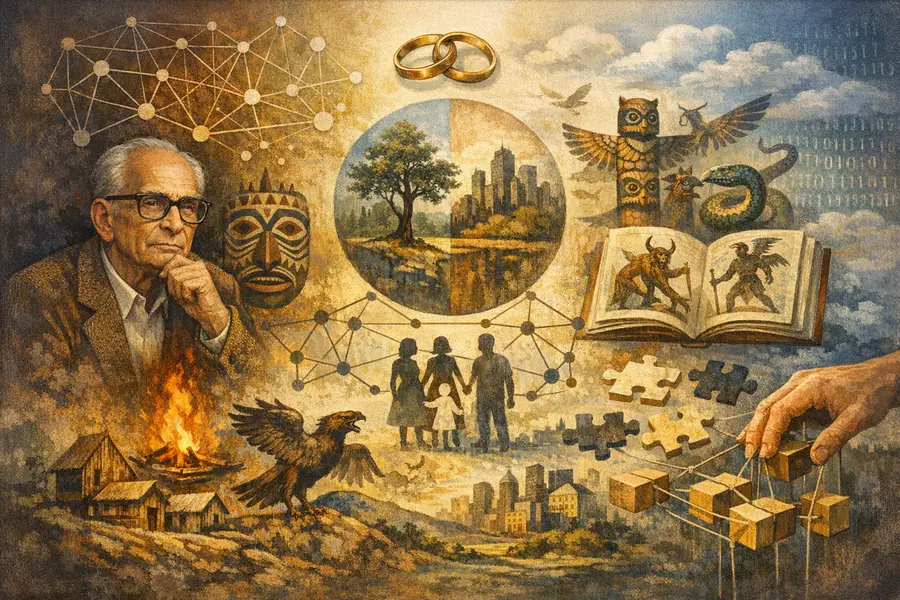
Lévi-Strauss explained social structure as a social construct shaped by human thought. He argued that societies are organized not by individuals but by relationships, oppositions, and symbolic patterns. Kinship, myths, and rituals act like a language, giving meaning through shared rules.
These structures are universal yet flexible, reflecting how the human mind processes reality. Thus, social order is continuously built, transformed, and sustained through imagination, communication, and symbolic exchange.
Levi-Strauss’ Understanding of Social Structure as Social Construct: Explained
Claude Lévi-Strauss, a leading anthropologist, viewed social structure not as a fixed reality but as a social construct shaped by human thought. He argued that societies are organized through systems of relationships, rules, and meanings rather than material objects alone.
For him, kinship, myths, and cultural practices reveal deep structures of the human mind. These structures are not natural laws but mental frameworks created collectively.
By analyzing myths and kinship systems, Lévi-Strauss showed that societies build order through symbolic patterns, often unconsciously. His approach emphasized that social life is less about individuals and more about the relationships between them.
Thus, social structures are products of shared human imagination, continuously shaped and reshaped. This perspective shifted anthropology toward understanding culture as a system of signs and meanings rather than just customs or traditions.
Structure as System of Relations
Lévi-Strauss believed that social structure is defined by relations, not individuals. For example, kinship is not about one person’s role but about how roles connect—father, mother, child, sibling. These relationships form a system that organizes society.
He argued that meaning arises from contrasts and oppositions, such as male/female or nature/culture.
Just as language gains meaning through differences between words, society gains meaning through differences between roles. This relational view shows that social order is not natural but constructed through shared rules.
By focusing on relations, Lévi-Strauss highlighted how societies maintain balance and continuity.
Social structure, therefore, is a mental map of relationships, guiding behavior and identity within a community.
Structure as Symbolic Patterns
For Lévi-Strauss, myths and rituals reveal the symbolic patterns that shape social life. He argued that societies use stories and symbols to resolve contradictions, such as life/death or nature/culture. These patterns are not random; they reflect deep structures of human thought.
Myths, for example, often repeat similar themes across cultures, showing universal mental frameworks.
Rituals also reinforce these symbolic meanings, helping communities feel connected. By studying myths comparatively, Lévi-Strauss showed that societies construct order through shared imagination.
Social structure, then, is not just practical organization but symbolic expression. It is a way for humans to make sense of the world, turning abstract oppositions into cultural systems that guide everyday life.
Structure as Social Construct
Lévi-Strauss concluded that social structures are constructed, not given. They are products of collective human thought, shaped by symbolic systems like language, kinship, and myth.
Unlike physical structures, social structures exist in the mind and are maintained through shared belief. This means societies can change their structures when meanings shift.
For example, marriage rules or kinship systems vary widely, showing that they are cultural inventions, not natural laws.
By calling social structure a construct, Lévi-Strauss emphasized human creativity in shaping order. His view challenged earlier anthropologists who saw social systems as fixed. Instead, he showed that societies continuously build and rebuild their structures through imagination, communication, and symbolic exchange.
Structure as Universal Mental Frameworks
Lévi-Strauss argued that social structures reflect universal mental frameworks shared by all humans. He believed the human mind organizes experiences through binary oppositions, such as life/death, raw/cooked, or nature/culture.
These oppositions appear across myths, rituals, and kinship systems worldwide, showing that societies think in similar patterns even if their customs differ.
By studying diverse cultures, he found recurring structures that reveal how humans universally seek order and meaning. This idea suggests that social structures are not random but rooted in the way the human brain processes reality.
Thus, societies construct their systems based on shared mental logic, making social structure both cultural and cognitive.
Structure as Language of Society
For Lévi-Strauss, social structure functions like a language. Just as words gain meaning through grammar and relations, social roles gain meaning through rules and connections.
Kinship systems, for example, act like sentences that organize relationships. Myths, too, are structured like narratives with recurring patterns. He applied linguistic models to anthropology, showing that society communicates through symbolic codes.
This approach revealed that social life is not chaotic but follows hidden rules, much like grammar in speech.
By treating culture as a language, Lévi-Strauss emphasized that social structures are constructed systems of meaning. They allow societies to “speak” their identity, values, and worldview through relationships, rituals, and symbolic practices.
Structure as Dynamic and Transformable
Lévi-Strauss highlighted that social structures are dynamic and transformable, not fixed. While they are built on universal mental patterns, societies adapt them to changing needs. For example, kinship rules may shift with modernization, or myths may be retold to fit new contexts.
Structures evolve as societies reinterpret symbols and relationships. This flexibility shows that social constructs are living systems, continuously reshaped by human imagination and communication.
Lévi-Strauss argued that transformation is central to understanding culture: myths change but still preserve underlying oppositions, and kinship adapts while maintaining relational logic.
Thus, social structures are creative constructs, always open to reinterpretation, proving that human societies are inventive in maintaining order while embracing change.