Confused about LangChain vs. Anthropic MCP? You’re not alone! The truth is, they aren’t competitors at all. Anthropic MCP and LangChain serve different roles in AI agent architecture.
MCP focuses on standardized tool communication and context sharing between AI systems, while LangChain provides frameworks for building agent workflows, memory, and integrations.
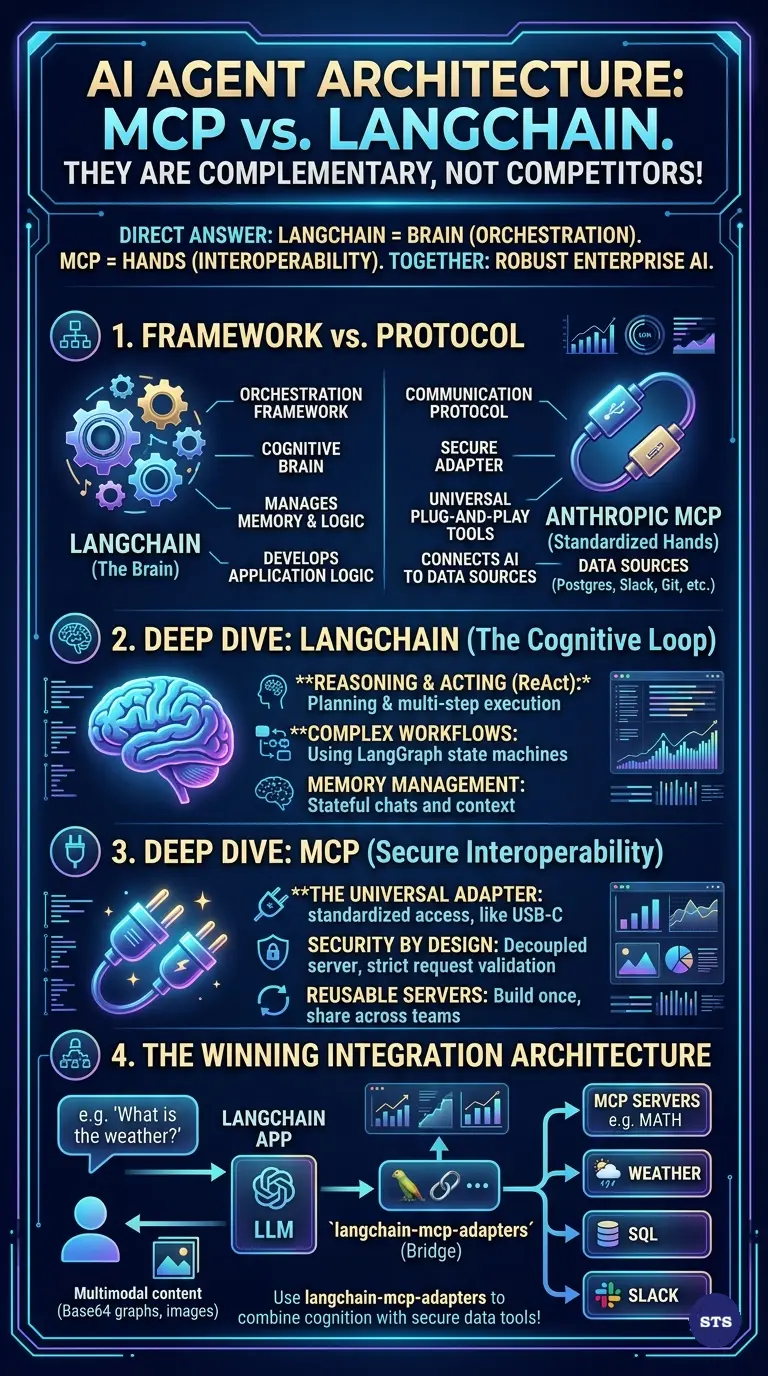
For robust AI architecture, developers combine both: LangChain acts as the agent’s brain, while MCP provides standardized hands to interact with the world.
Choosing the best option depends on whether you need interoperability, agent orchestration, tool connectivity, or scalable AI application development for enterprise and autonomous agents.
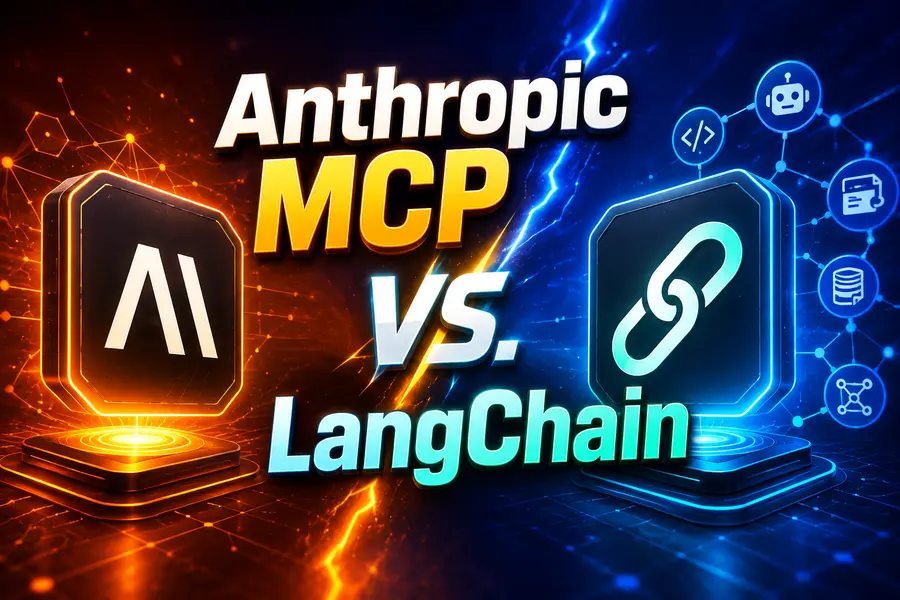
Anthropic MCP vs. LangChain: Which is Best for AI Agent Architecture?
Anthropic’s Model Context Protocol (MCP) and LangChain are not direct competitors; they operate at fundamentally different levels of the AI stack.
LangChain is an orchestration framework used to build application logic, manage memory, and create complex multi-step agent workflows. MCP is an open standard communication protocol designed to securely standardize how AI models plug into external enterprise tools and data sources.
Think of LangChain as the “brain”—an orchestration framework that manages your AI agent’s memory and complex reasoning loops. Think of MCP as the “hands”—a universal plug-and-play protocol that securely connects that brain to your external databases and APIs.
For the ultimate enterprise AI architecture, you don’t choose between them; you combine them using the langchain-mcp-adapters library!
What is Anthropic MCP?
Anthropic MCP stands for Model Context Protocol. It is an open-source framework designed to help AI assistants access and use real-world data more effectively.
Normally, AI models are limited because they cannot directly connect to business tools, content repositories, or coding environments. MCP solves this by creating a universal bridge between AI systems and data sources.
Developers can build MCP servers that expose data or tools, and MCP clients that connect AI applications to those servers. This makes integration faster, more secure, and scalable.
With MCP, AI agents can retrieve relevant information, understand coding tasks better, and generate more accurate responses. It is especially useful for enterprises that need reliable, connected AI solutions.
What is LangChain?
LangChain is a developer framework designed to simplify building AI applications using large language models. It allows you to chain together multiple steps, such as prompts, tools, and APIs, into reusable workflows.
With LangChain, developers can integrate LLMs with databases, APIs, and external knowledge sources, making responses more accurate and context-driven. It supports prompt management, memory handling, and vector databases for similarity search, which is useful in tasks like document retrieval and question answering.
LangChain also powers Retrieval-Augmented Generation (RAG) pipelines, combining embeddings and vector storage with LLMs to deliver precise answers. Its flexibility, open-source ecosystem, and support for Python and JavaScript make it popular for startups, researchers, and enterprises building advanced AI agents.
Core Differences: Framework vs. Protocol
Understanding the distinction between an orchestration framework and a transport protocol is crucial for modern AI development. When developers ask whether to use LangChain or MCP, it is similar to asking whether to use a web framework (like React) or a communication protocol (like HTTP).
| Feature | LangChain | Anthropic MCP |
| Nature | Software development framework. | Open-source communication standard (Protocol). |
| Primary Role | Orchestrating multi-step agents, handling prompts, and memory. | Standardizing how models securely connect to external tools and data. |
| Integration Style | Historically manual, requiring custom Python/TypeScript wrapper code for each tool. | Universal plug-and-play via a decoupled client-server architecture. |
| Scalability | Can lead to highly complex code in multi-tool enterprise environments if unmanaged. | Decoupled deployment makes tools highly scalable, auditable, and reusable across teams. |
Deep Dive: LangChain for Agent Orchestration
LangChain has established itself as the go-to framework for building Large Language Model (LLM) applications. It provides the necessary abstractions to turn a stateless AI model into a reasoning agent capable of executing long-term tasks.
The Power of Orchestration
When you build an AI agent, sending a single prompt to an LLM is rarely enough. An agent must evaluate a goal, plan a series of actions, execute them, observe the results, and correct its course if an error occurs. LangChain provides the scaffolding for this logic.
- Rapid Prototyping: LangChain provides pre-built modules for chains, state machines, and memory management. It allows developers to spin up Retrieval-Augmented Generation (RAG) pipelines or chat interfaces rapidly.
- Complex Workflows (LangGraph): LangChain excels in multi-step orchestration through extensions like LangGraph. It manages built-in retry logic, state machines, and conversation history, which are essential to keep an autonomous agent on track across multiple tool invocations.
- The Scaling Bottleneck: Before MCP, LangChain relied heavily on an “in-app design” where integrations were hardcoded. If you wanted your LangChain agent to access a PostgreSQL database, a Slack API, and a GitHub repository, you had to write custom wrapper code for each specific API. Adding new data sources became a maintenance nightmare as the enterprise scaled, known as the “N x M integration problem”.
Deep Dive: Anthropic MCP for Tool Interoperability
The Model Context Protocol represents a fundamental shift in how AI systems discover and interact with external systems. Developed by Anthropic, it solves the fragmentation problem by introducing a universal standard.
The “USB-C” of AI Architecture
Think of MCP as a universal adapter—the software equivalent of a USB-C port for AI. Instead of writing custom integration code for every new tool, developers build an MCP server once. Any MCP-compatible client (whether a LangChain application, Claude Desktop, or an IDE like Cursor) can then connect to it and immediately understand how to use its capabilities.
Client-Server Decoupling and Primitives
MCP strictly separates the application logic from the data source using a layered architecture.
- MCP Host/Client: The AI application routing the user’s requests.
- MCP Server: A lightweight program exposing specific capabilities securely.
The protocol exposes three primary primitives to the AI:
- Resources: Passive data sources the AI can read, like a database schema or a code repository.
- Tools: Active executable functions the AI can trigger, like executing a SQL query or fetching weather data.
- Prompts: Reusable instructional templates for standardized workflows.
Security by Design
By keeping tool execution logic completely isolated from the AI application logic, MCP provides a more secure foundation. Threat mitigation strategies like rate limiting, strict request validation, and scope restrictions are built into the protocol specification. Because the database or API connection runs securely on the MCP server, credentials are never exposed directly to the LLM client application.
The Winning Architecture: How to Connect LangChain Agents to MCP Servers
The most powerful enterprise architecture for 2026 does not choose between these technologies; it combines them. LangChain provides the cognitive loop (reasoning, acting, observing), while MCP provides the secure execution layer.
The langchain-mcp-adapters Bridge
To connect these systems, the open-source community provides the langchain-mcp-adapters library. This package automatically converts MCP tools into LangChain-compatible tools, allowing your LangChain agents to tap into hundreds of existing MCP servers without writing custom integration code.
Step-by-Step Execution Workflow:
- Initialization: The MultiServerMCPClient connects to various MCP servers.
- Tool Discovery: The client retrieves available tools and dynamically converts them into LangChain’s internal tool format.
- Reasoning Loop: The LangChain agent receives a user prompt and decides which tool to use.
- Execution: LangChain triggers the tool. The adapter securely forwards the JSON-RPC request over the MCP transport layer to the external server.
- Observation: The MCP server executes the command, returns the result, and LangChain processes the outcome to formulate the final answer.
Implementation Example: Connecting Multiple Servers
The langchain-mcp-adapters library supports managing multiple tool environments simultaneously. MCP supports different transport mechanisms, primarily stdio (standard input/output for local, stateful subprocesses) and Streamable HTTP/SSE (Server-Sent Events for remote connections).
Here is how you architect a multi-server LangChain agent:
Python
import asyncio
from langchain_mcp_adapters.client import MultiServerMCPClient
from langchain.agents import create_agent

async def run_agent():
    # Initialize the client with multi-transport architecture
    client = MultiServerMCPClient({
        "math_system": {
            # Local execution via stdio
            "command": "python",
            "args": ["/absolute/path/to/math_server.py"],
            "transport": "stdio"
        },
        "enterprise_weather": {
            # Remote execution via HTTP/SSE
            "url": "http://api.internal.company.com/mcp",
            "transport": "http",
            "headers": {
                "Authorization": "Bearer SECURE_TOKEN"
            }
        }
    })

    # Dynamically fetch and convert MCP tools to LangChain format
    tools = await client.get_tools()

    # Initialize a LangChain agent with an LLM
    agent = create_agent("openai:gpt-4o", tools)

    # Execute complex cross-tool reasoning
    response = await agent.ainvoke({
        "messages": "What is the weather in New York, and if the temperature is 75, what is it multiplied by 12?"
    })

    print(response)

if __name__ == "__main__":
    asyncio.run(run_agent())
Advanced Features: Multimodal and Stateful Context
When architecting complex AI solutions, you must handle different types of data. If an MCP server returns multimodal content (like graphs, charts, or images alongside text), the langchain-mcp-adapters library automatically parses and converts these into standard LangChain content blocks.
- Images: Converted to base64 data URLs.
- Text: Managed as standard string messages.
Furthermore, using the stdio transport layer inherently provides stateful sessions. The subprocess persists for the lifetime of the client connection, which is critical for workflows where context or memory must be strictly maintained across multiple sequential tool calls.
Future Outlook: MCP vs LangChain in AI Agent Architectures
The future of AI agent frameworks looks dynamic and competitive. Anthropic MCP has strong growth potential because it is built as an open standard. Its modular design and secure connections make it attractive for enterprises that need compliance, scalability, and reliable integrations.
As more developers adopt MCP servers and clients, its ecosystem will expand across industries like finance, healthcare, and education.
On the other hand, LangChain continues to grow rapidly due to its large open-source community. Its flexibility, support for multiple LLMs, and integration with vector databases make it ideal for startups, researchers, and rapid prototyping. The ecosystem is expanding with new plugins, libraries, and enterprise adoption.
Looking ahead, convergence trends are likely. Enterprises may use MCP for structured, secure workflows while leveraging LangChain for experimentation and RAG pipelines. These frameworks could shape a hybrid future where AI agents are both safe and highly adaptable.
Read Here: Key Role of Agentic AI in Business Process Automation
Summary: When to Choose What
To ensure an optimized AI software architecture, use this decision matrix:
- Use LangChain (Standalone) When: You are building simple, self-contained prototypes, tightly controlled logic loops, or chatbots where external tool sharing across the company is not necessary.
- Use MCP (Standalone) When: You want to connect an existing AI interface (like Claude Desktop) directly to a local database or proprietary API without building a custom chat application or orchestration layer from scratch.
- Use Both When: You are designing enterprise-grade, multi-agent systems that require advanced reasoning capabilities (via LangChain or LangGraph) while needing to interact safely and securely with a massive ecosystem of shared internal microservices and external APIs (via MCP). Integrating both eliminates the custom integration burden, allowing scalable and robust AI infrastructure.
FAQs: Anthropic MCP vs. LangChain
Are LangChain and MCP competitors?
No, they are not competitors. LangChain is an orchestration framework used to build and manage AI agent logic and memory. In contrast, MCP is a standardized communication protocol used to connect those agents securely to external enterprise data sources.
What is LangChain best used for?
LangChain excels at application orchestration. It is the industry standard for rapidly building chatbots, RAG pipelines, and complex multi-step reasoning workflows where an AI agent needs memory, conditional state management, and iterative decision-making capabilities to accomplish goals.
What exactly is the Model Context Protocol (MCP)?
MCP is an open-source communication standard created by Anthropic. It functions like a universal “USB-C adapter” for AI, allowing developers to connect LLMs to external tools, databases, and APIs securely without writing custom integration code for every single platform.
Can I use LangChain and MCP together?
Yes, combining them creates a highly robust enterprise architecture. LangChain acts as the cognitive brain managing the agent’s complex reasoning loops, while MCP acts as the standardized hands, securely interacting with external systems via universal plug-and-play tool integrations.
How does MCP solve the “integration problem”?
Historically, connecting AI to ten different tools required writing ten custom integration scripts. MCP solves this by providing one universal protocol. You build an MCP server once, and any compatible AI client can immediately discover and use those tools.
Is MCP more secure than LangChain’s native tools?
MCP provides a fundamentally more secure architecture. By completely decoupling the data execution server from the AI application client, MCP ensures that database credentials and execution logic remain fully isolated, significantly reducing the risks of prompt injection attacks.
What are MCP Resources and Tools?
In the MCP architecture, Resources are passive data sources that the AI reads for context, such as a database schema. Tools are active, executable functions that the AI can trigger, such as running a specific SQL query or API call.
How do I connect an MCP server to LangChain?
Developers can bridge these technologies using the official langchain-mcp-adapters library. This package automatically discovers available tools on an external MCP server and dynamically converts them into a native format that LangChain’s agent executors can immediately understand and utilize.
Does LangChain support multiple MCP servers simultaneously?
Yes, LangChain seamlessly supports multi-server architectures. Using the MultiServerMCPClient class, your AI agent can simultaneously connect to various local and remote MCP servers, dynamically routing user requests to the appropriate enterprise tools needed to formulate a complete answer.
Which transport layers does MCP support for LangChain?
MCP primarily supports two distinct transport layers. It uses standard input/output (stdio) for secure, local, stateful subprocess communication. For remote connections, it utilizes Streamable HTTP with Server-Sent Events (SSE), allowing LangChain agents to safely access distributed external microservices.
When should I choose LangChain without MCP?
Use LangChain independently when building simple, self-contained prototypes, lightweight chatbots, or tightly controlled internal logic loops where the application does not require sharing external API tools or database integrations across multiple enterprise teams or different AI platforms.
When should I choose MCP without LangChain?
Use MCP independently when you simply want an existing, compatible AI client—like the Claude Desktop app or the Cursor IDE—to securely read your local databases or execute proprietary APIs without needing to code an entirely new custom application.
Read Here: How to Build a MCP Server for PostgreSQL