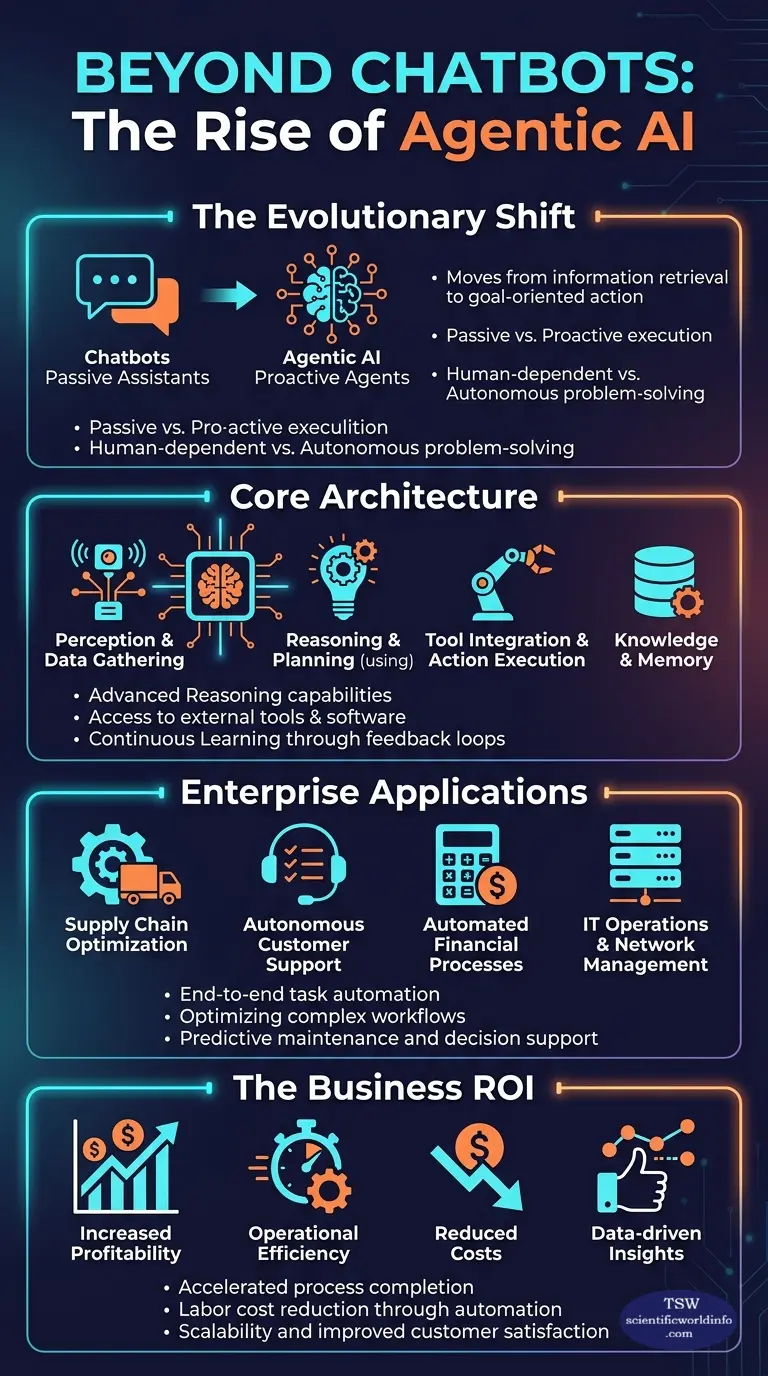
How does Agentic AI revolutionize Business Process Automation? Unlike standard chatbots that only retrieve information, agentic systems function as autonomous digital workers.
Agentic AI systems combine advanced cognitive reasoning with external tools and take a high-level corporate intent and execute multi-step workflows independently. They smoothly coordinate across complex software databases and self-correct when unexpected operational errors arise.
This definitive shift bridges the evolutionary gap between “understanding” and “doing”, delivering a massive 3.5x average ROI across global ecosystems. Consequently, modern enterprises are successfully scaling autonomous productivity.

Beyond Chatbots: Understanding Agentic AI and Its Role in Business Process Automation
Agentic AI systems are autonomous agents that can plan, use software tools, and execute multi-step workflows to achieve specific business goals without constant human prompting.
Explore the future of business process automation (BPA). See how Agentic AI uses advanced reasoning and tool integration to orchestrate autonomous process execution and reduce costs.
What is Agentic AI in business?
Agentic AI in business is an artificial intelligence system designed to accomplish a specific enterprise goal with limited human supervision.
Unlike traditional chatbots that simply generate text or answer questions, agentic systems act as autonomous digital workers. They can break down complex objectives, formulate strategic plans, interact directly with external software applications via APIs, and execute multi-step business workflows—such as resolving IT tickets or processing invoices—independently.
In essence, agentic AI bridges the critical gap between merely generating information and actually executing business actions.
If 2023 was the year the corporate world discovered generative AI, and 2025 was the year of embedding basic AI assistants into every app, then 2026 is undoubtedly the year of the “Agentic Enterprise”.
We are witnessing a monumental shift in how companies operate. Business process automation is no longer about writing rigid, easily broken rules for software bots to follow. It is about deploying intelligent agents capable of reasoning, planning, and executing tasks autonomously.
As organizations accelerate their digital transformations, AI is moving out of the chat window and into the core operations of the business.
The stakes are enormous. According to Gartner, global AI spending is forecast to reach a staggering $2.59 trillion in 2026, representing a massive 47% year-over-year growth. This growth is heavily driven by enterprises expanding their use of AI agents across multiple workflows to achieve true agentic automation.
For business leaders, understanding how to harness this technology is no longer optional; it is a critical mandate for survival in an increasingly automated economy.
How Does Agentic AI Differ From Generative AI?
The most common mistake business leaders make today is referring to standard AI assistants as “agents”. This misunderstanding, often referred to as “agentwashing,” creates false expectations about what the technology can actually do.
To understand the revolution happening in business process automation (BPA), we must clearly separate Generative AI (which acts as a copilot) from Agentic AI (which acts as an autonomous agent).
| Feature | Generative AI (The Copilot) | Agentic AI (The Autonomous Agent) |
| Primary Function | Creates content (text, code, images) based on learned patterns. | Accomplishes specific, multi-step goals autonomously. |
| Operational Mode | Requires step-by-step human prompts and continuous intervention. | Goal-driven. Requires one high-level prompt, then plans the steps. |
| System Interaction | Isolated. It lives in a chat interface and cannot take action. | Connected. It integrates with enterprise systems (APIs, databases) to execute tasks. |
| Memory & Context | Stateless. Often forgets past interactions once the session ends. | Stateful. Uses perception and memory to draw on past events for complex problem-solving. |
| Adaptability | Provides static answers based on training data. | Evaluates outcomes, gathers feedback, and refines strategies dynamically over time. |
As AskUI elegantly summarized, agentic AI succeeds when automation shifts from being merely predictable to becoming highly purposeful—driven by deep context and genuine autonomy rather than static, brittle scripts.
Generative models might tell you the best time to book a flight, but an agentic system will actually log into your corporate portal, check your calendar, and book the flight and hotel for you.
The Core Capabilities of Autonomous AI Agents
To understand how these systems are replacing legacy Robotic Process Automation (RPA), we have to look under the hood. Traditional RPA tools simply follow commands blindly. If a button on a web form moves a few pixels to the left, a traditional RPA script will break.
Agentic workflows, however, can interpret objectives, make contextual decisions, and self-correct when faced with exceptions. They achieve this through a distinct, highly advanced architecture.
The essential capabilities of an agentic system include:
- Reasoning and Planning: Instead of needing a human to script every click, an AI agent takes a broad objective—like “Onboard this new employee”—and breaks it down. The AI develops a strategy to achieve the goal, evaluating multiple possible actions and selecting the most efficient course of action using probabilistic models and machine learning-based reasoning.
- Tool Integration (Actuation): This is where agents come alive. Through API orchestration, agentic AI can interact directly with enterprise software. For example, systems like Salesforce’s Agentforce can converse in Slack, instantly trigger CRM automations, and modify customer data contextually in real-time.
- Self-Reflection and Error Correction: After an agent executes an action, it evaluates the outcome and gathers feedback. If an API call fails because a server is down, the agent does not just crash like a traditional script. It recognizes the error, adjusts its strategy, and perhaps attempts a workaround or escalates the issue to a human. Over time, through reinforcement learning, the agent refines its strategies to become more effective.
In more advanced enterprise setups, we are moving toward multi-agent systems. In these decentralized architectures, a “conductor” model oversees tasks and supervises other specialized, simple agents.
By 2027, Gartner predicts that one-third of all agentic AI implementations will combine multiple agents with different specialized skills to manage highly complex tasks collaboratively.
Top 7 Enterprise Applications for Agentic Systems in 2026
The market adoption numbers speak for themselves. In 2026, 79% of companies report that AI agents are actively being adopted within their organizations for real operations.
Gartner notes that 40% of enterprise applications will feature integrated, task-specific AI agents by the end of this year, a staggering jump from less than 5% in 2025.
So, where is this multi-billion dollar investment actually being deployed? The enterprise applications are rapidly expanding across seven primary verticals.
1. IT Service Management (ITSM) and HR Operations
Internal operations are the primary “front-door” workflows where AI demand first appears. Resolving internal IT tickets—password resets, software provisioning, and access requests—is a notoriously slow and expensive process for large organizations. Agentic AI is transforming this.
Instead of a human agent reading a ticket and manually granting permissions in Active Directory, an AI agent can read the intent of the ticket, verify the user’s identity, automatically run the necessary security checks, and provision the software instantly.
In environments like higher education, agents managing general student and IT inquiries have achieved a staggering 99.5% containment rate, meaning virtually no human intervention is required for standard operations. HR and IT sectors broadly report a 93% containment rate using agents.
2. E-Commerce and Customer Service
In the retail sector, agentic AI is moving far beyond basic FAQ chatbots. Approximately 25% to 30% of enterprise eCommerce brands are currently running or piloting AI shopping agents.
These agents act as autonomous personal shoppers and customer service reps. They can check inventory systems, initiate refunds, handle shipping escalations, and seamlessly manage omnichannel support.
Retailers are seeing a 5% to 15% increase in checkout conversion rates and a 10% to 20% increase in average order value (AOV) directly tied to agentic interventions.
Furthermore, these agents are saving small customer service teams over 40 hours a month by autonomously resolving 35% to 45% of post-purchase queries.
3. Financial Services and Back-Office Operations
The financial sector is rapidly deploying AI agents for complex document reviews, automated invoicing, forecasting, and expense auditing. These tools are accelerating financial close processes by 30% to 50%.
Currently, 15% to 18% of financial institutions use AI agents in production, with 30% to 40% of document review tasks being agent-assisted. However, this sector operates under strict regulatory constraints.
Because of compliance requirements, financial institutions operate with a 0% fully autonomous decision rate in regulated workflows—meaning humans remain the final approvers for critical financial actions. This brings us to the most vital component of enterprise AI deployment: governance.
4. Supply Chain and Logistics Management
The global supply chain is rapidly transitioning from reactive monitoring to proactive, autonomous management. Instead of human operators manually rerouting shipments during a storm, AI agents can detect the weather disruption, negotiate new freight routes, and automatically update enterprise resource planning (ERP) systems.
- Supply chain management (SCM) software that includes agentic AI capabilities is projected to grow from less than $2 billion in 2025 to $53 billion in spend by 2030.
- By 2030, an estimated 60% of enterprises using SCM software will have adopted agentic AI features, up from just 5% in 2025.
- Currently, about 62% of supply chain leaders note that AI agents help speed up decision-making and overall operations.
- These intelligent systems are actively being used to optimize inventory, improve forecasting, and efficiently manage complex supply networks.
5. Software Development and Engineering
Agentic AI is fundamentally reshaping the software development lifecycle. In 2026, we have moved past simple code auto-completion tools; autonomous coding agents can now independently debug errors, write comprehensive tests, and deploy infrastructure over sustained periods.
- AI cuts coding time by 55%, and 92% of US developers had adopted some form of AI coding by early 2026.
- Agents have evolved from handling tasks that take minutes to working autonomously for extended periods, effectively building and testing entire applications with periodic human checkpoints.
- As a result, Gartner predicts that by the end of 2026, 75% of developers will spend more time orchestrating and architecting than writing code directly.
- However, human oversight remains vital, as 45% of OWASP Top 10 security tests fail on AI-generated codebases, highlighting the need for developers to act as system reviewers.
6. Healthcare Administration and Revenue Cycle Management
The healthcare sector is heavily burdened by administrative overhead, making it a prime candidate for intelligent automation. AI agents are stepping in to autonomously manage everything from patient triage scheduling to complex insurance claims processing, severely reducing clinician burnout.
- Over the next 2-3 years, 85% of U.S. healthcare leaders plan to increase agentic AI investment, with 98% expecting at least 10% cost savings.
- AI agents orchestrate end-to-end revenue cycle workflows—from registration to claims submission and denials—drastically minimizing manual touches and rework.
- Agents also identify anomalous billing patterns, cross-reference against fraud indicators, and flag suspicious claims to prevent improper payments.
- In clinical environments, the medical imaging segment held the largest market share (19.13%) in 2024, driven by AI agents providing enhanced image analysis, increased diagnostic accuracy, and reduced interpretation times.
7. Marketing Automation and Hyper-Personalization
Marketing teams are moving beyond using generative AI simply to draft emails. In 2026, agentic AI acts as an autonomous campaign manager capable of hyper-personalizing content for thousands of distinct customer personas simultaneously, optimizing ad spend in real-time, and executing complex A/B testing on its own.
- Agentic AI will move beyond content generation to autonomously handle campaigns, scheduling, and reporting.
- Marketers are now 44% more productive, saving an average of 11 hours per week thanks to AI, with 75% of marketers using AI to close the gap between the personalized content they need versus what they can produce.
- AI driven PPC bid management can reduce wasted ad spend by around 37% and increase ad ROI by roughly 50%.
- As adoption scales, 60% of brands will use agentic AI to deliver streamlined one-to-one customer interactions by 2028.
What are the Risks of Agentic AI in the Enterprise?
While the potential for productivity gains is immense, giving an artificial intelligence system “read/write” access to your corporate databases introduces profound security and operational risks.
Gartner offers a sobering prediction: by 2027, more than 40% of agentic AI projects will be canceled due to inadequate risk controls, unclear business value, and escalating costs.
When autonomous systems are allowed to execute tasks without proper guardrails, they can violate company policy, expose sensitive data, or behave in ways that create massive organizational risk.
To prevent these failures, enterprises must adopt robust governance frameworks.
The Imperative of Human-in-the-Loop (HITL)
You cannot simply let an AI agent wire money or delete customer records without oversight. The solution is Human-in-the-Loop (HITL) architecture.
In a HITL setup, organizations create configurable guardrails where critical decisions are automatically routed to human reviewers.
The agent handles all the heavy lifting—gathering context, preparing the documentation, and proposing the final action—but the system requires human authorization to execute high-stakes operations.
This is heavily utilized in healthcare and financial services, where lower AI containment rates (87% and 80%, respectively) reflect intentional rules requiring human clinical reviews or compliance approvals.
Built-in Governance and Observability
To deploy agentic AI safely, enterprises need end-to-end visibility into agent decisions. Security teams require centralized orchestration platforms that provide real-time monitoring of model usage, latency, and performance metrics.
Furthermore, enterprise-grade governance requires strict role-based access control (RBAC), automated audit trails, and strict compliance enforcement for regulations like GDPR, SOC2, and HIPAA.
By 2026, half of enterprise ERP vendors will launch autonomous governance modules specifically designed to monitor these AI workflows in real-time.
Read Here: Top 5 Agentic AI Tools for Automating DevOps
Real-World Case Study: The ROI of Autonomous Agents
Is the investment in agentic AI actually paying off? The data from 2026 firmly indicates yes—if implemented correctly.
88% of Organizations Use AI in at Least One Function
In 2026, enterprise AI adoption reached a critical inflection point. According to joint research metrics from McKinsey and Gartner, 88% of organizations now utilize AI in at least one business function, an increase from 78% the prior year. This broad momentum illustrates that AI has transitioned from experimental labs into everyday enterprise operations. However, while 62% of organizations are actively experimenting with AI agents, only 6% qualify as true high performers capable of attributing more than 5% of their EBIT directly to AI initiatives. This indicates that while foundational adoption is ubiquitous, the gap between deployment and actual value capture remains significant.
66% Report Highly Measurable Productivity Gains
The shift from manual to AI-driven workflows has profound implications for production efficiency. An IBM report surveying 3,500 senior executives reveals that 66% of respondents have achieved significant, highly measurable operational productivity improvements through AI. Similarly, a PwC survey highlights that among organizations adopting AI agents, 66% report delivering measurable value through increased productivity. With employees freeing up time from routine task automation, executives note that workers are increasingly focused on developing new ideas (38%), strategic decision-making (36%), and engaging in creative, high-value work (33%).
57% Focus on Tangible Savings and Workflow Automation
When assessing tangible cost savings, companies naturally gravitate toward high-volume operational metrics. According to PwC, 57% of companies are actively using or planning to deploy AI agents in customer service, followed closely by sales, marketing, and IT. In parallel, McKinsey research estimates that currently demonstrated AI technologies could theoretically automate activities accounting for 57% of US work hours today. By automating these interactions, companies expect roughly 40% cost reductions over a three-year window, drastically lowering the cost per interaction—sometimes by over 90%—compared to strictly human-led processes.
3.5x Average ROI on Implementations within 12 to 18 Months
Justifying AI expenditure requires a hard look at the balance sheet. Research from IDC in 2026 demonstrates that organizations are seeing a 3.5x average return on investment on AI agent implementations within 12 to 18 months. For every dollar invested, companies are realizing approximately $3.70 back, provided the implementation is treated as a core transformation program rather than a siloed IT project. Despite this strong potential, IBM cautions that only 25% of AI initiatives deliver their expected ROI, largely due to a lack of data readiness, poor change management, and underestimated compliance costs.
5.8x Average ROI for Mature Deployments
While average deployments yield solid returns, mature AI adoption creates exponential value. The McKinsey Global AI Survey reports a remarkable 5.8x average ROI on AI investments within just 14 months of production deployment for high-performing enterprises. This top tier of companies successfully embeds AI across multiple functions, scaling well beyond single-use cases. Furthermore, organizations leveraging structured, private AI platforms report highly predictable cost models that protect against the fluctuating usage fees of cloud APIs. Forrester notes that 44% of intelligent automation projects that reach production scale achieve positive ROI in under 12 months.
Process Automation Generates $4.6 Million in Annual Savings
Standalone AI tools eventually plateau, but value multiplies rapidly when AI spans integrated systems. Research indicates that AI-driven process automation scaled across three or more departments generates an average annual savings of $4.6 million per enterprise. One major retail company, for example, initially used AI agents to reduce software development cycle times before successfully scaling the technology across HR, finance, supply chain, and marketing. By utilizing advanced frameworks like the Gemini Enterprise Agent Platform, companies can analyze billions of data points daily, translating deep data integration into massive, multi-million-dollar operational efficiencies.
88% of Executives Actively Increasing AI Budgets
Driven by clear financial benefits and the threat of competitive erosion, corporate funding for AI is surging. SHRM’s 2026 report highlights that 87% of CHROs forecast greater adoption of AI within their specific processes this year alone. In broader executive circles, the vast majority of senior leaders plan to actively increase their AI budgets. The rationale is simple: the cost of standing still—which includes talent loss to AI-mature competitors and mounting operational risks—is now far higher than the upfront cost of technology adoption, prompting widespread budget reallocations.
A $2.59 Trillion Competitive Mandate
AI is no longer viewed merely as an experimental innovation; it is a fundamental industrial production factor. Gartner forecasts that worldwide AI spending will surge by 47% year-over-year to reach a staggering $2.59 trillion in 2026. The vast majority of this expenditure—over 45%—is heavily concentrated on AI infrastructure, including optimized servers, cloud services, and semiconductors, to support complex generative AI applications and multistep agentic workflows. This monumental financial commitment cements agentic AI not as a speculative trend, but as an urgent competitive mandate essential for survival.
The 2026 Outlook and Beyond
We are rapidly approaching an era where software applications are no longer passive tools we manipulate, but active participants in the workforce.
By 2028, Gartner estimates that one-third of user experiences will shift away from traditional native applications and move entirely toward agentic front ends.
In this impending future, AI agent ecosystems will enable vast networks of specialized agents to dynamically collaborate across multiple business functions.
A user will simply state a goal, and a network of highly specialized AI agents will seamlessly communicate with one another behind the scenes to execute the task without the user ever having to click through multiple software interfaces.
As IDC projects, we will see a 1,000-fold increase in agent-related API call loads by 2027, driven by a tenfold increase in AI agent usage among Global 2000 companies. The transition is definitive: we are moving from experimental pilots to production-grade, revenue-linked deployments.
For CXOs and automation leaders, the path forward is clear. Start with contained, low-risk pilots like internal IT workflows.
Prioritize strict governance, establish clear audit policies, and layer in observability tools early to monitor agent behavior.
Agentic AI is not going to replace the human workforce; rather, it is poised to automate the predictable, freeing human employees to focus on purposeful, strategic innovation.
Read Here: The Industrial Internet of Things and Digital Transformation
FAQs
What is the main difference between a chatbot and Agentic AI?
Traditional chatbots are passive assistants that require constant prompts to generate text. Agentic AI functions as an autonomous digital worker, using advanced reasoning to independently plan and execute complex, multi-step business workflows without continuous human intervention.
How does Agentic AI interact with existing enterprise software?
Agentic AI utilizes secure API orchestration to interact directly with core enterprise systems like Salesforce, SAP, and Jira. This allows the autonomous agent to seamlessly read data, modify customer records, and trigger system-wide automations contextually.
What happens if an AI agent encounters an operational error?
Unlike rigid legacy scripts that instantly break, Agentic AI features self-reflection capabilities. When an error occurs, the agent evaluates the failed outcome, dynamically adjusts its strategy, and attempts an automated workaround before escalating to a human.
What is Human-in-the-Loop (HITL) in agentic automation?
Human-in-the-Loop is a critical governance framework. While the AI agent manages the computational heavy lifting, specific guardrails route high-stakes decisions—such as financial transactions or data deletion—to human administrators for final review and mandatory authorization.
What kind of ROI do businesses see from Agentic AI?
Mature enterprise deployments yield an impressive 3.5x to 5.8x average return on investment within 12 to 18 months. Scaling these autonomous agents across three or more corporate departments generates an average annual operational savings of $4.6 million.
Which business departments benefit most from agentic systems?
The highest adoption rates occur in IT Service Management, customer support, supply chain logistics, and financial operations. Agents successfully automate high-volume processes like provisioning user software, rerouting delayed freight shipments, and executing real-time compliance invoice audits.
What are the main security risks of deploying AI agents?
Giving autonomous AI “read/write” access to databases introduces data exposure and policy violation risks. Organizations must mitigate this by enforcing strict role-based access control (RBAC), end-to-end observability tools, and zero-trust API architecture.
Will Agentic AI entirely replace the human workforce?
No. Agentic AI is designed to act as an intelligent digital coworker. By automating repetitive, predictable back-office tasks, it frees human employees to focus on high-value creative problem-solving, emotional intelligence, and long-term business strategy.
References
- Gartner Inc. (2025, August 26). Gartner predicts 40% of enterprise apps will feature task-specific AI agents by 2026. Gartner Newsroom. https://www.gartner.com/en/newsroom/press-releases/2025-08-26-gartner-predicts-40-percent-of-enterprise-apps-will-feature-task-specific-ai-agents-by-2026-up-from-less-than-5-percent-in-2025
- Gartner Inc. (2025, October 20). Gartner identifies the top strategic technology trends for 2026. Gartner Newsroom. https://www.gartner.com/en/newsroom/press-releases/2025-10-20-gartner-identifies-the-top-strategic-technology-trends-for-2026
- International Data Corporation. (2024, November 12). The business opportunity of AI (Study Commissioned by Microsoft). Microsoft Official Blog. https://blogs.microsoft.com/blog/2024/11/12/idcs-2024-ai-opportunity-study-top-five-ai-trends-to-watch/
- International Data Corporation. (2025, December 9). The hidden AI tax: IDC research reveals nearly all organizations lose cost control when deploying GenAI and agentic workflows at scale (IDC InfoBrief Sponsored by DataRobot). DataRobot Newsroom. https://www.datarobot.com/newsroom/press/the-hidden-ai-tax-idc-research-reveals-nearly-all-organizations-lose-cost-control-when-deploying-genai-and-agentic-workflows-at-scale/
- Kellogg, K. (2025). Automating complex procedures via foundation models: Structural challenges in workflow integration and data engineering [As cited in MIT Sloan Management Review, 2026]. MIT Sloan Ideas Made to Matter. https://mitsloan.mit.edu/ideas-made-to-matter/agentic-ai-explained
- McKinsey & Company. (2025, November 5). The state of AI in 2025: Agents, innovation, and transformation. QuantumBlack AI Insights. https://www.mckinsey.com/capabilities/quantumblack/our-insights/the-state-of-ai
Read Here: The Role of AI Ethics in Labor Market Stratification