Green computing refers to designing, operating, and managing computing systems with lower energy use, reduced carbon emissions, and improved sustainability.
In 2026, Green Computing is transforming data centers from energy-intensive hubs into sustainable assets. If we integrate AI-driven workload optimization, liquid cooling technologies, and 100% renewable energy procurement, we can dramatically lower their Power Usage Effectiveness (PUE) scores. These innovations address the rising global demand for digital infrastructure while slashing carbon footprints.
For enterprises, transitioning to energy-efficient, modular data center designs is no longer just an environmental imperative—it is a critical strategy for long-term operational profitability and regulatory compliance.
Green Computing: How Energy-Efficient Data Centers Are Reducing Global Carbon Footprints in 2026
Introduction
Green computing refers to the design, operation, and management of computing systems in ways that reduce energy use, lower carbon emissions, and improve environmental sustainability.
In 2026, green computing has become more important because digital technologies are expanding rapidly.
Artificial intelligence (AI), cloud computing, big data, and connected devices now support many industries, increasing the need for powerful digital infrastructure.
Data centers play a major role in climate discussions because they store, process, and deliver digital services used worldwide. Every online search, AI model, cloud application, and streaming service depends on data center infrastructure.
As AI workloads and cloud platforms continue to grow, electricity demand from data centers is also rising.
This increasing energy use has encouraged technology companies and researchers to develop more sustainable solutions.
Modern data centers are adopting energy-efficient servers, advanced cooling systems, renewable energy sources, and intelligent power management technologies. These improvements are helping reduce carbon footprints while supporting the growing digital economy.
Green computing is therefore becoming a key strategy for balancing technological progress with environmental responsibility.
At-a-Glance Specifications: Green Computing and Energy-Efficient Data Centers (2026)
| Category | Key Details |
| Topic | Green Computing and Sustainable Data Centers |
| Primary Goal | Reduce energy consumption, carbon emissions, and environmental impact |
| Major Drivers in 2026 | AI expansion, cloud computing growth, digital infrastructure demand |
| Main Energy Consumers | Servers, cooling systems, networking equipment, backup infrastructure |
| Key Green Technologies | Liquid cooling, immersion cooling, AI optimization, digital twins, edge computing |
| Energy Efficiency Metrics | PUE (Power Usage Effectiveness), CUE (Carbon Usage Effectiveness), WUE (Water Usage Effectiveness) |
| Renewable Energy Sources | Solar power, wind energy, hydroelectric power, geothermal energy |
| Sustainability Strategies | Renewable integration, smart power management, heat recovery, waste heat reuse |
| Environmental Benefits | Lower carbon emissions, reduced electricity use, less e-waste, better resource efficiency |
| Major Challenges | AI energy demand, water use, e-waste, infrastructure costs, grid reliability |
| Future Trends | Net-zero data centers, carbon-aware computing, autonomous energy systems, circular hardware economy |
| Industry Focus in 2026 | Energy efficiency, carbon neutrality, renewable adoption, AI sustainability |
| Expected Long-Term Goal | Sustainable and low-carbon digital infrastructure worldwide |
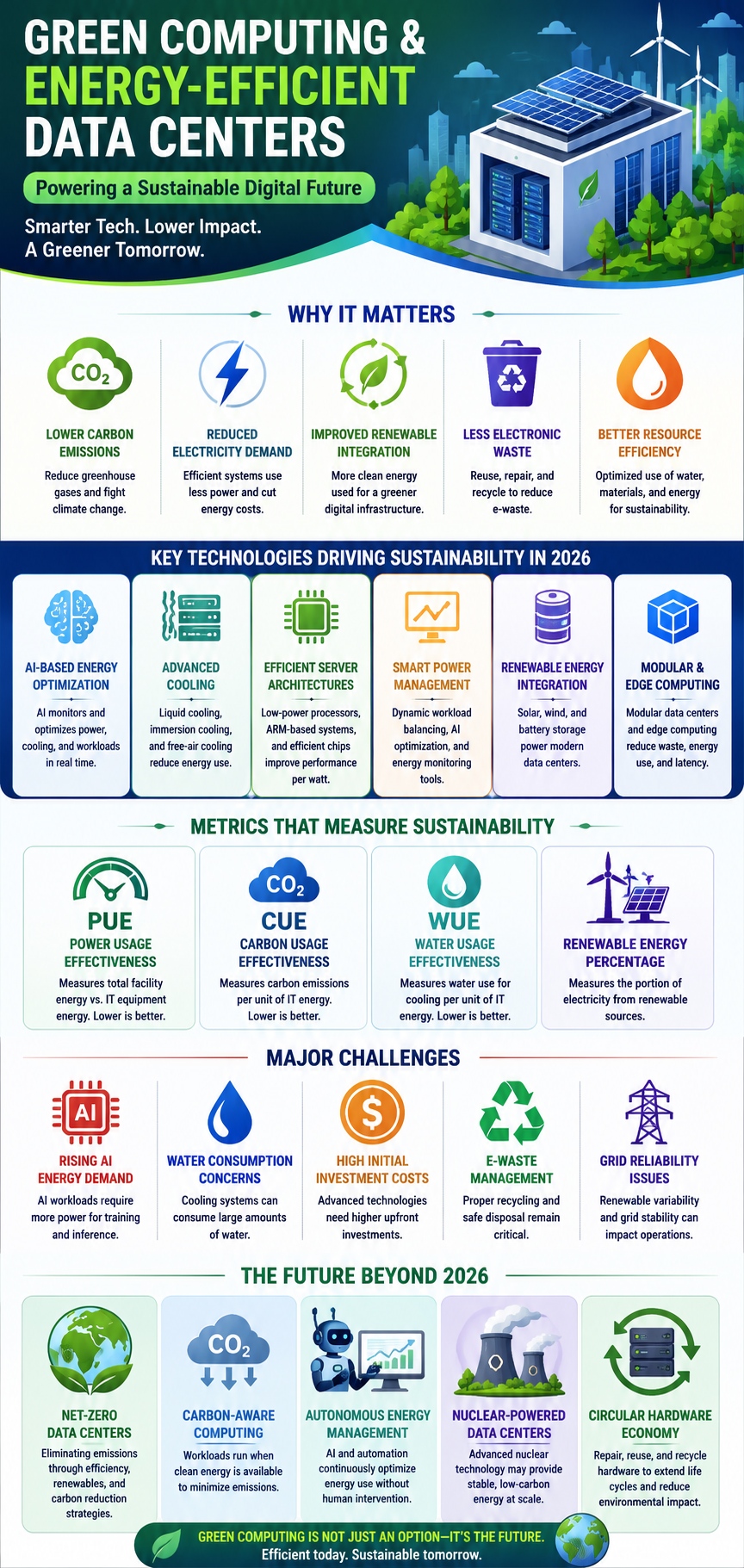
What Is Green Computing and Why Is It Important in 2026?
Green computing reduces energy consumption, lowers greenhouse gas emissions, decreases e-waste, and improves sustainability across digital infrastructure.
In 2026, green computing has become a major focus because digital technologies are growing rapidly and using more electricity worldwide.
Definition of Green Computing
Green computing includes many technologies and strategies that improve the environmental performance of digital systems.
Energy-efficient hardware is one important part of green computing. Modern processors, servers, storage devices, and networking equipment are being designed to deliver higher performance while using less electricity. Energy-efficient hardware helps reduce operational costs and lowers greenhouse gas emissions.
Sustainable software practices also support green computing. Developers are creating software that uses computing resources more efficiently. Optimized code, efficient algorithms, virtualization, and workload management can reduce unnecessary energy use in data centers and cloud systems.
Low-carbon data center operations are another key area. Many modern data centers now use renewable energy, advanced cooling systems, and intelligent energy management technologies to reduce their environmental footprint.
Green computing also follows circular economy approaches. This includes repairing, reusing, recycling, and extending the life of electronic devices to reduce electronic waste and conserve resources.
Why Green Computing Matters Today
Green computing is becoming increasingly important because digital infrastructure is expanding quickly.
The rapid growth of artificial intelligence (AI) requires large computing resources. Training and operating AI models often need significant processing power and electricity.
The expansion of cloud computing has also increased demand for data centers, storage systems, and networking infrastructure worldwide.
At the same time, many governments and organizations have adopted carbon neutrality goals to reduce greenhouse gas emissions and address climate change. Green computing supports these goals by improving energy efficiency and lowering carbon footprints.
In addition, environmental regulations are encouraging businesses to adopt sustainable technologies, reduce energy consumption, and improve electronic waste management.
As AI, cloud services, and digital infrastructure continue to expand in 2026, green computing is becoming an essential strategy for building a more sustainable digital future.
Why Are Data Centers Responsible for Large Carbon Footprints?
Data centers are the physical backbone of the digital economy. They store websites, run cloud platforms, support artificial intelligence (AI), process online transactions, and deliver digital services worldwide. Every AI query, cloud application, video stream, and internet search depends on data center infrastructure.
Some hyperscale AI facilities can exceed 100 megawatts (MW) of electricity demand, making them comparable to large industrial operations or the annual electricity use of many households. This shift is changing how energy systems, grids, and sustainability strategies are planned worldwide.
How Data Centers Consume Energy
Data centers use electricity across several systems, not only for computing.
Servers consume the largest share of energy. Servers process data, run applications, train AI models, and store information. According to the International Energy Agency (IEA), servers account for about 60% of electricity use in many modern data centers. AI-focused facilities often use high-performance processors and graphics processing units (GPUs), which increase power demand further.
Cooling systems are another major energy consumer. Servers generate large amounts of heat during operation. Data centers use air cooling, liquid cooling, chillers, and environmental control systems to maintain safe temperatures. Cooling demand can range from about 7% in highly efficient hyperscale centers to more than 30% in less efficient facilities.
Networking equipment such as routers, switches, and load balancers also require continuous power. These systems move data between servers, users, and cloud networks. Although their share is smaller, they still contribute to total electricity use.
Backup infrastructure supports uninterrupted operation. Uninterruptible power supplies (UPS), batteries, and backup generators keep systems running during power failures. These systems improve reliability but add material, manufacturing, and operational impacts.
Sources of Data Center Emissions
The carbon footprint of data centers comes from multiple stages of their life cycle.
Electricity generation remains the largest source. If electricity comes from coal, oil, or natural gas, higher energy use leads to greater carbon emissions.
Cooling demand increases environmental impact because cooling systems need additional electricity and, in some locations, significant water resources.
Hardware manufacturing also contributes emissions. Producing servers, processors, storage systems, batteries, and networking equipment requires raw materials, manufacturing energy, and transportation.
Supply chains add further impacts through mining, component production, shipping, construction materials, and infrastructure expansion.
This means a data center’s carbon footprint is influenced not only by operation but also by the technologies and materials used to build it.
Global Data Center Energy Trends in 2026
Data center electricity demand continues to rise in 2026 because of AI expansion and digital growth.
The IEA estimated global data center electricity consumption at around 415 terawatt-hours (TWh) in 2024, equal to about 1.5% of global electricity use. Electricity use had been growing by roughly 12% annually, and projections indicate that demand may approach 945 TWh by 2030, nearly doubling within the decade.
A major driver is AI-powered workloads. AI model training, inference systems, and generative AI services require high-performance computing infrastructure. The IEA reported that electricity demand from data centers increased by 17% during 2025, while AI-focused facilities expanded even faster.
At the same time, cloud infrastructure expansion continues worldwide. More businesses are adopting cloud platforms, edge computing, streaming services, and digital applications. This growth increases demand for hyperscale data centers and digital storage infrastructure.
How Energy-Efficient Data Centers Work
Energy-efficient data centers are designed to deliver high computing performance while using less electricity and producing fewer carbon emissions.
Modern facilities improve efficiency through advanced cooling methods, optimized server hardware, and intelligent power management systems.
Traditional data centers mainly focused on performance and reliability. Modern green data centers aim to achieve performance, sustainability, and energy efficiency at the same time.
Advanced Cooling Technologies
Cooling is one of the largest energy demands in many data centers because servers generate significant heat during operation. New cooling technologies are helping reduce this energy use.
Liquid Cooling
Liquid cooling uses fluids to absorb and remove heat directly from processors and servers. Liquids transfer heat more efficiently than air, allowing systems to stay cooler with less energy.
This method is becoming more important for AI workloads because high-performance processors and graphics units generate large amounts of heat. Liquid cooling can improve efficiency while supporting higher computing densities.
Immersion Cooling
Immersion cooling places servers inside special non-conductive liquids. The fluid absorbs heat directly from hardware components.
This approach can reduce cooling energy requirements and improve thermal performance. Some systems also reuse recovered heat for nearby buildings or industrial applications, increasing overall energy efficiency.
Free-Air Cooling
Free-air cooling uses outside air when environmental conditions are suitable. Instead of relying entirely on energy-intensive chillers, facilities bring in filtered external air to cool equipment.
Data centers located in cooler regions often use this approach to lower electricity demand and reduce cooling costs.
AI-Optimized Thermal Management
Artificial intelligence is now being used to improve cooling efficiency. AI systems analyze temperatures, airflow patterns, humidity, and server loads in real time.
The system automatically adjusts fans, cooling equipment, and workloads to reduce unnecessary energy use.
Efficient Server Architectures
Server design also plays a major role in reducing electricity demand.
Low-Power Processors
Modern processors deliver more computing performance while consuming less energy. Manufacturers are improving efficiency through smaller manufacturing processes and optimized architectures.
Low-power processors help reduce electricity consumption and generate less heat, which also lowers cooling demand.
ARM-Based Systems
ARM-based architectures are becoming more common in data centers because they are designed for energy efficiency.
ARM processors often provide high performance per watt compared with some traditional server architectures. Many cloud providers are adopting ARM-based servers for web services, cloud workloads, and AI applications.
Examples include processors developed by companies such as Amazon Web Services and Microsoft for cloud environments.
Energy-Efficient Chips
Specialized chips such as AI accelerators, tensor processors, and workload-specific processors improve efficiency by performing targeted tasks with lower energy use.
Instead of using general-purpose hardware for every workload, these chips optimize processing and reduce wasted power.
Smart Power Management Systems
Modern data centers increasingly use intelligent software to optimize energy use continuously.
Dynamic Workload Balancing
Workloads do not always require equal computing resources. Dynamic workload balancing moves applications between servers to improve efficiency.
Systems can shift workloads away from underused servers and concentrate activity on fewer machines, reducing unnecessary energy consumption.
AI-Based Optimization
Artificial intelligence is now helping manage power distribution and resource allocation.
AI systems can predict demand patterns, optimize cooling, schedule workloads, and improve equipment efficiency automatically.
These technologies help reduce energy waste while maintaining performance.
Energy Monitoring Tools
Modern facilities use sensors and monitoring platforms to track electricity use in real time.
Operators monitor metrics such as:
- Power Usage Effectiveness (PUE)
- Server utilization
- Cooling performance
- Temperature distribution
- Carbon emissions
These tools help identify inefficiencies and support sustainability targets.
Renewable Energy Is Transforming Modern Data Centers
Renewable energy is becoming one of the most important changes in modern data center design.
Traditional data centers only consumed electricity. New facilities are increasingly interacting with power systems through batteries, energy storage, and demand management. Some facilities may support grid stability by adjusting consumption patterns.
Future data centers may automatically schedule workloads based on renewable electricity availability. AI systems could move computing tasks to locations where solar or wind energy is currently abundant, reducing emissions further.
This concept is known as carbon-aware computing and is emerging as an important sustainability strategy for the next generation of green data centers.
Solar-Powered Data Centers
Solar energy is increasingly being used to support data center operations. Solar panels can generate electricity directly at facilities or supply power through utility-scale solar projects.
Solar power helps reduce dependence on fossil fuels and lowers operational emissions. Although solar generation depends on weather and daylight, it can significantly contribute to renewable energy portfolios when combined with storage systems.
Several technology companies have invested heavily in solar energy projects to support their sustainability goals.
For example, Google has signed long-term renewable energy agreements and invested in large solar projects to support its global operations.
Microsoft has also expanded solar energy procurement as part of its sustainability strategy.
Wind Energy Integration
Wind energy is another major source of renewable electricity for data centers. Large wind farms can provide significant amounts of power and help reduce carbon emissions from electricity generation.
Wind projects are often paired with cloud and hyperscale facilities because they can supply electricity at large scales.
Amazon Web Services supports multiple renewable energy projects, including wind facilities, to power cloud infrastructure.
Similarly, Meta has invested in renewable energy agreements linked to wind and solar developments supporting its operations.
Battery Storage and Grid Optimization
Renewable energy sources such as solar and wind are variable because production changes with weather and time of day. Battery storage systems help solve this challenge.
Modern data centers increasingly use batteries to store excess electricity and supply power when renewable generation decreases.
Battery systems also support grid optimization by balancing electricity demand and improving reliability.
Advanced energy management platforms can shift workloads, store power during low-demand periods, and use renewable electricity more efficiently.
Carbon-Neutral Operations
Many technology companies now aim to reduce or offset operational emissions through renewable energy adoption, efficiency improvements, and carbon reduction programs.
Google has announced goals to operate on 24/7 carbon-free energy, meaning electricity consumption would be matched with carbon-free sources every hour of the day.
Microsoft has stated its goal to become carbon negative by 2030 and has expanded renewable energy investments.
Amazon Web Services supports renewable energy expansion through its parent company’s sustainability commitments.
Meta reports matching operational electricity use with renewable energy purchases across global operations.
Carbon-neutral operations usually involve multiple strategies:
- Renewable electricity adoption
- Energy-efficient infrastructure
- Carbon reduction measures
- Improved cooling technologies
- Sustainability reporting and monitoring
Green Data Center Technologies Driving Sustainability in 2026
Modern data centers are using new technologies to reduce energy use and improve sustainability. In 2026, efficiency is no longer based only on hardware. It also depends on intelligent management systems and optimized infrastructure.
- AI-based energy optimization helps data centers reduce electricity consumption. Artificial intelligence monitors server loads, temperatures, and cooling systems in real time. It can automatically adjust operations to improve efficiency and lower energy waste.
- Digital twin technology creates virtual models of physical data centers. Operators can test airflow, cooling performance, and power use digitally before making real changes. This improves planning and reduces operational inefficiencies.
- Edge computing processes data closer to users instead of sending everything to large centralized facilities. This can reduce network traffic, improve response time, and lower energy demand for some applications.
- Heat recovery systems capture excess heat produced by servers. Instead of releasing it into the environment, facilities can redirect this energy for heating buildings or industrial processes.
- Waste heat reuse supports circular energy approaches by turning unused thermal energy into useful resources.
- Modular data centers use prefabricated units that improve scalability, reduce construction waste, and support energy-efficient expansion.
Metrics Used to Measure Data Center Sustainability
Data center sustainability is measured using specific performance metrics. These indicators help operators evaluate energy use, carbon emissions, water consumption, and renewable energy adoption.
- Power Usage Effectiveness (PUE) is one of the most widely used metrics. It compares the total energy consumed by a data center with the energy used only by IT equipment such as servers and storage systems. A lower PUE value indicates better energy efficiency because less electricity is wasted on cooling and support systems.
- Carbon Usage Effectiveness (CUE) measures carbon emissions generated per unit of IT energy consumption. It helps organizations understand the climate impact of their operations. Lower CUE values indicate lower carbon footprints.
- Water Usage Effectiveness (WUE) tracks the amount of water used for cooling relative to IT energy consumption. This metric has become increasingly important because some cooling methods require significant water resources.
- Renewable Energy Percentage measures how much of a data center’s electricity comes from renewable sources such as solar and wind power.
Modern sustainability assessments increasingly combine PUE, CUE, WUE, and renewable energy metrics because energy efficiency alone does not fully represent environmental impact.
Major Challenges Facing Green Computing
Green computing is helping reduce the environmental impact of digital technologies, but several challenges still remain in 2026.
- Rising AI energy demand is one of the biggest concerns. Artificial intelligence models require powerful processors and large data centers for training and operation. AI workloads often use more electricity than traditional computing tasks, increasing energy demand and cooling requirements.
- Water consumption concerns are also growing. Many data centers use water-based cooling systems to control heat generated by servers. In regions facing water stress, this can create sustainability challenges and increase pressure on local resources.
- High initial investment costs can slow green technology adoption. Energy-efficient servers, advanced cooling systems, renewable energy projects, and smart management technologies often require significant upfront spending.
- E-waste management remains another major issue. Rapid hardware upgrades create electronic waste containing valuable materials and hazardous components. Recycling and reuse systems are still developing in many regions.
- Grid reliability issues also affect sustainability efforts. Renewable energy sources such as solar and wind are variable, and stable electricity supply remains essential for continuous operations.
Future green computing strategies increasingly focus on balancing energy efficiency, resource use, and long-term infrastructure resilience.
Future Trends in Sustainable Data Centers Beyond 2026
Sustainable data centers are expected to evolve rapidly beyond 2026 as energy demand continues to grow. Future developments will focus on reducing emissions while maintaining high computing performance.
Net-zero data centers aim to balance or eliminate greenhouse gas emissions through energy efficiency, renewable electricity, carbon reduction measures, and low-carbon infrastructure. Many technology companies are working toward long-term net-zero targets.
Carbon-aware computing is emerging as an important strategy. In this approach, computing workloads can be scheduled based on the availability of low-carbon electricity. Tasks may run when solar or wind energy production is high, helping reduce emissions.
Autonomous energy management will likely expand through artificial intelligence and automation. Smart systems may continuously monitor power use, cooling performance, and workload distribution while automatically optimizing operations.
Interest in nuclear-powered data centers is also increasing. Small modular reactors and advanced nuclear technologies are being explored as possible low-carbon energy sources for large computing facilities, although deployment remains limited.
A circular hardware economy will focus on repairing, reusing, recycling, and extending the life of electronic equipment to reduce waste and conserve materials.
Future sustainability may depend not only on cleaner electricity but also on smarter energy timing and resource reuse.
Environmental Benefits of Energy-Efficient Data Centers
Energy-efficient data centers provide important environmental benefits by reducing resource use and lowering the impact of digital infrastructure. As artificial intelligence, cloud computing, and online services continue to grow, efficient facilities are becoming more important for sustainability.
One major benefit is lower carbon emissions. Energy-efficient servers, advanced cooling systems, and renewable electricity reduce dependence on fossil-fuel energy sources. This helps decrease greenhouse gas emissions linked to digital operations.
These facilities also support reduced electricity demand. Intelligent power management, efficient hardware, and optimized workloads allow data centers to perform more computing tasks while using less energy.
Another advantage is improved renewable integration. Modern facilities increasingly use solar and wind power together with battery storage systems. This helps increase the share of low-carbon electricity in operations.
Energy-efficient practices can also lead to less electronic waste. Extending hardware life, repairing equipment, and recycling components support circular economy approaches and reduce discarded electronics.
Better resource efficiency is another important outcome. Efficient cooling technologies can lower water use, while optimized infrastructure reduces unnecessary energy losses.
Modern sustainability efforts now evaluate energy, water, materials, and carbon together because environmental performance depends on all these factors.
Read Here: Impact of Environmental Policies on Urban Development
Frequently Asked Questions (FAQs)
What is an energy-efficient data center?
An energy-efficient data center is a facility that uses less electricity while maintaining computing performance. It achieves this through efficient servers, advanced cooling systems, smart power management, renewable energy integration, and optimized infrastructure to reduce environmental impact and operating costs.
How do green data centers reduce carbon emissions?
Green data centers reduce carbon emissions by using renewable electricity, energy-efficient hardware, intelligent cooling technologies, optimized workloads, and low-carbon operational practices. These measures lower electricity consumption and reduce dependence on fossil-fuel-based power generation.
What technologies make data centers sustainable?
Sustainable data centers use technologies such as AI-based energy optimization, liquid cooling, digital twins, edge computing, renewable energy systems, waste heat recovery, energy monitoring tools, and modular infrastructure to improve efficiency and reduce environmental impact.
Why is cooling important in data center sustainability?
Cooling is important because servers generate large amounts of heat during operation. Efficient cooling systems reduce electricity use, improve equipment performance, lower operational costs, and decrease carbon emissions associated with data center energy consumption.
What renewable energy sources power data centers?
Modern data centers are increasingly powered by renewable energy sources such as solar power, wind energy, hydroelectricity, geothermal energy, and battery-supported renewable systems to reduce carbon emissions and improve sustainability.
What is PUE in green computing?
Power Usage Effectiveness (PUE) is a metric used to measure data center energy efficiency. It compares total facility energy consumption with energy used by IT equipment. Lower PUE values indicate higher operational efficiency.
Are AI data centers increasing electricity demand?
Yes. AI data centers are increasing electricity demand because AI training and inference workloads require powerful processors and high-performance computing systems that consume more energy than many traditional digital applications.
What is the future of green computing?
The future of green computing includes net-zero data centers, carbon-aware computing, autonomous energy management, renewable energy integration, circular hardware systems, and more efficient digital infrastructure to support sustainable technological growth.
References
- International Energy Agency. (2025). Energy and AI. IEA.https://www.iea.org/reports/energy-and-ai
- International Energy Agency. (2025). Energy supply for AI. In Energy and AI. IEA.https://www.iea.org/reports/energy-and-ai/energy-supply-for-ai
- International Energy Agency. (2025). Executive summary: Energy and AI. IEA.https://www.iea.org/reports/energy-and-ai/executive-summary
- Google Sustainability Reports. (2020). Carbon-free energy performance at Google data centers. Google LLC.
- Google Sustainability Reports. (2018). Moving toward 24×7 carbon-free energy at Google data centers: Progress and insights. Google LLC.
- Microsoft Sustainability Report. (2025). Environmental sustainability report 2025. Microsoft Corporation.
- Chen, X., Wang, X., Colacelli, A., Lee, M., & Xie, L. (2025). Electricity demand and grid impacts of AI data centers: Challenges and prospects. arXiv.https://arxiv.org/abs/2509.07218
- Chen, D., Zhou, Z., Cai, Y., Qin, J., Katchova, A., & Chen, L. (2026). Concentrated siting of AI data centers drives regional power-system stress under rising global compute demand. arXiv.https://arxiv.org/abs/2604.06198
- Li, S., Tong, L., & Mount, T. D. (2025). Energy management for renewable-colocated artificial intelligence data centers. arXiv.https://arxiv.org/abs/2507.08011
- Kim, D., Ahn, J., McJeon, H., & Kim, C. (2026). Efficiency vs demand in AI electricity: Implications for post-AGI scaling. arXiv.https://arxiv.org/abs/2603.10498
Read Here: Applications of Internet of Things in Industrial Automation