Objectification of labour, a core concept in Karl Marx’s theory of estranged labor, refers to the process where a worker’s labor becomes embodied in a tangible product. Under capitalism, this turns into alienation, as the product is owned by another (the capitalist), and the labor process becomes a controlling force that strips the worker of their humanity, reducing their work to a commodity.
Understanding the Objectification of Labour: How Does It Affect the Production Process?
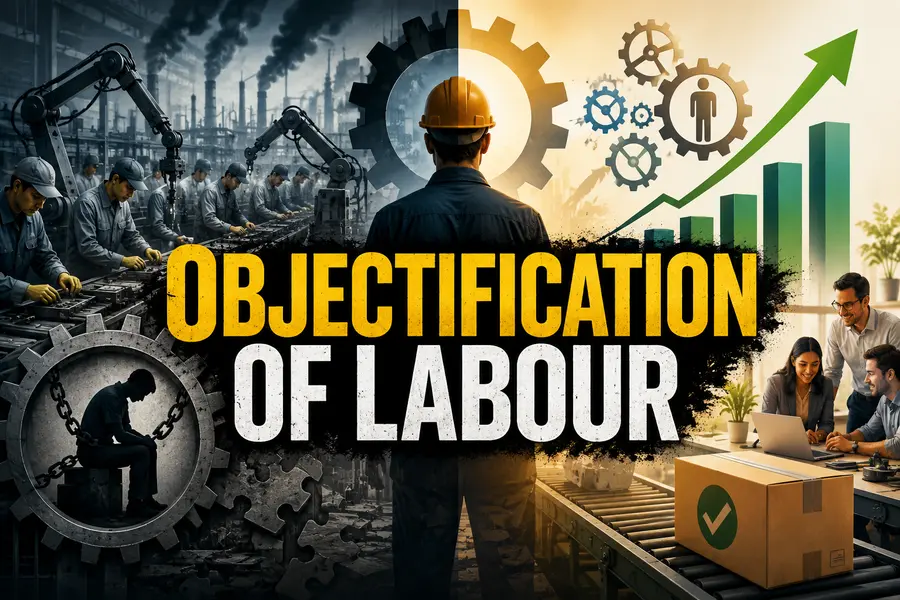
Introduction: What is Objectification of Labour in Sociology?
The concept of objectification of labour is central to sociological and economic thought, especially in the work of Karl Marx. It refers to the process through which human labour becomes embodied in material objects or products.
In simple terms, when workers use their skills, time, and effort to produce goods or services, their labour takes a concrete, visible form in what they create. This process is essential for all production systems because it transforms abstract human effort into usable commodities.
However, in capitalist systems, objectification often becomes problematic. Workers may lose control over the products they create and the process of production itself. As a result, labour becomes something external to the worker rather than an expression of their creativity.
Understanding this concept helps explain broader issues like alienation, exploitation, and inequality within modern industrial societies.
Conceptual Meaning of Objectification of Labour
Objectification of labour means that human effort becomes materialized in a product. When a worker builds a table, their labour is embedded in that object.
This idea highlights how labour is not just an activity but something that produces tangible outcomes. In sociology, this concept helps explain how value is created in society.
Labour is the source of all production, and without it, raw materials cannot be transformed into useful goods. However, objectification is not inherently negative. It becomes problematic when workers are separated from the products they create.
In such cases, labour is no longer a personal or creative activity. Instead, it becomes mechanical and controlled by external forces. This shift is especially visible in industrial production systems, where workers perform repetitive tasks without ownership over the final product. Thus, objectification is both a necessary process and a potential source of social inequality.
Role in the Production Process
Objectification of labour is fundamental to the production process. It is the mechanism through which raw materials are transformed into finished goods. Every product in the market represents accumulated labour. This process connects human effort with economic output.
In factories and industries, workers contribute their labour in specialized ways, and each stage of production adds value to the final product.
Objectification allows labour to be measured, priced, and exchanged in the market. This is essential for economic systems to function efficiently. However, it also introduces challenges.
When production is highly structured, workers often have limited control over how their labour is used. Their role becomes confined to specific tasks rather than the whole process.
This fragmentation can reduce job satisfaction and creativity. Despite these issues, objectification remains a key principle that explains how labour contributes to economic growth and industrial development.
Link with Marx’s Theory of Alienation
Objectification of labour is closely linked to the concept of alienation. According to Marx, workers in capitalist systems become alienated from the products they create.
While labour becomes objectified in goods, these goods do not belong to the workers. Instead, they are owned by employers or capitalists. This creates a separation between the worker and their labour. Workers may feel disconnected from their work because they do not control the outcome.
This alienation affects not only their economic condition but also their psychological well-being. Labour becomes a means of survival rather than a fulfilling activity. The worker’s creativity and individuality are suppressed.
This connection between objectification and alienation highlights the unequal power relations in capitalist societies. It shows how the production process can lead to dissatisfaction and loss of identity among workers, even though their labour is essential for creating value.
Objectification vs. Alienation
It is important to distinguish between objectification and alienation. Objectification itself is a neutral and necessary process. It simply refers to labour becoming embodied in a product. Without objectification, production would not exist.
Alienation, on the other hand, is a negative condition that arises under certain social systems. It occurs when workers lose control over their labour and its outcomes.
In non-capitalist or cooperative systems, objectification may not lead to alienation. Workers may feel connected to what they produce and take pride in their work.
However, in capitalist systems, the two concepts often overlap. Workers produce goods, but they do not own or benefit fully from them.
This distinction is important for understanding how economic structures influence human experiences. It also helps sociologists analyze whether production systems promote well-being or create inequality and dissatisfaction among workers.
Impact on Worker Identity
Objectification of labour has a strong impact on worker identity. In ideal conditions, workers can see themselves reflected in the products they create. Their skills and creativity become part of the final output. This can enhance their sense of purpose and self-worth.
However, in many modern production systems, this connection is weakened. Workers perform repetitive tasks that do not allow for personal expression. As a result, they may not identify with their work.
The role of workers becomes limited to completing assigned duties rather than contributing meaningfully to production. This can lead to a loss of individuality and reduced motivation. Workers may feel like replaceable parts of a larger system.
The objectification of labour, when combined with lack of control, can therefore weaken personal identity. It transforms work from a meaningful activity into a routine obligation, affecting both morale and productivity.
Division of Labour and Specialization
The objectification of labour is closely linked to the division of labour. In modern industries, production is divided into small, specialized tasks.
Each worker contributes a specific part to the final product. This increases efficiency and productivity. However, it also intensifies the objectification process.
Workers focus on narrow roles rather than the entire production cycle. This limits their understanding of how their labour contributes to the final product. While specialization improves output, it can reduce job satisfaction.
Workers may feel disconnected from the overall process. Their labour becomes a small fragment rather than a complete creative activity. This fragmentation is a key feature of industrial capitalism. It shows how economic efficiency can come at the cost of human experience.
Sociologists study this relationship to understand how production systems can balance productivity with worker well-being.
Commodification of Labour
Objectification of labour leads to the commodification of labour. This means that labour itself becomes something that can be bought and sold in the market. Workers sell their labour power in exchange for wages.
The value of their work is determined by market conditions rather than personal effort alone. This process turns human activity into an economic commodity. While this system allows for organized production and trade, it also raises concerns.
Workers may be valued only for their productivity, not as individuals. Their skills and time are treated as economic inputs rather than human contributions. This can reduce the dignity of work.
Commodification also creates inequalities, as some forms of labour are valued more than others. Understanding this concept helps explain how labour markets operate and why certain jobs are better rewarded than others in capitalist economies.
Control and Ownership in Production
Objectification of labour raises important questions about control and ownership. In many production systems, workers do not own the products they create.
Instead, ownership lies with employers or corporations. This creates a power imbalance. Workers contribute their labour, but they have limited control over how it is used.
Decisions about production, distribution, and profit are made by those who own the means of production. This separation can lead to exploitation. Workers may not receive fair compensation for the value they create. It also affects their ability to influence workplace conditions.
Greater control and participation can reduce these issues. For example, cooperative models allow workers to share ownership and decision-making. This can improve job satisfaction and fairness.
Thus, the relationship between labour and ownership is a key factor in understanding the effects of objectification in the production process.
Technological Advancement and Labour Objectification
Technology plays a significant role in shaping the objectification of labour. Modern machines and automation have transformed production processes. They increase efficiency and reduce the need for manual labour. However, they also change how labour is experienced.
Workers may become operators of machines rather than active creators. This can deepen the sense of detachment from the production process.
At the same time, technology can also create new opportunities. Skilled workers can use advanced tools to produce complex and innovative products.
The impact of technology is therefore mixed. It can both enhance and reduce the meaningfulness of work.
Sociologists study this relationship to understand how technological change affects labour dynamics. The challenge is to ensure that technological progress improves working conditions rather than reducing workers to passive participants in production.
Effects on Productivity and Efficiency
Objectification of labour has a direct impact on productivity and efficiency. By transforming labour into measurable outputs, it allows organizations to plan and optimize production.
Standardized processes and clear roles can increase output and reduce costs. This is why objectification is central to industrial growth. However, there are also negative effects. When workers feel disconnected from their work, their motivation may decline. This can reduce productivity over time.
Lack of engagement can lead to errors, absenteeism, and low morale. Balancing efficiency with worker satisfaction is therefore essential.
Organizations that recognize the human aspect of labour often achieve better long-term results. They create environments where workers feel valued and involved. This shows that while objectification is necessary for production, it must be managed carefully to avoid negative social and economic consequences.
Conclusion
Objectification of labour is a foundational concept in sociology that explains how human effort becomes part of the material world. While it enables production and economic growth, its effects depend on the social and economic context.
When combined with inequality and lack of control, it can lead to alienation and dissatisfaction.
Understanding this concept helps us critically examine modern work systems and explore ways to make labour more meaningful and equitable.
Read Here: The Effects of Child Labor on India’s Future Workforce