Jacques Derrida explained deconstruction as a critical approach that reveals how meaning in language is unstable and shaped by context. It examines hidden assumptions, binary oppositions, and power relations within texts and social structures.
Deconstruction is linked to Post-structuralism and it shows that meanings are never fixed but constantly shifting. It helps question dominant narratives and highlights how language constructs social reality and knowledge.
Understanding Derrida’s Theory of Deconstruction: A Revolutionary Approach
Introduction: Understanding Jacques Derrida’s Deconstruction
Jacques Derrida introduced the concept of deconstruction as a way to analyze how meaning is created in language, texts, and social structures. Rather than simply breaking things apart, deconstruction examines hidden assumptions, contradictions, and power relations within ideas. It challenges the belief that words have fixed meanings and shows that meaning is always shifting.
In sociology, this approach helps scholars question dominant narratives, social norms, and accepted truths. Derrida argued that language shapes how we see reality, and therefore, no interpretation is completely neutral or final. His ideas are closely linked to Post-structuralism, which critiques stable structures in society.
Deconstruction is not about destroying meaning but about revealing multiple meanings and possibilities. This makes it a powerful tool for sociological analysis, especially when studying identity, culture, and power relations.
Language and the Instability of Meaning
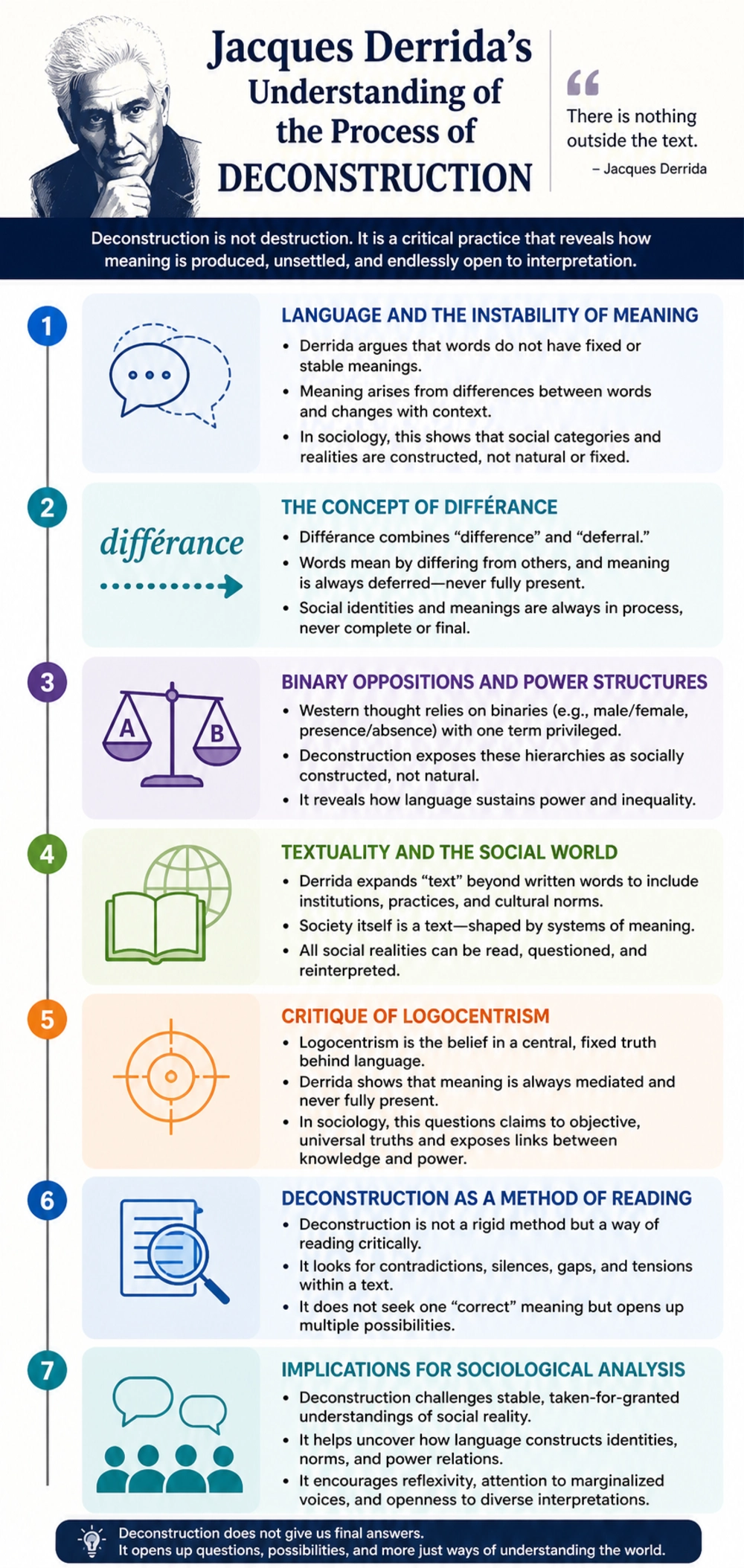
Derrida argued that language does not produce fixed or stable meanings. Instead, meaning is always changing and depends on context. Words gain meaning through their differences from other words, not from any inherent essence.
This idea challenges traditional linguistic theories, such as those of Ferdinand de Saussure, who emphasized structured systems of language. Derrida extended this by showing that meanings are never fully present or complete.
In sociology, this insight is important because social categories like “class,” “gender,” or “nation” are also constructed through language. These categories appear stable, but they are actually fluid and open to reinterpretation.
Deconstruction reveals how meanings shift over time and across contexts. This helps sociologists understand that social reality is not fixed but continuously produced through communication. As a result, any claim to a single, universal truth becomes questionable, encouraging a more critical and reflective approach to knowledge.
The Concept of Différance
One of Derrida’s most important ideas is “différance,” a term he created to explain how meaning works.
Différance combines two ideas: difference and deferral. First, words mean something because they are different from other words. Second, meaning is always delayed because we understand a word only through its relation to other words. This means that meaning is never fully present at any moment.
In sociological analysis, différance shows that social identities and meanings are never complete or fixed. For example, identities like “male” or “female” gain meaning only in relation to each other and are shaped by cultural contexts.
Différance also suggests that attempts to define concepts clearly will always leave something out.
This idea challenges rigid classifications in society and opens up space for alternative interpretations. It helps sociologists examine how meaning is constantly shifting, making social reality more complex and dynamic than it first appears.
Binary Oppositions and Power Structures
Derrida argued that Western thought often relies on binary oppositions, such as male/female, speech/writing, or presence/absence. These pairs are not neutral. One term is usually seen as superior, while the other is considered inferior.
Deconstruction examines these hierarchies and shows how they maintain power structures. For example, in many societies, masculinity is often valued over femininity. This creates unequal social relations.
Derrida’s analysis helps sociologists uncover hidden inequalities within language and thought. By questioning these binaries, deconstruction reveals that the oppositions are not natural but socially constructed. It also shows that the two terms depend on each other for meaning. This means the hierarchy can be challenged and reversed.
In sociology, this approach is useful for studying issues like gender inequality, racism, and cultural dominance. It encourages critical thinking about how power operates through everyday language and assumptions.
Textuality and the Social World
Derrida expanded the idea of “text” beyond written documents. He suggested that everything in society can be understood as a text, including institutions, practices, and cultural norms.
This idea is often summarized as “there is nothing outside the text.” In sociology, this means that social reality is shaped by systems of meaning and interpretation.
Social practices, laws, and traditions can all be analyzed like texts. They contain hidden assumptions and contradictions that can be uncovered through deconstruction.
This approach allows sociologists to study how meaning is produced in everyday life. It also shows that no interpretation is final or complete. Different people can read the same “text” in different ways.
This insight is important for understanding cultural diversity and social conflict. By treating society as a text, deconstruction provides a powerful method for analyzing how meanings are constructed and contested.
Critique of Logocentrism
Derrida criticized what he called “logocentrism,” the belief that there is a central, fixed meaning or truth behind language.
Logocentrism assumes that words can directly represent reality. Derrida challenged this idea by showing that meaning is always mediated by language and is never fully stable.
In sociological terms, this critique questions the idea that there are objective, universal truths about society. Instead, knowledge is seen as shaped by cultural, historical, and linguistic contexts. This perspective aligns with critical approaches that question dominant ideologies.
Deconstruction reveals how claims to truth often hide power relations. For example, certain groups may define what counts as “truth” to maintain control. By exposing these assumptions, sociologists can better understand how knowledge and power are connected.
Derrida’s critique encourages a more cautious and reflective approach to truth and knowledge in social research.
Deconstruction as a Method of Reading
Deconstruction is not a fixed method with clear steps. Instead, it is a way of reading texts that focuses on uncovering contradictions and hidden meanings.
Derrida showed that texts often undermine their own claims. For example, a text that tries to present a clear argument may contain ambiguities that weaken its position. In sociology, this approach can be used to analyze policies, media, and cultural narratives.
Deconstruction looks for what is not said, as well as what is said. It examines gaps, silences, and tensions within texts. This helps reveal underlying assumptions and power relations.
Deconstruction does not aim to find a single correct interpretation. Instead, it opens up multiple possibilities for understanding. This makes it a valuable tool for critical analysis. It encourages sociologists to question taken-for-granted ideas and to explore alternative perspectives.
Implications for Sociological Analysis
Derrida’s deconstruction has important implications for sociology. It challenges the idea that social reality is stable and objectively knowable. Instead, it shows that reality is constructed through language and interpretation.
This perspective encourages sociologists to question dominant narratives and explore marginalized voices.
Deconstruction is especially useful in areas like gender studies, cultural studies, and postcolonial theory. It helps reveal how power operates through language and representation. For example, it can show how certain identities are privileged while others are excluded.
Deconstruction also promotes reflexivity in research. Sociologists must recognize their own role in shaping interpretations. This leads to more critical and self-aware scholarship.
Overall, Derrida’s approach expands the scope of sociological analysis by highlighting complexity, ambiguity, and diversity. It provides tools for understanding how meaning and power are intertwined in social life.
Conclusion
Jacques Derrida’s concept of deconstruction challenges the idea that meaning in language is fixed or absolute. He argued that every text contains contradictions and hidden assumptions that undermine its own claims.
Deconstruction is not destruction—it is a careful analysis that reveals how meaning is built through differences and oppositions.
Derrida showed that words gain meaning only in relation to other words, making interpretation an endless process. His approach encourages readers to question authority, certainty, and traditional structures of thought. He exposed the instability of meaning and transformed philosophy, literature and cultural theory.
Deconstruction teaches us to read critically, to look beyond surface meanings, and to understand that truth is never final but always evolving through interpretation.