IoT sensors can solve urban traffic congestion. They replace static, timed traffic lights with adaptive traffic signals. IoT cameras and radar sensors collect real-time data on vehicle density and send it to local edge computers. These smart systems instantly adjust green light timings to clear bottlenecks and prioritize heavy traffic lanes. This real-time responsiveness reduces intersection wait times by up to 40% and lowers vehicle carbon emissions by 21%, transforming traditional grids into highly efficient and sustainable smart cities.
Learn how 2026 IoT sensors and adaptive traffic signals are reducing urban congestion, cutting intersection wait times by 40%, and lowering emissions.
Designing Smarter Cities: How IoT Sensors Are Solving Real-Time Urban Traffic Congestion
How do smart cities fix gridlock? Learn how AI and IoT sensors dynamically adjust traffic lights to cut wait times and reduce carbon emissions in 2026.
What Role Does IoT Play in Smart City Traffic Management?
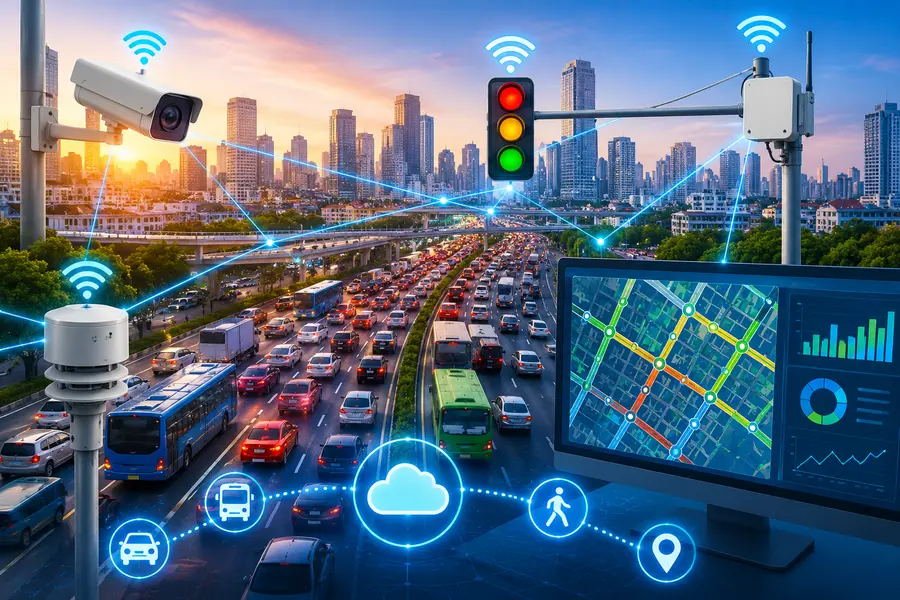
IoT sensors reduce urban traffic congestion by collecting real-time data on vehicle flow and dynamically adjusting traffic signals. Instead of relying on fixed timers, AI-driven IoT systems detect vehicle buildup and prioritize signal changes to clear bottlenecks instantly.
Recent city-wide deployments show that adaptive smart traffic systems can reduce intersection wait times by up to 40% and lower vehicle emissions by 21%, making urban transit faster and environmentally sustainable.
The days of sitting at a red light on an empty street at 2:00 AM are rapidly coming to an end. As we navigate through 2026, the Internet of Things (IoT) has transformed from a buzzword into the invisible, operational backbone of the modern municipality.
By giving our streets a “digital nervous system,” city planners are finally able to solve one of the most frustrating aspects of modern life: traffic congestion.
The Breaking Point: Why Traditional Traffic Grids Fail
Why do our roads get so backed up in the first place? Traditional traffic grids operate on historical data, rendering them blind to real-time anomalies.
For decades, urban intersections have been governed by rigid timing plans computed off-line. Traffic engineers would study average vehicle flows during specific times of the day—such as the morning commute or the evening rush hour—and program the lights to follow fixed cycle lengths.
While these static schedules worked decently well for predictable, single-lane suburban corridors, they fail spectacularly in complex urban grids with multiple, competing traffic flows that shift throughout the day.
- The Single Point of Failure: If an accident blocks a lane, or a major sporting event lets out earlier than expected, static systems cannot adapt. They continue to allocate “green time” to empty lanes while hundreds of cars idle in cross-streets.
- Actuated Signals Aren’t Enough: Even intersections equipped with basic vehicle detectors (like the induction loops buried under the pavement) are severely limited. They can trigger a light change if a single car pulls up, but they lack the network awareness to understand how that change impacts the next five intersections down the road.
This inability to adapt to real-time conditions causes cascading pockets of congestion. Enter IoT and AI-driven workload management for urban mobility.
The Mechanics: How IoT Traffic Sensors Work
How do smart traffic systems actually “see” the road? They utilize a multi-layered technology stack consisting of real-time data collection, edge computing, and dynamic signal adaptation.
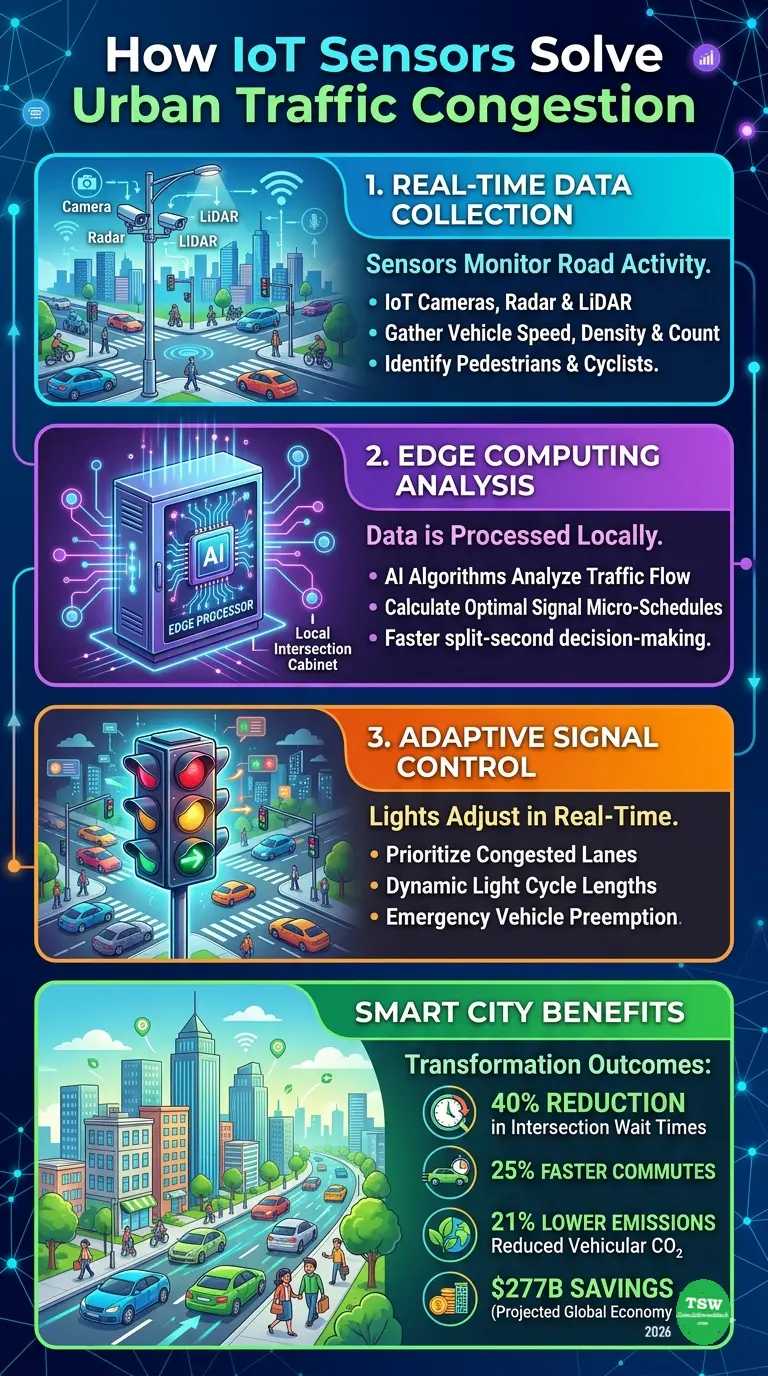
To understand how cities are eliminating gridlock, it helps to break down the infrastructure into three sequential steps:
1. Real-Time Data Collection
The foundation of any smart city is its sensory network. Intersections are outfitted with a combination of high-definition cameras, radar systems, and LiDAR sensors. These IoT devices do not just detect the presence of a car; they classify the object. They can differentiate between a passenger vehicle, a city bus, a cyclist, and a pedestrian. Furthermore, they continuously gather up-to-the-second data on vehicle density, speed, trajectory, and even lane positioning.
2. Edge Computing Analysis
Instead of sending gigabytes of raw video data to a centralized cloud server—which would introduce critical latency—IoT traffic systems rely on Edge Computing.
Processing units installed directly in the intersection’s control cabinet analyze the traffic flow locally. This decentralized approach allows the system to treat intersection control as a “single-machine scheduling problem.”
The AI algorithm calculates the absolute most efficient order to let every detected vehicle pass through the intersection, updating this micro-schedule on a second-by-second basis.
3. Dynamic Signal Adaptation
Once the edge processor determines the optimal flow, the AI automatically adapts the traffic lights. It can dynamically lengthen a green light to clear a heavy platoon of vehicles, shorten a cycle to prevent cross-street backup, or instantly preempt all signals to clear a path for approaching emergency responders.
Because the system is decentralized but connected, it communicates its scheduled outflows to downstream neighbor intersections, allowing the entire grid to synchronize and create massive “green corridors.”
Read Here: The Importance of Internet of Things (IoT) in Our Life
Case Study: Pittsburgh’s Adaptive Traffic Signals
How effective are smart traffic lights in the real world? A premier example of IoT traffic management is Pittsburgh’s deployment of the SURTRAC (Scalable Urban Traffic Control) system, which proved that decentralized, AI-driven networks drastically outperform traditional grids.
Developed initially by researchers at Carnegie Mellon University’s Robotics Institute and subsequently commercialized, SURTRAC was designed specifically for complex urban grids where traffic patterns are highly unpredictable.
Pittsburgh, with its dense neighborhoods, challenging topography, and highly variable daily traffic, served as the ultimate testing ground.
The city upgraded traditional intersections with radar sensors and AI-driven control networks, shifting entirely from static schedules to real-time, decentralized responsiveness.
The results were transformative. Extensive drive-through studies and continuous monitoring generated verified performance statistics that have become the gold standard for IoT smart city benchmarks:
- Intersection Wait Times: Reduced by 40%. Commuters spent significantly less time idling at red lights, smoothing out the stop-and-go frustration of city driving.
- Travel Time Efficiency: Overall commute times decreased by 25% across equipped urban corridors, essentially giving drivers a quarter of their commute time back.
- Reduction in Stops: The number of times a vehicle had to come to a complete halt dropped by up to 53% during off-peak periods.
- Environmental Impact: With fewer cars idling at intersections and drastically reduced mechanical wear from stopping and starting, citywide vehicular carbon emissions plummeted by 21%.
Because SURTRAC is inherently decentralized, it avoids the computational bottleneck of a central server. Adding a new intersection to the network simply means plugging in a new node that immediately starts communicating with its neighbors.
Expanding the Scope: The Global Smart City Movement
How are other regions utilizing IoT to solve traffic? Cities worldwide are investing heavily in customized intelligent transit solutions, proving that smart traffic management scales universally.
While Pittsburgh provides an excellent micro-lens, the macro-lens is staggering. Global research firms, including Juniper Research, projected that the global smart traffic management market would surge past $15 billion in 2025, driven by rapid urbanization and stringent sustainability goals. The push for smarter roads is global:
- Europe’s Low-Emission Zones: Cities in the UK and Germany are integrating IoT traffic systems directly with air quality sensors. If the network detects localized spikes in nitrogen dioxide or particulate matter, the traffic management AI automatically reroutes commercial vehicles and adjusts signal timings to disperse congestion away from the polluted zone.
- Asia’s Mega-Grids: In densely populated urban centers across Japan and Singapore, AI-powered video analytics not only optimize vehicle flow but heavily prioritize multi-modal transport. Intersections are programmed to hold green lights slightly longer for massive pedestrian crowds or to prioritize public transit buses over single-occupancy vehicles, driving efficiency at a massive scale.
- Cloud and SaaS Integration: To manage costs, municipalities are increasingly turning to Software-as-a-Service (SaaS) models. Vendors provide the edge-processing software and AI maintenance through subscription tiers, lowering the barrier to entry so even mid-sized towns can deploy enterprise-grade traffic solutions without massive upfront capital expenditure.
Economic and Social Impacts of Smart Traffic Management
What is the financial benefit of curing urban congestion? Smart traffic management solutions are projected to save global cities and their citizens billions of dollars annually by recapturing lost productivity and reducing fuel waste.
Traffic congestion is more than just a daily annoyance; it is a massive economic drain. When millions of workers sit in gridlock, productivity plummets, delivery supply chains are delayed, and billions of gallons of fuel are burned for absolutely zero forward movement.
Reclaiming Time and Productivity
Industry analytics reveal that before the widespread implementation of adaptive systems, the average driver in a metropolitan area lost roughly 36 to 50 hours a year to pure congestion. By smoothing traffic flow and reducing intersection wait times, IoT networks give this time back.
Juniper Research estimates that smart traffic infrastructure is on track to save global cities an astonishing $277 billion cumulatively by the end of 2026.
This financial recapture stems directly from recovered labor hours, more efficient commercial freight movement, and reduced overhead for public transit authorities.
Mitigating Driver Stress and Improving Safety
The psychological toll of traffic cannot be overstated. Stop-and-go driving induces anxiety, frustration, and road rage, which frequently translate into aggressive driving behaviors and accidents. By creating predictable, flowing traffic environments, smart grids naturally calm driver behavior.
Furthermore, the reduction in sudden stops decreases the likelihood of rear-end collisions, making the streets inherently safer for both drivers and pedestrians.
Environmental Sustainability: The Green IoT Benefit
How does IoT traffic management fight climate change? By eliminating unnecessary vehicle idling and smoothing traffic flow, IoT sensors directly reduce the volume of greenhouse gases emitted into the urban atmosphere.
In an era where every industry is striving to lower its carbon footprint, urban transportation remains one of the heaviest polluters. While the transition to Electric Vehicles (EVs) is accelerating, the reality of 2026 is that millions of internal combustion engine (ICE) vehicles are still on the road.
We can look at urban traffic efficiency much like we look at data center energy metrics. In the tech world, lowering Power Usage Effectiveness (PUE) is the gold standard for green computing. In urban planning, lowering the “Idle Time Ratio” is the equivalent.
When a car accelerates from a dead stop, it burns significantly more fuel than it does while cruising. By reducing the number of stops by over 50% in some corridors, adaptive signal controls prevent thousands of tons of CO2 from ever being generated.
A proven 20% to 21% reduction in vehicle emissions simply by changing how the lights operate is a monumental victory for municipal sustainability goals. It allows cities to aggressively combat climate change without requiring citizens to immediately purchase new vehicles.
Read Here: The Impact of Environmental Policies on Urban Development
Proactive and Predictive Maintenance of Urban Infrastructure
Can IoT sensors protect the physical roads themselves? Yes, smart traffic networks double as infrastructure health monitors, using predictive analytics to foresee road wear and prevent traffic-inducing repairs.
The sensors installed for traffic management are multi-functional. The same high-definition cameras and IoT connected devices that watch for traffic bottlenecks are also constantly analyzing the state of the physical environment.
- Surface Degradation: Advanced algorithms can detect the formation of potholes or surface cracking by analyzing micro-vibrations in vehicle movement and visual data. This allows city maintenance crews to dispatch targeted repairs before a minor crack turns into a massive, axle-breaking pothole that shuts down a lane.
- Weather Response: IoT environmental sensors monitor localized weather conditions such as flash flooding, black ice formation, or dense fog. The system can dynamically adjust digital speed limit signs, close hazardous lanes autonomously, and alert incoming drivers to slow down via connected-car dashboards.
- Hardware Diagnostics: The IoT network also monitors itself. If an intersection camera loses visibility or a radar sensor goes offline, the system instantly flags the component for repair while neighboring intersections adjust their models to compensate for the temporary blind spot. This guarantees a highly resilient, always-on traffic network.
Read Here: Urbanization 2050: The Promise and Perils of Megacities
The 2026 Outlook: 5G, V2X and Autonomous Integration
What is the future of IoT traffic management? The next evolution lies in Vehicle-to-Everything (V2X) communication, where autonomous cars and 5G networks converse directly with the city infrastructure to create entirely seamless transportation ecosystems.
As we look toward the remainder of the 2020s, the capabilities of smart cities are expanding exponentially, driven by the rollout of hyper-fast 5G networks and the increasing market share of connected vehicles. We are transitioning from infrastructure that watches cars to infrastructure that talks to them.
Vehicle-to-Infrastructure (V2I) Communication
Modern vehicles are essentially rolling computers. Through V2I technology, a car approaching a smart intersection doesn’t just wait for the camera to see it; the car broadcasts its exact speed, trajectory, and destination to the intersection’s edge processor miles in advance.
The traffic light algorithm factors this data into its single-machine scheduling problem, potentially ensuring the car never even has to touch its brakes.
Paving the Way for Autonomous Vehicles
Self-driving cars are heavily dependent on their onboard sensors (cameras, LiDAR, radar). However, a vehicle’s onboard sensors cannot see around corners or through large trucks.
Smart city IoT infrastructure acts as an omniscient “eye in the sky” for autonomous vehicles. The intersection can broadcast a warning to an approaching autonomous car that a pedestrian has stepped into the crosswalk blindly, prompting the car to decelerate before its own sensors even register the human.
This synergy between physical AI in the vehicle and physical AI in the infrastructure is critical for achieving zero-fatality urban environments.
Overcoming Deployment Challenges
What are the hurdles to implementing smart city traffic networks? Despite the massive benefits, municipalities must navigate high initial deployment costs, legacy system interoperability, and stringent data security requirements.
It is important to acknowledge that blanketing a city in IoT sensors is not a trivial undertaking. Urban planners face several distinct challenges:
- Cost and Funding: Retrofitting thousands of intersections requires a massive capital injection. However, as Juniper Research highlighted, adopting Software-as-a-Service (SaaS) operational models allows cities to pay for these systems out of operating budgets rather than capital budgets, proving rapid ROI through immediate fuel and time savings.
- Interoperability: Most cities have traffic cabinets running on hardware from the 1990s. Integrating cutting-edge edge AI processors with legacy relay switches requires specialized engineering to bridge the digital-to-analog divide.
- Data Privacy and Security: A system that tracks every vehicle’s movement must be rigorously secured. Cities are adopting zero-trust architectures and heavy data anonymization. The edge computing model inherently boosts privacy; because the video is processed locally at the intersection and turned into anonymous metadata (e.g., “Vehicle count: 5”), the actual video feeds are often deleted instantly rather than stored in a central database, ensuring citizen privacy is maintained.
Conclusion: The Era of Intelligent Transit
The implementation of IoT in traffic management represents a fundamental shift in how human beings interact with their built environment.
By leveraging real-time data collection, edge computing, and AI-driven dynamic adaptation, cities are finally untangling the gridlock that has choked urban growth for decades.
The verified metrics from early adopters like Pittsburgh—yielding 40% reductions in wait times and 21% drops in emissions—prove that this technology is not merely a theoretical concept; it is an active, deployable solution to a universal problem.
As 5G and V2X communication continue to mature, the Intelligent Transportation Systems (ITS) of 2026 will serve as the foundation for the fully autonomous, zero-emission urban centers of tomorrow.
Embracing IoT traffic infrastructure is no longer a luxury for affluent municipalities; it is an absolute necessity for economic survival, environmental stewardship, and the preservation of urban sanity.
FAQs
1. What is a smart traffic management system?
A smart traffic management system uses IoT sensors, cameras, and artificial intelligence to monitor roads in real time. Instead of using rigid, pre-programmed timers, these systems dynamically adjust traffic lights to match the actual flow of vehicles and pedestrians.
2. How do IoT sensors reduce traffic congestion?
IoT sensors detect vehicle buildup and instantly communicate with edge processors at the intersection. The AI then dynamically changes traffic light timing, prioritizing congested lanes and moving cars through the grid efficiently, eliminating unnecessary stops and reducing overall gridlock.
3. What is edge computing in traffic management?
Edge computing means processing data locally right at the intersection’s control cabinet. Instead of sending heavy video files to a distant central cloud server, edge processors analyze traffic instantly, allowing for split-second decisions without critical network delays or latency.
4. How do smart traffic lights help the environment?
Traditional traffic lights force cars to stop and idle unnecessarily, burning excess fuel. By streamlining traffic flow and cutting stop times by over 50%, smart intersections drastically reduce idling. This can lower citywide vehicular carbon emissions by up to 21%.
5. How much time can smart traffic lights save commuters?
Smart traffic lights significantly shorten daily commutes. By automatically adjusting to real-time traffic conditions, these adaptive systems can reduce intersection wait times by 40% and lower overall urban travel times by 25%, giving drivers hours of their lives back.
6. Can smart traffic systems improve road safety?
Yes, they greatly enhance safety. Smoother traffic flows naturally reduce driver frustration and aggressive driving. Furthermore, by minimizing sudden stops and stop-and-go conditions, these systems significantly lower the risk of rear-end collisions while better accommodating pedestrians and cyclists.
7. Do IoT traffic cameras record and store personal data?
Privacy is a top priority. Edge computing processes video locally, instantly converting visual data into anonymous metadata, like simple vehicle counts. The actual video feeds are typically deleted immediately rather than stored, ensuring citizen privacy and robust data security.
8. How do smart intersections help emergency vehicles?
Smart intersections can detect approaching fire trucks, ambulances, or police cars. The AI instantly preempts the normal traffic cycle, turning lights green for first responders and clearing out congestion ahead of them. This can cut emergency transit times by 40%.
9. What is Vehicle-to-Infrastructure (V2I) communication?
V2I technology allows modern, connected vehicles to communicate directly with city infrastructure. Approaching cars securely broadcast their speed and trajectory to the intersection’s sensors. The traffic system uses this data to adjust lights, paving the way for autonomous driving.
10. How do cities afford to upgrade to smart traffic systems?
While initial hardware costs are high, many cities use Software-as-a-Service (SaaS) models to pay through operating budgets rather than massive capital expenditures. Furthermore, the massive economic savings from recovered productivity and reduced fuel waste provide a rapid return on investment.
References
- Barthélemy, J., Verstaevel, N., Forehead, H., & Perez, P. (2019). Edge-Computing Video Analytics for Real-Time Traffic Monitoring in a Smart City. Sensors, 19(9), 2048.https://doi.org/10.3390/s19092048 Cited by: 282
- Junaidi, W. (2024). Strategic Use Cases of Digital Transformation Implementation in Cities in Developing Countries. Business Economic, Communication, and Social Sciences Journal (BECOSS), 6, 201–210.https://doi.org/10.21512/becossjournal.v6i3.12084 Cited by: 4
- Liu, P., & Fan, W. D. (2021). Exploring the impact of connected and autonomous vehicles on mobility and environment at signalized intersections through vehicle-to-infrastructure (V2I) and infrastructure-to-vehicle (I2V) communications. Transportation Planning and Technology, 44(2), 129–138.https://doi.org/10.1080/03081060.2020.1868088 Cited by: 37
- Wang, R. (2025). IoT in Urban Traffic Prediction Development Case Studies and Future Trends. ITM Web of Conferences, 70, 01007. https://doi.org/10.1051/itmconf/20257001007
Read Here: How Green Computing Reduces Data Center Carbon Footprints