Sodium-ion (Na-ion) is rapidly capturing the indoor warehouse market (AGVs, AMRs, automated forklifts), while Lithium-ion (LFP/NMC) maintains an absolute monopoly on weight-sensitive systems like heavy autonomous trucks and delivery drones.
2026 marks the official transition of sodium-ion from laboratory pilots to full-scale commercial grid and industrial deployments.
Discover whether sodium-ion or lithium-ion is best for autonomous logistics in 2026. Compare real-world benchmarks for AGVs, AMRs, drones, and heavy trucks.
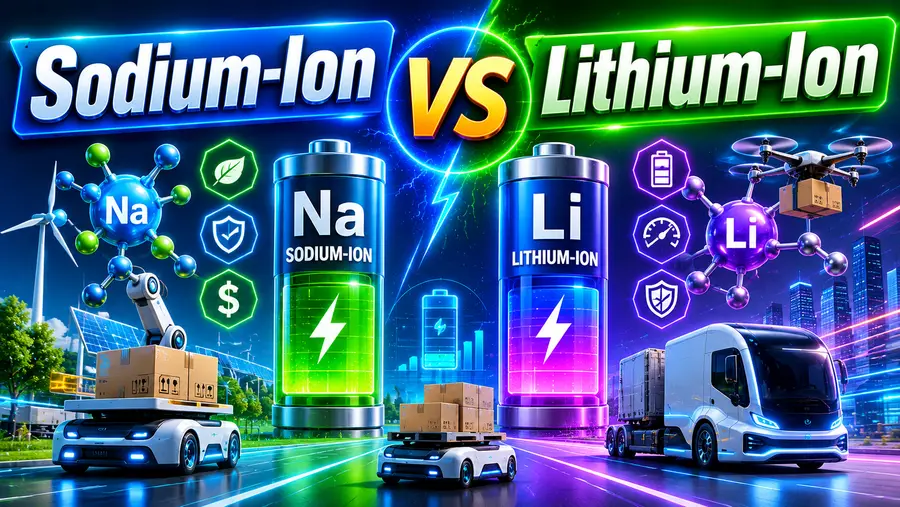
Sodium-Ion vs. Lithium-Ion: Which is Best for Autonomous Logistics in 2026?
In 2026, the winner between sodium-ion and lithium-ion depends entirely on the specific type of autonomous vehicle you are deploying.
Sodium-ion (Na-ion) is rapidly capturing the indoor and cold-chain warehouse market—specifically Automated Guided Vehicles (AGVs), Autonomous Mobile Robots (AMRs), and automated forklifts. It wins here because of its unmatched cold-weather performance, high-speed opportunity charging, and superior safety profile.
However, Lithium-ion (both LFP and NMC chemistries) maintains an absolute monopoly on weight-sensitive, long-range systems like heavy Class 8 autonomous trucks and last-mile delivery drones, where maximizing volumetric and gravimetric energy density is the strict physical priority.
The year 2026 officially marks the massive inflection point for energy storage. Sodium-ion is no longer a laboratory experiment or a limited pilot program.
With mega-scale manufacturing agreements fully commercialized by industry titans like CATL—and massive real-world trials successfully executed by logistics giants like Jungheinrich—sodium-ion has entered full commercial mass production.
Procurement managers must now treat sodium-ion not as a future technology, but as a viable, active alternative that fundamentally shifts the Total Cost of Ownership (TCO) for automated fleets.
The Technical Matrix: 2026 Battery Performance Benchmarks
To make an informed decision for your logistics fleet, you must evaluate the raw data. The table below represents the commercial reality of battery chemistries actively coming off the production lines in 2026. This data bypasses marketing hype to show exactly where each chemistry excels and where it falls short.
| Performance Metric | Sodium-Ion (Na-Ion) | Lithium Iron Phosphate (LFP) | Lithium Nickel Manganese Cobalt (NMC) |
| Energy Density | 100–175 Wh/kg | 150–210 Wh/kg | 240–350 Wh/kg |
| Lifecycles (2026 Data) | 4,000 – 6,000+ cycles | 3,000 – 6,000 cycles | 1,000 – 2,000 cycles |
| Fast Charging Capacity | Ultra-Fast (Up to 5C rate) | Moderate (1C–2C rate) | High (2C–3C rate) |
| Operating Temp Range | Extreme (-40°C to 70°C) | Moderate (-20°C to 60°C) | Narrow (-20°C to 55°C) |
| Thermal Runaway Risk | Extremely Low (Passes 300°C) | Low | Moderate to High |
| Raw Material Cost | Highly Stable / Very Low | Fluctuating / Moderate | Highly Volatile / Expensive |
| Zero-Volt Transport | Yes (No degradation at 0V) | No (Permanent cell death at 0V) | No (Permanent cell death at 0V) |
This technical matrix reveals a critical truth: energy density is not the only metric that matters. For warehouse automation, operational parameters like charge rates, lifecycle endurance, and thermal resilience consistently outweigh the need for lightweight cells.
Deep Dive: Why Sodium-Ion is Disrupting Warehouse Automation (AGVs & AMRs)
The indoor logistics sector—warehouses, distribution centers, and manufacturing floors—is experiencing the most aggressive adoption of sodium-ion technology in 2026. The reasons are entirely structural and operational. For AGVs, AMRs, and automated forklifts, the traditional “drawbacks” of sodium-ion either do not matter or are actively advantageous.
The 5C Opportunity Charging Edge
In a modern, highly automated 24/7 fulfillment center, robots do not have the luxury of taking eight-hour breaks to recharge.
Modern fleets utilize opportunity charging. This means the robot docks into a charging station for brief, high-power bursts—sometimes just 5 to 10 minutes—while waiting for a new task, loading a pallet, or during short shift handovers.
Lithium-ion batteries (particularly LFP) can struggle under these conditions over time. Constantly pushing high currents (high C-rates) into a lithium cell generates significant heat and can accelerate lithium plating on the anode, severely degrading the battery’s lifespan.
Sodium-ion chemistry fundamentally solves this bottleneck. Because sodium ions transfer efficiently without the same risk of destructive plating, commercial sodium-ion batteries in 2026 can comfortably handle charge rates up to 5C. This means a depleted AMR battery can rocket from 10% to 80% state-of-charge in under 15 minutes, doing so continuously without degrading the core cell architecture.
This ultra-fast opportunity charging allows fleet managers to run smaller total fleets, as fewer robots are sidelined at charging stations at any given moment.
Weight as a Counterweight: Flipping the Script
The most frequently cited criticism of sodium-ion is its lower energy density (100–175 Wh/kg). Put simply, a sodium battery is heavier and larger than a lithium battery holding the exact same amount of energy.
In passenger electric vehicles, this is a distinct disadvantage. But in heavy logistics, this perceived flaw becomes an engineering asset.
Automated forklifts, reach trucks, and heavy-duty AGVs physically require immense weight in their chassis to act as a counterweight. When a robotic forklift lifts a two-ton pallet of goods 20 feet into the air, it must have thousands of pounds of ballast at its base to prevent the machine from tipping forward.
Historically, manufacturers used massive lead-acid batteries, or they used lightweight lithium-ion batteries and bolted giant slabs of dead iron into the frame to make up the difference.
Sodium-ion is the perfect Goldilocks solution. Its naturally heavier footprint acts as the necessary functional counterweight, perfectly balancing the load without the need for expensive, useless dead weight. It aligns the physical mass of the energy storage directly with the mechanical requirements of the vehicle.
Zero-Volt Transport Safeties and Hazmat Bypass
Transporting lithium-ion batteries is a logistical nightmare. Because lithium cells become highly unstable if discharged below a certain voltage, they must be shipped at a partial state of charge (usually around 30%). This makes them “live” cargo, subjecting them to strict, highly expensive international Hazmat (hazardous materials) shipping regulations, specialized packaging, and complex warehousing insurance requirements.
Sodium-ion breaks this paradigm completely. Due to the stability of the aluminum current collectors used on both the anode and the cathode, a sodium-ion battery can be fully discharged to Zero Volts (0V) without sustaining any internal chemical damage or risk of short-circuiting.
For logistics operators in 2026, this is revolutionary. You can ship a multi-megawatt container of sodium-ion replacement batteries for your AGV fleet entirely dead. They are essentially inert metal boxes during transit. This bypasses the most stringent Hazmat shipping classifications, massively reduces freight costs, lowers insurance premiums, and dramatically simplifies how spare batteries are stored in warehouse racks.
Where Lithium-Ion Remains Unbeatable: Long-Haul and Airborne Autonomy
Despite the rapid rise of sodium-ion, it is not a universal replacement for all autonomous logistics. When the vehicle leaves the controlled environment of a warehouse and enters the open road or the sky, physics dictates that energy density reigns supreme.
In these sectors, Lithium-ion—specifically Lithium Iron Phosphate (LFP) and high-density Lithium Nickel Manganese Cobalt (NMC)—remains the undisputed king in 2026.
The Volumetric Density Challenge for Class 8 Autonomous Trucks
For a heavy-duty, long-haul autonomous truck moving freight across interstate highways, space and weight are the absolute limiters of profitability.
In the trucking industry, there are strict legal limits on total vehicle weight. Every kilogram dedicated to the battery is a kilogram that cannot be used for paying freight.
Furthermore, volumetric density (energy per liter of space) is critical. Class 8 trucks have a finite amount of frame space between the axles to mount battery packs.
A sodium-ion battery pack required to push a fully loaded 80,000-pound truck for 500 miles would simply be too massive to physically fit within the standard dimensions of the truck chassis.
Modern LFP chemistries (now easily exceeding 200 Wh/kg at the cell level) and solid-state or advanced NMC packs (pushing 350 Wh/kg) provide the necessary range in a package small and light enough to keep the freight operation profitable.
Until sodium-ion can double its current energy density, it will not compete in the long-haul trucking sector.
Payload-to-Weight Ratios in Last-Mile Drones
The last-mile delivery drone market is arguably the most weight-sensitive logistics sector in existence. For an autonomous quadcopter delivering medical supplies or retail packages, gravity is the primary adversary.
Every single gram counts. The payload-to-weight ratio dictates everything from flight time to motor strain to regulatory compliance.
Sodium-ion’s bulkier footprint makes it functionally impossible for aerial drone logistics in 2026. A drone requires the absolute maximum energy squeezed into the absolute lightest package to maintain lift and fight wind resistance.
In this space, high-nickel NMC lithium-ion batteries are the only scientifically viable choice, delivering the high voltage and ultra-lightweight characteristics required for sustained autonomous flight.
Cold Chain & Outdoor Logistics: The Sub-Zero Performance Factor
One of the most profound shifts in 2026 logistics is how sodium-ion is transforming cold-chain automation. Operating robots in deep-freeze environments has historically been the bane of battery engineers.
The Refrigerated Warehouse Dilemma
Inside a modern grocery fulfillment center or pharmaceutical distribution hub, ambient temperatures are strictly maintained well below freezing, often reaching -20°C or even -30°C.
Traditional lithium-ion batteries despise the cold. At these extreme sub-zero temperatures, the liquid electrolytes inside a lithium cell become sluggish, severely slowing down the transfer of lithium ions.
In a deep-freeze environment, an LFP or NMC battery can easily lose up to 40% of its operational capacity. To combat this, AGV manufacturers have been forced to build complex, energy-hungry internal battery heaters into their robots.
These heaters drain power from the battery just to keep the battery warm enough to function, resulting in abysmal overall efficiency and vastly reduced run times.
The Na-Ion Solution
Sodium-ion behaves entirely differently in the cold. The unique chemical properties of the sodium electrolyte allow it to maintain incredibly high ionic conductivity even as temperatures plummet.
According to real-world commercial data validated by major manufacturers like CATL and testing partners in 2026, a sodium-ion battery retains over 80% to 90% of its usable capacity at -40°C.
For autonomous cold-chain fleets, this is a massive operational breakthrough. Fleet operators can deploy sodium-ion powered AGVs directly into blast freezers and sub-zero storage facilities without needing auxiliary battery heaters.
This eliminates parasitic power draw, drastically simplifies the thermal management system (BMS) design of the robot, reduces the likelihood of mechanical failures, and ensures that the robot can work a full shift regardless of how cold the environment gets.
For outdoor autonomous yard trucks operating in harsh winter climates (such as Canada or the Nordic regions), sodium-ion is rapidly becoming the mandated standard.
Supply Chain Resilience and Total Cost of Ownership (TCO)
Beyond the technical specifications, the driving force behind the massive 2026 pivot toward sodium-ion in industrial logistics is financial predictability and supply chain security. Procurement managers are looking closely at how global geopolitics affect their autonomous fleets.
Geopolitical De-risking and Material Abundance
The lithium-ion supply chain is highly fragile and heavily concentrated. Mining and refining lithium, cobalt, and nickel are geographically bottlenecked, making the prices of these raw materials highly susceptible to geopolitical tensions, trade tariffs, and sudden supply shocks.
Sodium-ion inherently de-risks the supply chain. The primary ingredient is sodium carbonate (soda ash). Sodium is the sixth most abundant element in the Earth’s crust and can be easily extracted from seawater or common rock salt. It is literally over 1,000 times more abundant than lithium.
Furthermore, sodium-ion cells do not use copper for the anode current collector (replacing it with much cheaper aluminum) and completely eliminate the need for controversial elements like cobalt and nickel.
For logistics companies scaling up fleets of thousands of autonomous robots, this material abundance guarantees that they will not face battery shortages or massive price spikes if a geopolitical crisis disrupts the global lithium trade.
The Upfront vs. Lifecycle Cost Analysis
As of 2026, the massive gigafactories built by companies like CATL and BYD have reached the economies of scale necessary to bring sodium-ion to its projected cost floor.
At the cell manufacturing level, sodium-ion is roughly 30% to 40% cheaper to produce than comparable LFP lithium-ion cells. The raw materials cost a fraction of their lithium counterparts (soda ash trades for a few hundred dollars a ton, whereas lithium carbonate historically fluctuates by tens of thousands of dollars).
When evaluating the Total Cost of Ownership (TCO) for a warehouse fleet, sodium-ion presents a compelling business case. Not only is the upfront capital expenditure (CAPEX) lower, but the operational expenditure (OPEX) drops significantly.
The combination of 5C fast-charging (requiring fewer backup batteries), 4,000 to 6,000 cycle lifespans, zero-volt shipping logistics, and the elimination of thermal management heaters in cold environments drives a projected Return on Investment (ROI) that drastically outpaces legacy lithium systems for indoor applications.
FAQs: Na-Ion vs. Li-Ion
As logistics managers navigate this transition in 2026, several common questions arise regarding integration, safety and cost. Here are the definitive answers.
Can I drop sodium-ion batteries directly into my existing Lithium-ion AGV fleet?
Physically, yes, but digitally, it requires adaptation. Sodium-ion packs can be built into the exact same dimensions and weight profiles as your legacy batteries, allowing for a physical “drop-in” replacement. However, sodium-ion batteries have a different voltage curve than lithium-ion. Therefore, you cannot simply swap the battery without updating the firmware on the robot’s Battery Management System (BMS) and the external charging docks so they understand the new voltage parameters and State of Charge (SOC) algorithms.
Is sodium-ion actually cheaper than Lithium Iron Phosphate (LFP) in 2026?
Yes, decisively. While intense competition and overcapacity briefly drove LFP prices to record lows in 2024 and 2025, the underlying raw materials for sodium (soda ash and aluminum) are fundamentally cheaper to extract and refine than lithium and copper. With massive gigafactories achieving full scale in 2026, sodium-ion has officially broken below the cost floor of LFP, offering a structurally cheaper product immune to lithium price volatility.
How do the safety features of sodium-ion compare to lithium in automated facilities?
Sodium-ion is vastly superior in high-density warehouse environments. It has a much higher thermal runaway threshold. In penetration tests, crush tests, and extreme overcharging scenarios where a standard lithium-ion battery would catch fire, sodium-ion cells generally only vent gas without sparking a catastrophic fire. This drastically reduces the fire mitigation infrastructure and insurance premiums required for massive indoor robotic fleets.
What is the typical cycle life of a commercial sodium-ion battery today?
As of 2026, commercial tier-one sodium-ion batteries reliably achieve 4,000 to 6,000+ deep charge cycles before degrading to 80% of their original capacity. This brings them entirely on par with standard LFP lithium batteries, ensuring that the battery will likely outlast the mechanical chassis of the AGV or forklift it is powering.
Does cold weather affect sodium-ion batteries the same way it affects lithium?
No. This is sodium’s greatest operational advantage. While lithium batteries can lose up to 40% of their capacity and suffer permanent damage when charged in freezing temperatures, sodium-ion batteries comfortably retain 80% to 90% of their capacity at -40°C. They can also accept a rapid charge in sub-zero environments without the lithium-plating damage that destroys standard batteries, making them the ultimate choice for cold-storage logistics and winter outdoor operations.
How do the end-of-life recycling processes compare for sodium-ion and lithium-ion batteries?
Sodium-ion is vastly easier, safer, and cheaper to recycle. Lithium-ion recycling is a complex, highly regulated process because of the toxicity of cobalt and the persistent fire risk if cells are not properly discharged. Sodium-ion batteries contain zero cobalt or nickel, and because they can be mechanically short-circuited to 0 Volts with zero risk of thermal runaway, they can be shipped safely to recycling centers as non-hazardous waste. The materials are then easily broken down using standard hydrometallurgical processes, driving a much more efficient circular economy.
Can sodium-ion batteries handle high-power demands during heavy lifting or sudden acceleration?
Yes. While sodium-ion has lower energy density (total storage capacity), it actually has an excellent power density (how fast it can release energy). The kinetics of sodium ions moving through the electrolyte allow for rapid bursts of current. This makes sodium-ion incredibly effective for automated forklifts and AMRs that require immediate, high-torque bursts of power to lift a two-ton pallet or accelerate a heavy load from a dead stop.
Does the larger size of sodium-ion batteries require larger charging stations in the warehouse?
Paradoxically, it usually shrinks your overall charging infrastructure footprint. Even though the physical battery inside the robot is slightly larger, sodium-ion’s ability to accept 5C ultra-fast charging means robots spend drastically less time docked. Because the turnaround time is so fast (under 15 minutes for a deep charge), warehouse managers can install fewer physical charging stations to service the same number of robots, freeing up valuable floor space.
How does the self-discharge rate of sodium-ion compare to lithium-ion during periods of fleet inactivity?
Both sodium-ion and lithium-ion chemistries boast an incredibly low self-discharge rate of roughly 1% to 2% per month. If you have to sideline a portion of your AGV fleet during a slow logistical season, a sodium-ion battery will retain its charge safely on the shelf for months, ready to be deployed without needing constant trickle-charging to keep the cells healthy.
How does transitioning to sodium-ion impact corporate ESG (Environmental, Social, and Governance) targets?
For major logistics and retail companies aiming for strict 2030 sustainability goals, sodium-ion is a massive strategic advantage. Lithium mining is highly water-intensive (often depleting local water tables) and relies on concentrated supply chains, while cobalt mining is historically tied to severe human rights and labor violations. Sodium, extracted primarily from abundant sea salt and soda ash, has a fraction of the ecological footprint. Switching a warehouse fleet to sodium-ion drastically cleans up Scope 3 supply chain emissions and instantly eliminates the ethical liabilities tied to heavy-metal extraction.
References
- Bača, P., Libich, J., Gazdošová, S., & Polkorab, J. (2025). Sodium-Ion Batteries: Applications and Properties. Batteries, 11(2), 61. https://doi.org/10.3390/batteries11020061
- Carvalho, M. L., Mela, G., Temporelli, A., Brivio, E., & Girardi, P. (2022). Sodium-Ion Batteries with Ti1Al1TiC1.85 MXene as Negative Electrode: Life Cycle Assessment and Life Critical Resource Use Analysis. Sustainability, 14(10), 5976. https://doi.org/10.3390/su14105976
- Kim, H. (2023). Sodium-Ion Battery: Can It Compete with Li-Ion?. ACS Materials Au, 3(6), 571-575. https://doi.org/10.1021/acsmaterialsau.3c00049
- Nekahi, A., Dorri, M., Rezaei, M., Bouguern, M. D., Madikere Raghunatha Reddy, A. K., Li, X., Deng, S., & Zaghib, K. (2024). Comparative Issues of Metal-Ion Batteries toward Sustainable Energy Storage: Lithium vs. Sodium. Batteries, 10(8), 279. https://doi.org/10.3390/batteries10080279
- Smith, D., Ozpineci, B., Graves, R., Jones, P. T., Lustbader, J., Kelly, K., Walkowicz, K., Birky, A., Payne, G., Sigler, C., & Mosbacher, J. (2020). Medium- and Heavy-Duty Vehicle Electrification: An Assessment of Technology and Knowledge Gaps. Office of Scientific and Technical Information (OSTI). https://doi.org/10.2172/1615213
- Zhao, Y., Zhang, Z., Zheng, Y., Luo, Y., Jiang, X., Wang, Y., Wang, Z., Wu, Y., Zhang, Y., Liu, X., & Fang, B. (2024). Sodium-Ion Battery at Low Temperature: Challenges and Strategies. Nanomaterials, 14(19), 1604. https://doi.org/10.3390/nano14191604
Read Here: Top 10 Emerging Technology Trends You Need to Know