Wondering if your VPN is quantum-safe? Start by checking whether it supports post-quantum cryptography (PQC) or hybrid cryptographic algorithms designed to resist future quantum attacks. Review your VPN provider’s encryption standards, key exchange methods, and roadmap for quantum-resistant security. Testing PQC readiness helps identify potential vulnerabilities before quantum computers become practical threats. Organizations that assess and upgrade VPN security today can better protect sensitive data, ensure compliance, and strengthen long-term cyber resilience.
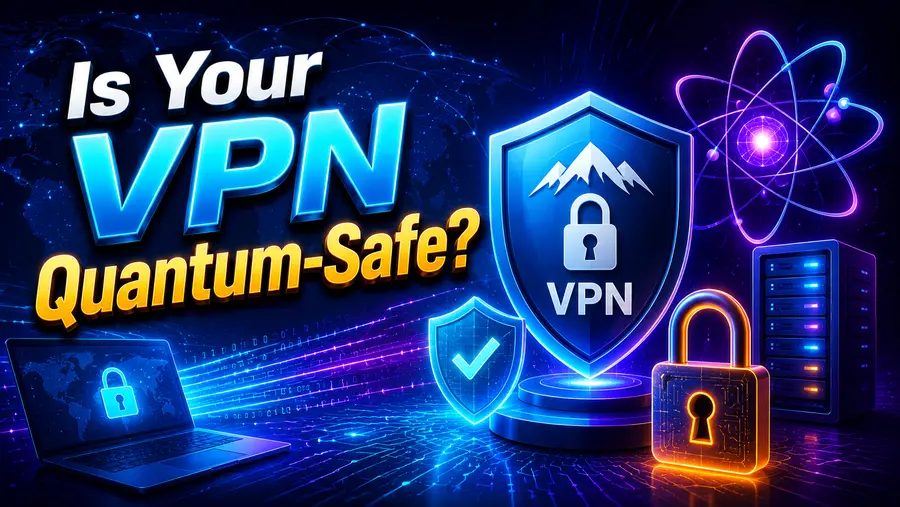
Is Your VPN Quantum-Safe? Testing Post-Quantum Cryptography (PQC) Readiness
Over 99% of commercial and enterprise VPNs currently deployed are not quantum-safe because their connection handshakes still rely on classical public-key cryptography like RSA or Elliptic Curve Cryptography (ECC).
A Post-Quantum Cryptography (PQC) VPN is one that has upgraded its foundational key exchange protocols to utilize mathematical models—like the NIST-standardized ML-KEM algorithm—that are inherently resistant to quantum decryption.
However, building a true quantum-safe VPN does not mean throwing away current security models. It requires implementing a hybrid key encapsulation mechanism. This hybrid approach pairs a proven classical algorithm with a new post-quantum algorithm, securing the initial handshake against both current software exploits and the looming threat of future quantum computers.
The Core Vulnerability: Why Modern VPNs Will Fail
Virtual Private Networks (VPNs) are the backbone of remote corporate access and individual online privacy. To understand why they are vulnerable, you have to look under the hood at how a VPN establishes a secure connection.
The Handshake Flaw
When you connect to a VPN, two distinct cryptographic phases occur:
- The Handshake: Your device and the VPN server use asymmetric public-key cryptography (usually RSA or Diffie-Hellman/ECDH) to securely agree on a secret, temporary key.
- The Tunnel: Once that secret key is established, both sides use symmetric cryptography (like AES-256 or ChaCha20) to encrypt the actual data flowing back and forth.

The symmetric encryption (AES-256) used in the tunnel is already considered highly resistant to quantum attacks. The critical vulnerability lies entirely in the handshake.
If an attacker with a Cryptographically Relevant Quantum Computer (CRQC) can break the initial RSA or ECDH handshake, they can extract the symmetric AES key. Once they have that key, the entire secure tunnel is compromised, and all data within it becomes readable text.
The “Harvest Now, Decrypt Later” Threat Vector
You might think, “Quantum computers capable of doing this don’t exist yet, so why worry?” The danger is not that your VPN will be hacked tomorrow; the danger is “Harvest Now, Decrypt Later” (HNDL).
Nation-state threat actors and sophisticated cybercriminal syndicates are currently intercepting and storing massive volumes of encrypted VPN traffic. They cannot read this data today. Instead, they are stockpiling it in massive data centers. Their strategy is to hold onto this encrypted traffic until a CRQC is developed—perhaps in 5 to 10 years. Once the hardware catches up, they will use Shor’s algorithm to retroactively break the recorded handshakes, decrypt the AES keys, and read every single packet of your historical corporate communications, trade secrets, and personal data.
Traditional OpenVPN and standard WireGuard configurations are fully exposed to this threat vector today.
The New Standards: What Makes a VPN “Quantum-Safe”?
A VPN cannot just declare itself “quantum-safe” as a marketing gimmick. To achieve genuine post-quantum security, the underlying protocol must integrate specific algorithms standardized by the National Institute of Standards and Technology (NIST).
The NIST Post-Quantum Standards
After years of rigorous global testing, NIST finalized the cryptographic algorithms that will secure the next generation of network traffic:
- ML-KEM (FIPS 203): Originally known as CRYSTALS-Kyber, this is a Module-Lattice-Based Key Encapsulation Mechanism. It is the primary algorithm used to securely establish a shared secret over a public network. Its security relies on the “Module Learning with Errors” (MLWE) mathematical problem, which involves finding a secret vector hidden in a noisy, high-dimensional grid. Neither classical nor quantum computers currently possess an efficient way to solve this.
- ML-DSA (FIPS 204): A digital signature algorithm used for authentication, ensuring that the server your VPN client is talking to is actually the genuine server and not a Man-in-the-Middle (MitM).
The Hybrid Protocol Strategy
Transitioning to a quantum-safe VPN is not an abrupt switch. The industry standard is to use a Hybrid Key Exchange.
In a hybrid setup, the VPN client and server execute both a classical handshake (like X25519) and a post-quantum handshake (like ML-KEM) simultaneously. Both secrets are then mathematically combined to create the final encryption key.
| Feature | Classical VPN | Hybrid Post-Quantum VPN |
| Key Exchange | ECDH / X25519 | X25519 + ML-KEM |
| Data Encryption | AES-256 / ChaCha20 | AES-256 / ChaCha20 |
| Quantum Threat | Vulnerable to HNDL | Secure against HNDL |
| Compliance | FIPS 140-2 | Maintains FIPS compliance while adding PQC |
This hybrid strategy acts as an insurance policy. If cryptographers discover an unforeseen mathematical flaw in the newly minted ML-KEM algorithm a year from now, the VPN tunnel remains completely secure because the classical X25519 algorithm is still enforcing the encryption.
Step-by-Step Guide: How to Test Your VPN’s PQC Readiness
Evaluating whether your corporate network or commercial VPN provider is truly quantum-safe requires methodical testing. You must look beyond vendor claims and inspect the actual network traffic.
Inventory Current VPN Protocols and Cipher Suites:
Audit your infrastructure.Begin by mapping exactly what protocols your organization relies on. Check your firewall and remote-access gateways. Are you terminating connections using OpenVPN, IPsec/IKEv2, or WireGuard? Look at the specific cipher suites enabled on your VPN server. If you see suites relying solely on RSA, DHE, or ECDHE, your connection is entirely classical and vulnerable to future decryption.
Check Vendor Technical Documentation for a PQC Roadmap:
Review your VPN vendor’s current capabilities. Do they support hybrid key exchanges? If you use a commercial VPN, check if their proprietary protocols (like ExpressVPN’s Lightway or NordVPN’s NordLynx) have been explicitly updated to support ML-KEM or Kyber. For enterprise hardware, check the firmware release notes from vendors like Cisco, Palo Alto, or Fortinet for experimental PQC support.
Establish a PQC Testbed Environment:
Do not test in production. Because PQC algorithms are still relatively new and can cause network instability due to packet size, you must build an isolated staging area. Use Docker containers or isolated virtual machines. The most reliable way to test PQC is to use the Open Quantum Safe (OQS) project. Install the liboqs library and use OQS-OpenSSL to emulate a quantum-safe VPN client and server locally.
Execute Handshake Wireshark Analysis:
Launch a passive network sniffer (like Wireshark) on your testbed. Initiate a connection between your PQC VPN client and server. Filter the Wireshark capture for the TLS handshake or the specific UDP ports your VPN uses. You are looking for the “Client Hello” and “Server Hello” packets. Inspect the Key Share extensions in the packet details. You should see indicators of hybrid negotiation, specifically parameters combining classical curves with ML-KEM (e.g., X25519Kyber768Draft00 or similar OQS identifiers).
Run Network Performance and Latency Benchmarks:
Test for fragmentation. The mathematical complexity of PQC comes with a cost. Run heavy traffic loads through your PQC testbed using tools like iperf3. Measure the connection establishment time (how long the handshake takes) and monitor for dropped packets. Because ML-KEM keys are physically larger than classical keys, they can exceed the Maximum Transmission Unit (MTU) of standard network paths, causing UDP packet fragmentation. Adjust your MTU settings during testing to find the optimal balance between stability and quantum security.
Read Here: How to Upgrade to Post-Quantum Cryptography Using AWS Key Management Service
Current Landscape: Who Supports Post-Quantum VPNs Right Now?
The transition to PQC is moving rapidly. Both open-source communities and commercial providers are racing to implement these standards.
Open Source Frameworks
- Open Quantum Safe (OQS): Backed by the Linux Foundation, OQS is the gold standard for PQC research. Their liboqs library provides a C-based implementation of ML-KEM and ML-DSA. They actively maintain forks of OpenSSL and OpenSSH, making it the easiest way for engineers to prototype quantum-safe tunnels.
- WireGuard PQC Experiments: WireGuard intentionally avoids “protocol agility” (the ability to negotiate different ciphers) to reduce its attack surface, making it difficult to upgrade to PQC natively. However, researchers are successfully testing Post-Quantum WireGuard by leveraging WireGuard’s existing Pre-Shared Key (PSK) feature, delivering quantum-resistant PSKs over an out-of-band ML-KEM connection.
Enterprise & Commercial Solutions
- ExpressVPN (Lightway): ExpressVPN has integrated post-quantum protection directly into its custom Lightway protocol (which was rewritten in Rust for better performance and security). It uses ML-KEM by default alongside classical algorithms to shield users from HNDL attacks.
- Zscaler Internet Access (ZIA): Zscaler provides inline inspection of PQC traffic, automatically recognizing and negotiating hybrid PQC key-encapsulation mechanisms (like ML-KEM) in TLS handshakes.
- Tailscale: Tailscale, which is built on WireGuard, acknowledges the quantum threat. While not natively post-quantum yet, their roadmap involves building automatic PQC-secured provisioning of Pre-Shared Keys to make their mesh networks quantum-safe out of the box in the future.
Performance Bottlenecks: The Reality of Testing PQC VPNs
While the mathematics behind ML-KEM are secure, the physical reality of moving these keys across the internet introduces significant engineering challenges.
The Fragmentation Problem
Classical elliptic curve (ECC) public keys are incredibly small—usually around 32 bytes. An ML-KEM-768 public key is 1,184 bytes, and the resulting ciphertext is 1,088 bytes.
When a VPN attempts to send a handshake packet containing these massive keys, the packet often exceeds the standard Ethernet MTU limit of 1,500 bytes. To compensate, the router must slice the packet into smaller fragments (packet fragmentation). Over unreliable networks like public Wi-Fi or cellular data, if even one of those fragments drops, the entire handshake fails. This can lead to frequent connection timeouts and an unstable VPN experience.
Handshake Latency
While the actual computation of ML-KEM on a modern CPU is surprisingly fast, the sheer volume of data that must be transmitted back and forth increases the round-trip time (RTT). In a hybrid scenario where the VPN is computing both X25519 and ML-KEM, users connecting from high-latency environments (like satellite internet or rural mobile networks) will notice a measurable delay when initially connecting to the VPN server, often adding 15 to 30 milliseconds to the connection time.
Read Here: How to Implement Agentic SRE on AWS: Step-by-Step Guide
FAQs
Do I need to replace my VPN if it already uses AES-256?
Yes. While AES-256 is quantum-resistant for encrypting the data payload, the initial handshake that creates the AES-256 key likely relies on vulnerable RSA or ECDH mathematics. If an attacker records the handshake today, they can break it in the future, extract the AES key, and decrypt your data.
What is a hybrid post-quantum VPN?
A hybrid post-quantum VPN uses two different cryptographic algorithms simultaneously to secure its handshake: a proven classical algorithm (like X25519) and a new post-quantum algorithm (like ML-KEM). This ensures the connection is secure against both current, known vulnerabilities and future quantum computer attacks.
Can a quantum computer break OpenVPN today?
No. There is currently no publicly known quantum computer powerful enough to break OpenVPN’s cryptography. The threat is not immediate decryption; the threat is the “Harvest Now, Decrypt Later” strategy, where adversaries record your encrypted traffic today to decrypt it years from now when the hardware catches up.
Does WireGuard support post-quantum cryptography natively?
No, standard WireGuard does not natively support post-quantum cryptography. WireGuard was designed to have a fixed, non-negotiable cryptographic suite to minimize security flaws. To make WireGuard quantum-safe, organizations must manually distribute Pre-Shared Keys (PSKs) using a separate, quantum-safe distribution channel (like a PQC-enabled TLS connection).
How do larger PQC key sizes affect mobile VPN users?
The massive size of PQC keys (like ML-KEM) can cause significant issues for mobile users. The large keys often cause network packet fragmentation. When a user is on an unstable 4G/5G cellular network, fragmented packets are frequently dropped. This results in the VPN struggling to establish a connection, increased battery drain as the device repeatedly attempts to reconnect, and noticeable latency during the initial handshake.
Do I need to upgrade my firewall or router hardware for a quantum-safe VPN?
In most cases, a firmware or software update is sufficient, rather than a full hardware replacement. However, older network appliances with limited CPU power or strict Maximum Transmission Unit (MTU) limitations might struggle to process the larger post-quantum keys. If you manage a high-throughput enterprise network, you may need to plan a hardware refresh to prevent CPU bottlenecks when processing thousands of simultaneous ML-KEM handshakes.
How does post-quantum cryptography affect IPsec and IKEv2 site-to-site VPNs?
To make IPsec VPNs quantum-safe, the Internet Key Exchange (IKEv2) protocol must be updated to support hybrid key exchanges (specifically referencing RFC 9370). While TLS-based client VPNs (like OpenVPN) are rapidly adopting ML-KEM, the IETF standards for integrating PQC into IPsec are slightly further behind, meaning traditional site-to-site hardware VPNs may take longer to fully transition.
What is the official deadline for organizations to adopt post-quantum VPNs?
For US federal agencies and defense contractors, the NSA’s Commercial National Security Algorithm Suite 2.0 (CNSA 2.0) mandates that software and firmware (including VPNs) must support post-quantum algorithms by 2030, with full, exclusive implementation required by 2033. Private enterprises and financial institutions are strongly encouraged to align with this timeline to mitigate the immediate “harvest now, decrypt later” threat.
Does the new ML-KEM algorithm provide Perfect Forward Secrecy (PFS)?
Yes, when implemented correctly, ML-KEM provides Perfect Forward Secrecy. Just like the classical ephemeral Diffie-Hellman (ECDHE) protocol, ML-KEM can generate fresh, temporary key pairs for every single VPN session. This ensures that even if a long-term identity key is compromised in the future, past VPN tunnel sessions remain mathematically impossible to decrypt.
Are consumer VPNs upgrading to post-quantum cryptography faster than enterprise VPNs?
Yes, several top-tier consumer VPNs (like ExpressVPN and Mullvad) have deployed hybrid post-quantum protocols faster than traditional enterprise hardware vendors (like Cisco or Palo Alto). This is because consumer VPNs often use custom, agile software protocols (like Lightway) and control both the client app and the server, allowing them to push PQC updates globally without waiting for slow enterprise hardware validation and certification cycles.
Read Here: Microsoft Purview vs AWS Macie: Which is Best for AI Data Governance?