Max Weber explained power through three key dimensions: class, status, and party. Class refers to economic position and life chances. Status relates to social prestige and honor. The party represents organized political power and influence.
These dimensions show that power is not based on wealth alone but also on social recognition and political participation in society.
Let us explain in detail Max Weber’s view on class, status and party as source of power.
Understanding Weber’s View on Class, Status and Party as Source of Power
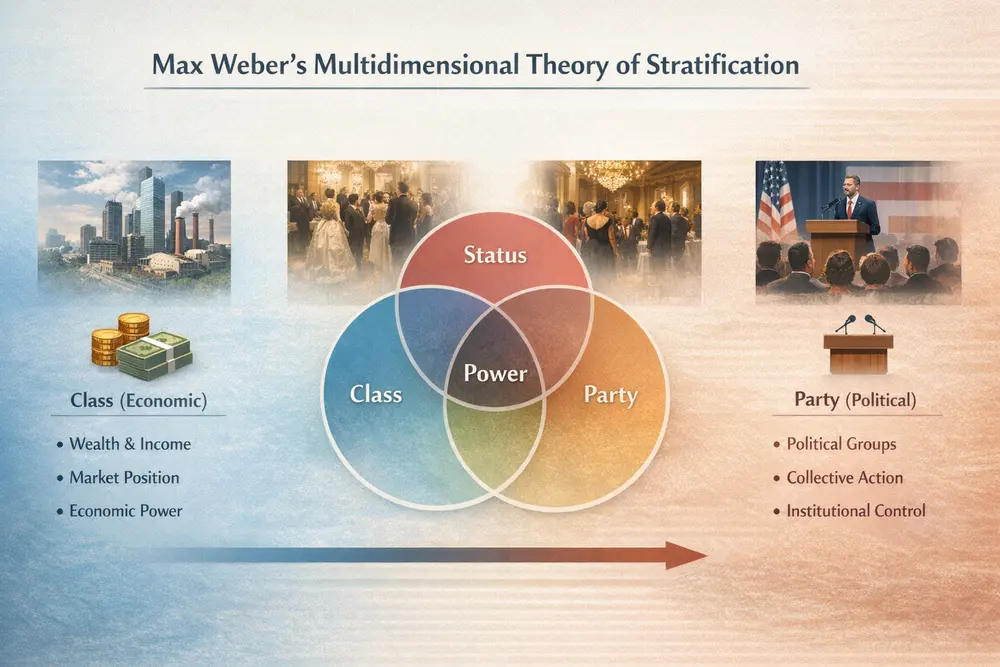
Max Weber’s Multidimensional Theory of Stratification
Max Weber offers a nuanced understanding of power in society by moving beyond a single economic explanation.
While earlier thinkers focused mainly on wealth such as Karl Marx, Weber argued that power operates through multiple dimensions. He identified class, status, and party as three distinct but interconnected sources of power. Each of these reflects a different way individuals and groups gain influence in society.
Class relates to economic position, status refers to social honor and prestige, and party represents organized political power.
Weber’s framework helps us understand why people with similar wealth may still have different levels of influence. It also explains how power is distributed across social, cultural, and political spheres. His ideas remain relevant in analyzing modern societies, where economic success alone does not guarantee authority or respect.
This multi-dimensional approach makes Weber’s theory both flexible and deeply insightful.
Class as a Source of Power
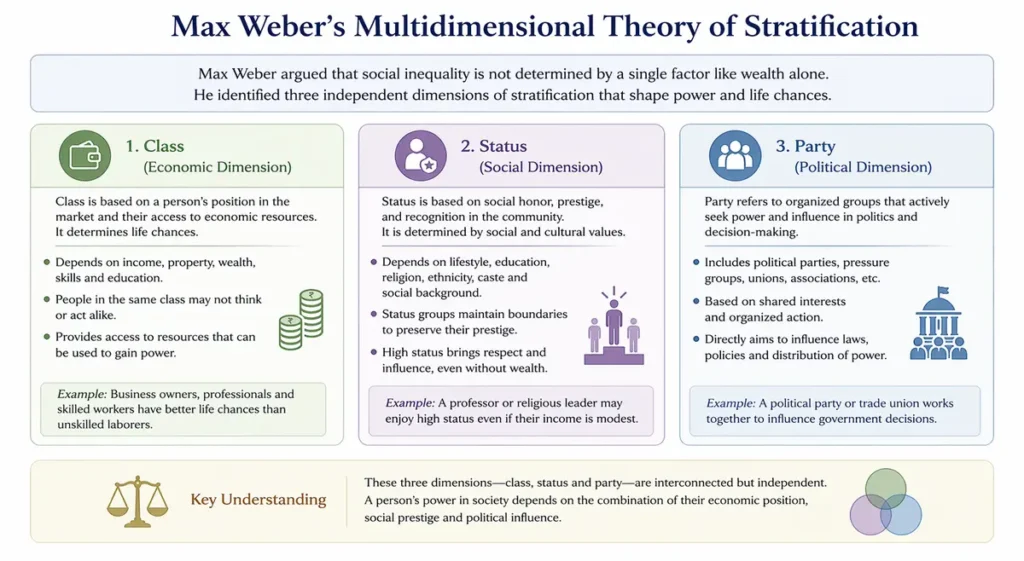
Weber defines class in terms of an individual’s position in the economic market. It is not simply about income, but about life chances, meaning the opportunities people have to improve their lives. These chances depend on access to resources such as education, skills, and property.
People who own wealth or possess valuable skills have better opportunities compared to those who rely only on labor.
Unlike some earlier theories, Weber does not see class as a fixed or unified group. Instead, he argues that classes are categories of people who share similar economic situations. They may not always act together or have a shared identity. For example, two individuals may belong to the same economic class but have different goals and interests.
Class becomes a source of power because it determines access to economic resources. These resources allow individuals to influence decisions and shape their environment. However, Weber emphasizes that economic power alone is not sufficient to explain all forms of social inequality.
Status as a Source of Power
Status refers to the level of social honor or prestige that a person or group holds in society. Unlike class, which is based on economic factors, status is shaped by cultural values, lifestyle, education, and social recognition. People with high status are respected and often admired, even if they are not the wealthiest.
Weber explains that status groups maintain their position by creating social boundaries. They may follow specific customs, dress codes, or behaviors that distinguish them from others. For example, certain professions or communities may enjoy higher prestige due to their perceived importance or cultural value.
Status becomes a source of power because it influences how others treat an individual. High-status individuals are more likely to be heard, trusted, and followed. This gives them an advantage in social interactions and decision-making processes.
Importantly, status can sometimes outweigh class. A person may have wealth but lack respect, while another may have modest income but enjoy high social prestige.
Party as a Source of Power
Party, in Weber’s framework, refers to organized groups that aim to achieve power within a political system. These groups are not limited to formal political parties; they include any organization that seeks to influence decisions, such as unions, associations, or pressure groups.
Unlike class and status, which are based on social and economic positions, party is about active participation in power struggles. It involves strategy, leadership, and collective action. Members of a party work together to achieve specific goals, often by controlling or influencing policies and governance.
Party becomes a powerful source of authority because it directly engages with decision-making processes. Through organization and coordination, parties can shape laws, policies, and public opinion.
Weber highlights that individuals from different classes and status groups can come together within a party if they share common interests.
Thus, the party represents the most direct form of power, as it operates within the political sphere and actively seeks to control or influence the distribution of authority in society.
Read Here: The Dynamics of Power in Local Communities
Interrelation of Class, Status, and Party
Max Weber emphasized that class, status, and party are distinct yet interconnected dimensions of power. These dimensions overlap in practice but remain analytically separate. For example, a wealthy entrepreneur may hold significant economic power (class) but lack elite cultural prestige (status).
However, by entering political office or joining influential organizations, the same individual can acquire authority through party affiliation. This illustrates how power in modern societies cannot be reduced to a single factor.
Instead, Weber’s framework highlights the complex interplay of economic resources, social esteem, and political organization in shaping stratification and authority across communities.
Read Here: Sovereignty: Its Characteristics and Dynamics
Conclusion
Weber’s Three Dimensions of Power
Class
Weber defined class by economic position. It is determined by one’s market situation — ownership of property and marketable skills. Class shapes life chances but does not automatically create group identity.
Status
Status refers to social honour and prestige. It is based on lifestyle, education, and social esteem. Unlike class, status groups share a strong collective identity and distinct way of life.
Party
Parties operate within the political sphere. They are organised groups that deliberately pursue power and influence. Parties may draw members across class and status lines.
Synthesis
Weber argued these three dimensions are analytically distinct yet interconnected. Together, they provide a comprehensive framework for understanding the distribution of power in society.
Read Here: Legitimacy and Its Various Bases