The state provides governance, law, and institutional order, while civil society promotes participation, accountability, and representation. Civil society acts as a bridge between citizens and the state, ensuring that public interests are voiced and protected. At the same time, the state regulates and collaborates with civil society. Together, they shape a balanced, responsive, and inclusive democratic system.
Explore the dynamic relationship between the state and civil society in a democracy, highlighting their roles in governance, accountability, participation, and the balance needed for a strong and responsive political system.
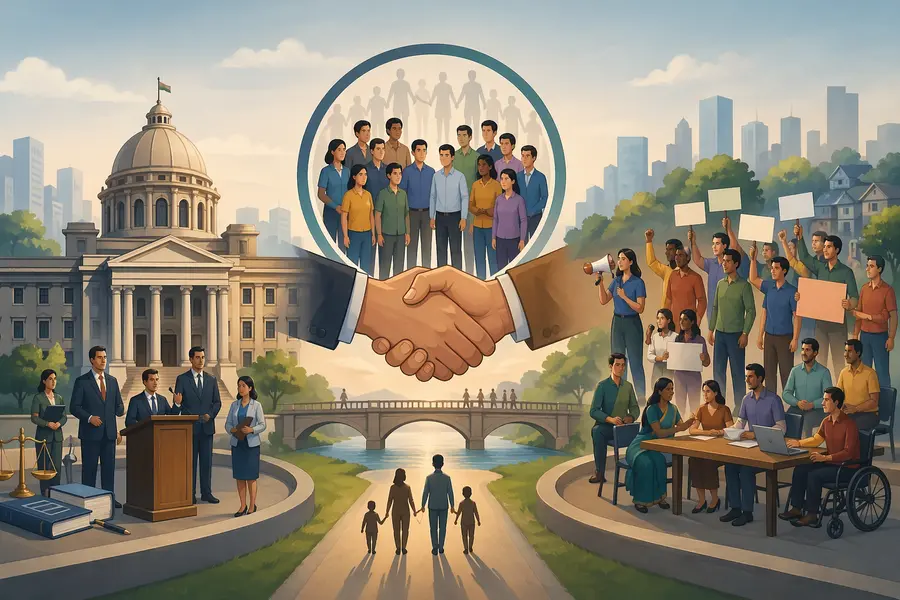
Elucidating the Relationship between State and Civil Society in Democracy
Examining the relationship between the state and civil society is important because it shapes how power is exercised, controlled, and legitimized in modern political systems.
A strong interaction between them helps ensure transparency, citizen participation, and responsive governance. At the same time, tensions may arise when civil society challenges state policies or authority.
Therefore, the relationship between the state and civil society in a democracy is dynamic and interdependent, marked by cooperation, conflict, and mutual accountability, all of which are essential for the healthy functioning and stability of democratic systems.
Conceptual Foundations
Conceptual foundations clarify the meanings of the state, civil society, and democracy. These ideas help us understand how political power works and how citizens and institutions interact in democratic systems.
A. The State
The state is a political authority that governs a territory through laws and institutions. Its core functions include governance, law enforcement, and policy-making.
Max Weber defined state as holding the monopoly of legitimate force, while Thomas Hobbes viewed it as necessary for maintaining order and preventing chaos.
B. Civil Society
Civil society includes voluntary groups such as NGOs, media, and community organizations that operate outside the state. It acts as a link between individuals and the government.
Alexis de Tocqueville emphasized its role in strengthening democracy, while Antonio Gramsci saw it as a space of both control and resistance.
C. Democracy
Democracy is a system based on participation, accountability, rule of law, and protection of rights. It allows citizens to influence decision-making.
Liberal democracy focuses on institutions and individual rights, while participatory democracy stresses active citizen involvement in governance, making political processes more inclusive, responsive, and representative of people’s needs and interests.
Read Here: Online Activism and Social Change
Theoretical Perspectives on State–Civil Society Relations
Theoretical perspectives explain how scholars understand the relationship between the state and civil society. These approaches highlight different roles, power structures, and interactions that shape democratic governance in society.
Liberal Perspective
The liberal perspective views civil society as a necessary check on state power. It emphasizes the importance of individual freedoms, rights, and pluralism in a democracy.
Civil society organizations, such as media and NGOs, monitor government actions and hold leaders accountable.
This perspective believes that a strong and independent civil society prevents the misuse of power.
It also encourages citizen participation and protects diversity of opinions, ensuring that the state remains responsive, limited, and respectful of individual liberty.
Marxist Perspective
The Marxist perspective sees civil society as a space where dominant class interests are maintained.
It argues that institutions like media, education, and religion spread ideas that support the ruling class.
The state is viewed as an instrument that protects economic elites and maintains inequality.
Civil society does not always act independently but often reflects existing power structures.
According to this view, true change requires challenging both the state and the underlying economic system that shapes social relations.
Gramscian Perspective
The Gramscian perspective, developed by Antonio Gramsci, introduces the idea of cultural hegemony. It explains how the ruling class maintains control by shaping beliefs, values, and norms in society.
Civil society plays a dual role in this process. It can support domination by spreading dominant ideas, but it can also become a space for resistance and change.
Through education, media, and activism, alternative ideas can challenge existing power and create possibilities for social transformation.
Contemporary Theories
Contemporary theories focus on cooperation and communication between the state and civil society.
Governance theory highlights the role of networks, partnerships, and shared decision-making in solving public problems. It shows that the state does not act alone but works with various actors.
Deliberative democracy emphasizes dialogue, discussion, and reasoned debate between citizens and the state.
These approaches stress participation, transparency, and inclusion, aiming to make democratic governance more effective, responsive, and legitimate in complex modern societies.
Functions of Civil Society in a Democracy
Civil society plays a vital role in sustaining democratic governance by connecting citizens with the state. It consists of voluntary organizations, media, professional associations, and social movements that operate independently from government control.
One major function is promoting political participation by encouraging citizens to express opinions, vote, and engage in public debate.
Civil society also ensures accountability by monitoring government actions and exposing corruption or misuse of power.
Through advocacy and dialogue, it influences policy decisions and represents diverse social interests.
Educationally, civil society fosters civic awareness and democratic values like tolerance, cooperation, and respect for rights, helping individuals understand rights and responsibilities. It also provides social cohesion by building trust and cooperation among different groups.
In times of crisis, civil organizations often mobilize resources and support vulnerable communities.
Overall, civil society strengthens democracy by balancing state authority with citizen empowerment, ensuring transparency, responsiveness, and inclusiveness in governance.
Modes of Interaction Between State and Civil Society
The interaction between the state and civil society takes different forms in a democracy. These modes include cooperation, conflict, and regulation, which together shape governance, participation, and accountability.
Cooperation
Cooperation between the state and civil society occurs when both work together to achieve common goals.
Public-private partnerships help deliver services such as education, healthcare, and welfare more efficiently.
Civil society organizations often provide expertise and local knowledge that improve policy outcomes.
Policy consultation allows citizens and groups to share their views in decision-making processes.
Participatory governance strengthens trust, improves transparency, and ensures that government policies better reflect the needs and interests of society.
Conflict and Contestation
Conflict and contestation arise when civil society challenges the actions or decisions of the state.
Protests, activism, and dissent are common ways through which citizens express disagreement.
Civil disobedience movements involve the peaceful violation of laws to highlight injustice and demand change.
These actions are important in a democracy because they hold the government accountable and protect rights.
Although conflict may create tension, it plays a key role in correcting policies and strengthening democratic systems.
Co-optation and Regulation
Co-optation and regulation refer to the ways in which the state controls or influences civil society.
Governments may impose legal and institutional frameworks to monitor NGOs and other organizations.
In some cases, civil society groups may become dependent on state funding, which can limit their independence.
Co-optation occurs when the state absorbs or influences organizations to reduce criticism. While regulation can ensure accountability and transparency, excessive control may weaken civil society and reduce democratic participation.
Challenges and Critiques in State–Civil Society Relations in Democracy
The relationship between the state and civil society faces several important challenges in modern democracies.
One major issue is the shrinking of civic space, where governments impose restrictions on protests, media, and non-governmental organizations. This limits freedom of expression and weakens public participation.
Another challenge is the politicization of civil society, where organizations align with political interests instead of representing citizens independently.
Funding dependency is also a concern, as reliance on state or external support can reduce autonomy and credibility.
Additionally, the rise of digital media has created problems such as misinformation and manipulation, which can distort public opinion.
Critics also argue that civil society does not always represent all groups equally, often excluding marginalized voices.
These challenges highlight tensions in maintaining a balanced relationship. Addressing them is essential to ensure that civil society remains active, independent, and effective in supporting democratic governance and accountability.
Read Here: Understanding Sovereignty: Its Characteristics and Dynamics
Conclusion
The relationship between the state and civil society is central to the functioning of democracy. This discussion has shown that both are interconnected and influence each other in multiple ways.
Civil society promotes participation, accountability, and representation, while the state provides structure, law, and governance. Their relationship is not always smooth, as it includes cooperation, conflict, and regulation. However, this interaction is necessary for maintaining democratic balance.
A healthy democracy requires that neither the state dominates civil society nor civil society weakens state authority. Maintaining this balance is important for democratic consolidation and long-term stability.
To strengthen this relationship, governments should protect freedoms, encourage participation, and ensure transparency. At the same time, civil society must remain independent, inclusive, and responsible.
Building trust, improving dialogue, and supporting fair legal frameworks can further enhance cooperation.
Overall, a balanced and active relationship helps create a more responsive, accountable, and effective democratic system.