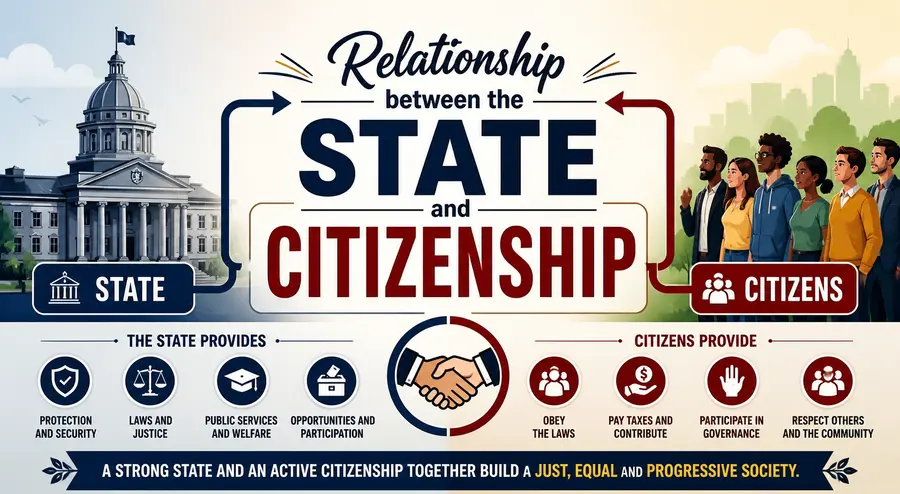
Sociologists see state and citizenship as interdependent: the state legitimizes authority through citizens’ consent, while citizenship provides individuals with rights, identity and belonging. This bond evolves with history, globalization, and social struggles for inclusion.
The state is a political organization that governs a defined territory through laws and institutions, while citizenship is the legal and social status that connects individuals to that state. The relationship between the state and citizenship is based on rights, duties, and participation. Citizens receive protection, welfare and political voice, while the state regulates inclusion and belonging. Sociologically, this relationship also shapes identity, inequality, and access to power within society.
Exploring The Relationship between the State and Citizenship: A Sociological Analysis
Introduction
The relationship between the state and citizenship is a central concern in sociology and political theory.
A state is a political organization that governs a defined territory and population through laws and institutions.
Citizenship, on the other hand, refers to the legal and social status that connects individuals to the state. This relationship is not only about rights and duties but also about identity, belonging, and participation.
Aristotle viewed citizenship as active moral and political participation, essential for justice and collective life.
T.H. Marshall framed citizenship as evolving rights—civil, political, and social—that ensure equality and inclusion across history.
Modern sociologists expand this view, seeing citizenship as multidimensional, shaped by power, identity, globalization, and social struggles.
Sociologists study how states define who is included as a citizen and how this inclusion shapes access to resources, power, and opportunities. Over time, the meaning of citizenship has evolved, influenced by historical changes such as democracy, globalization, and social movements.
Understanding this relationship helps explain inequalities, political participation, and social cohesion. It also reveals how individuals both shape and are shaped by the state in everyday life.
Legal Foundations of Citizenship
Citizenship is primarily defined through legal frameworks created by the state. These laws determine who qualifies as a citizen, often based on birth, descent, or naturalization.
Two key principles are jus soli (right of the soil) and jus sanguinis (right of blood). Through these rules, the state controls membership within its political community.
Legal citizenship provides individuals with formal recognition and protection under the law. It also allows access to important rights such as voting, education, and employment.
However, sociologists argue that legal definitions can exclude certain groups, such as migrants or stateless persons. These exclusions reveal how citizenship is not purely neutral but shaped by political and social priorities.
Therefore, the legal foundation of citizenship reflects the power of the state to define belonging and regulate inclusion in society.
Rights and Duties of Citizens
The relationship between the state and citizens is structured by a balance of rights and duties. Citizens are granted civil, political, and social rights by the state.
Civil rights include freedom of speech and equality before the law. Political rights involve participation in governance, such as voting and contesting elections.
Social rights include access to education, healthcare, and welfare. In return, citizens are expected to perform certain duties, such as obeying laws, paying taxes, and contributing to society. This mutual exchange creates a stable relationship between individuals and the state.
Sociologist T.H. Marshall emphasized that the expansion of rights over time reflects the development of modern citizenship. However, in practice, not all citizens enjoy these rights equally.
Social inequalities, discrimination, and economic differences can limit access to rights, showing that the relationship between state and citizenship is dynamic and often contested.
Citizenship and Identity Formation
Citizenship plays a key role in shaping individual and collective identities. Being a citizen of a state often creates a sense of belonging and shared identity among people. This identity is reinforced through symbols such as national flags, anthems, and public institutions.
The state actively promotes a national identity through education systems, media, and policies.
Sociologists argue that citizenship is not only a legal status but also a cultural and emotional experience. However, identity formation is complex and can include multiple layers, such as ethnicity, religion, and regional affiliations.
In multicultural societies, tensions may arise when state-defined national identity does not fully include diverse groups. This can lead to feelings of exclusion or marginalization.
Therefore, the relationship between state and citizenship also involves the negotiation of identity, where individuals continuously interpret their place within the nation.
Political Participation and Civic Engagement
Citizenship is closely linked to political participation and civic engagement. The state provides institutional channels, such as elections and public forums, through which citizens can express their views.
Active participation strengthens democracy and ensures that the government remains accountable.
Sociologists highlight that citizenship is not passive but involves continuous engagement with political processes. However, levels of participation vary across different social groups.
Factors such as education, income, and social status can influence the extent to which individuals engage in politics.
Marginalized communities often face barriers that limit their participation. In addition, modern forms of engagement, such as digital activism and social movements, have expanded the meaning of citizenship beyond traditional voting.
These developments show that the relationship between the state and citizenship is evolving, with citizens increasingly demanding greater inclusion, transparency, and responsiveness from the state.
Social Inequality and Unequal Citizenship
Although citizenship is often presented as equal for all, in reality it is shaped by social inequalities. Differences in class, gender, race, and ethnicity can affect how individuals experience their rights and duties.
Some citizens may have full access to resources and opportunities, while others face discrimination and exclusion.
Sociologists use the concept of “unequal citizenship” to describe these disparities. For example, marginalized groups may encounter difficulties in accessing education, healthcare, or legal protection.
The state plays a crucial role in either reducing or reinforcing these inequalities through its policies and institutions.
Welfare programs, affirmative action, and inclusive policies can promote greater equality. However, restrictive laws or biased practices can deepen social divisions.
Thus, the relationship between the state and citizenship is not always fair, and it often reflects broader patterns of inequality within society.
Read Here: Natural and Social Inequalities: Explained
Globalization and Changing Citizenship
Globalization has significantly transformed the relationship between the state and citizenship. Increased migration, international trade, and global communication have challenged traditional ideas of fixed national boundaries.
People now often maintain connections with multiple countries, leading to concepts such as dual citizenship and transnational identity.
States must adapt to these changes by redefining their policies on citizenship and belonging. At the same time, global institutions and human rights frameworks influence how states treat their citizens.
Sociologists argue that citizenship is becoming more flexible and less tied to a single nation-state. However, globalization also creates tensions, as some states respond by tightening immigration controls and emphasizing national identity.
These conflicting trends show that the relationship between the state and citizenship is evolving in complex ways. Understanding these changes is essential for analyzing modern societies in an interconnected world.
Read Here: How Globalization is Reshaping Cultural Values in Modern Society
Conclusion
The bond between the state and citizenship is not just a legal arrangement; it is the heartbeat of modern society.
Citizenship gives people rights, responsibilities, and a sense of belonging, while the state provides protection, order, and legitimacy. Over time, this relationship has shifted from narrow privileges to broader democratic participation, reflecting society’s push for equality and recognition.
Sociologists remind us that citizenship is more than paperwork — it is about identity, inclusion, and active involvement in collective life. At the same time, the state depends on citizens’ trust and consent to sustain authority.
Today, globalization, migration, and digital governance challenge traditional boundaries, forcing us to rethink what citizenship means in a connected world.
Ultimately, the state and citizenship remain deeply interdependent, shaping how communities hold together, how justice is pursued, and how societies adapt to change in the twenty‑first century.
Read Here: What is The Relationship between State and Civil Society?