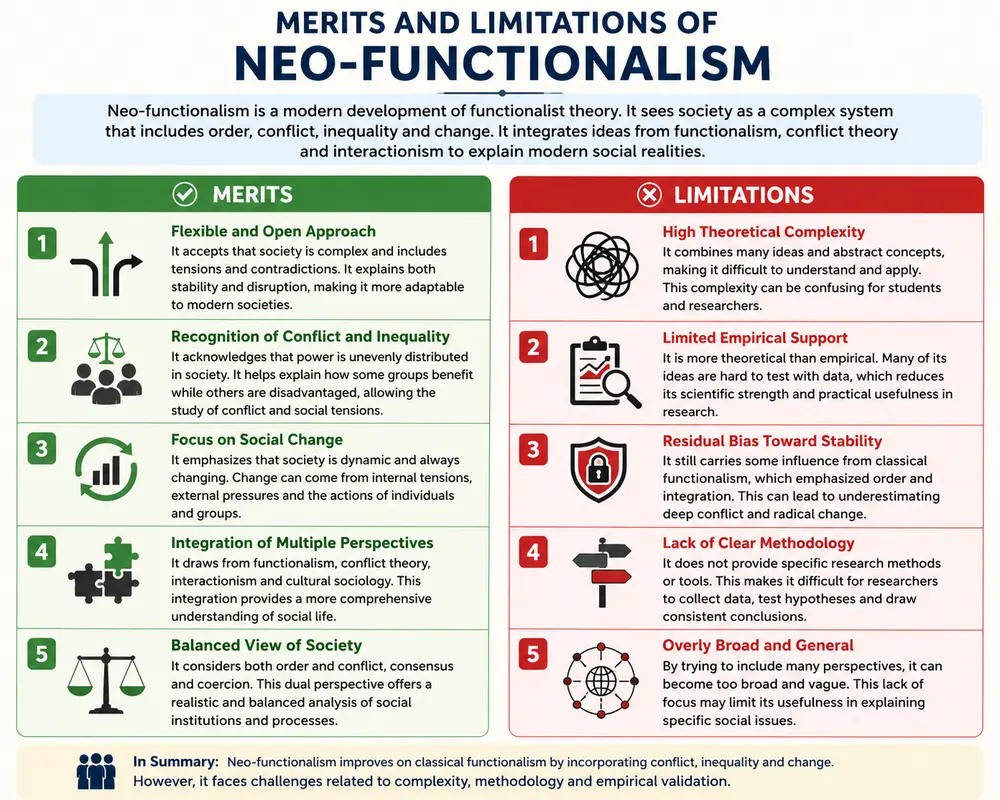
Neo-functionalism in sociology has both merits and limitations. Its main strengths are flexibility, inclusion of conflict and inequality, focus on social change, and integration of multiple perspectives, as developed by Jeffrey C. Alexander. However, it is often criticized for being complex, lacking clear methods, having limited empirical support, and retaining some bias toward social stability from Talcott Parsons.
Discover the merits and limitations of Neofunctionalism in sociology. Learn how it revises classical functionalism by integrating agency, conflict, pluralism, and social change.
Merits and Demerits of Neo-Functionalism in Modern Sociological Theory

What is Neo‑Functionalism in Sociology?
Neo-functionalism is a revised form of functionalist theory in sociology. It developed in response to the limitations of classical functionalism, especially the work of Talcott Parsons.
Neofunctionalism views society as a system of interconnected parts, but it also accepts that conflict, inequality, and change are normal features of social life.
Jeffrey C. Alexander and Paul Colomy are central to this school of thought, with Alexander defining it as an “intellectual tendency” aiming to reconsider and revise Talcott Parsons’ theory and make functionalism more relevant to modern societies.
Neofunctionalism draws ideas from multiple perspectives, including conflict theory and interactionism. This makes it more balanced and realistic than earlier approaches. However, like any theory, it has both strengths and weaknesses.
Understanding the merits and limitations of neo‑functionalism helps students critically evaluate how sociological theories explain social order, power, and transformation in complex and changing societies.
Core Features
Reflexivity & Pluralism
Neo‑Functionalism embraces multiple perspectives, drawing from conflict theory, symbolic interactionism, and phenomenology. This pluralism makes the theory flexible, allowing it to adapt to diverse social realities while avoiding the rigidity of classical functionalism.
Agency & Subjectivity
Unlike classical functionalism, which often reduced individuals to passive roles, Neofunctionalism highlights human agency. It recognizes people as active agents shaping society, emphasizing subjective experiences and personal choices alongside structural influences.
Conflict & Change
Neo‑Functionalism accepts that societies are not always harmonious. It acknowledges tensions, contradictions, and conflicts as natural parts of social life. This makes the theory more realistic in explaining social change and transformation.
Micro–Macro Integration
Neofunctionalism bridges individual actions (micro level) with larger social structures (macro level). It shows how personal choices and everyday interactions connect to institutions, systems, and societal patterns, creating a more holistic sociological analysis.
Left Orientation
Neofunctionalism challenges the conservative bias of classical functionalism. It engages with issues of inequality, power, and social justice, aligning more with progressive perspectives that emphasize reform, inclusivity, and critical evaluation of social structures.
Merits of Neo-Functionalism
More Flexible and Open Approach
Neo-functionalism offers a flexible way to understand society. Unlike earlier functionalism, it does not assume that all parts of society work smoothly together.
Scholars like Jeffrey C. Alexander argued that social systems include tensions and contradictions. This makes the theory more adaptable to modern societies. It can explain both stability and disruption at the same time. For example, institutions like education can promote unity but also create inequality.
This balanced view improves its usefulness. Because of this flexibility, neofunctionalism can study diverse social realities without relying on overly simple assumptions about harmony.
Recognition of Conflict and Inequality
A key merit of neofunctionalism is that it recognizes conflict and inequality. Classical functionalism often ignored these issues.
Neo-functionalism, however, accepts that power is unevenly distributed. It draws inspiration from thinkers like Karl Marx. This helps explain how some groups benefit more than others in society. For example, economic systems may favor wealthy groups while disadvantaging the poor.
By including conflict, the theory becomes more realistic. It allows sociologists to study struggles, protests, and social tensions. This makes neofunctionalism better suited for analyzing modern societies marked by inequality.
Focus on Social Change
Neo-functionalism improves on earlier theories by focusing on social change. It does not see society as fixed or unchanging. Instead, it explains how social systems evolve over time. It also recognizes that change can come from internal tensions or external pressures. This idea connects with interactionist insights from George Herbert Mead.
Individuals and groups actively shape society through their actions. Social movements, innovation, and cultural shifts all play a role.
This dynamic approach helps explain real-world transformations. It makes neofunctionalism more relevant in studying globalization, modernization, and rapid social developments.
Integration of Multiple Perspectives
Neo-functionalism combines ideas from different sociological theories. It does not rely only on functionalist thinking. Instead, it borrows from conflict theory, interactionism, and cultural sociology.
This integration makes the theory richer and more comprehensive. For example, it studies both social structure and human behavior. It also connects macro-level systems with micro-level interactions.
This broad approach helps explain complex social phenomena. It avoids the narrow focus of earlier theories. As a result, neofunctionalism provides a more complete understanding of society. It is especially useful for analyzing diverse and interconnected modern social systems.
Balanced View of Society
Neo-functionalism offers a balanced view of society. It does not focus only on stability or only on conflict. Instead, it shows how both can exist together.
This balance makes it more realistic than earlier theories. It explains how institutions can maintain order while also producing problems. For example, political systems can create stability but also generate inequality.
This dual perspective improves sociological analysis. It helps researchers avoid extreme conclusions.
Neofunctionalism considers both positive and negative aspects and provides a deeper understanding of social life. This balance is one of its strongest advantages.
Limitations of Neo-Functionalism
High Theoretical Complexity
One major limitation of neofunctionalism is its complexity. The theory combines many ideas, which makes it difficult to understand. Compared to classical functionalism, it is less clear and more abstract.
The work of Jeffrey C. Alexander often involves complex concepts. This can confuse students and researchers. It also makes the theory harder to apply in practical situations. Because of this complexity, it may not be easily accessible.
While its depth is valuable, it reduces its usability. This is a key drawback of neo-functionalism in sociological study.
Limited Empirical Support
Neo-functionalism often lacks strong empirical support. It focuses more on theory than on data. This makes it harder to test its ideas scientifically.
Researchers may struggle to measure its concepts in real-world studies. Compared to quantitative approaches, it appears less practical. This weakens its credibility as a scientific theory.
Although it provides useful insights, it does not always offer clear research methods. This gap between theory and evidence is a major limitation.
As sociology becomes more data-driven, theories need strong empirical backing. Neofunctionalism sometimes fails to meet this requirement.
Residual Bias Toward Stability
Despite its improvements, neo-functionalism still shows a bias toward stability. It retains some ideas from Talcott Parsons.
The theory often emphasizes social order and system integration. This can lead to underestimating deep conflicts and inequalities.
For example, it may not fully explain revolutionary changes or systemic oppression. While it includes conflict, it often treats it as manageable within the system. This limits its critical perspective. As a result, it may not fully capture the intensity of social struggles. This lingering bias is an important limitation.
Lack of Clear Methodology
Neo-functionalism does not provide a clear research methodology. It offers broad concepts but few practical tools. This makes it difficult for researchers to apply it in studies.
Unlike some sociological approaches, it does not give step-by-step methods. This creates challenges in data collection and analysis.
Researchers may interpret its ideas in different ways. This can lead to inconsistency in findings.
A strong theory should guide both thinking and research. Neofunctionalism does well in theory but not in method. This weakens its usefulness in empirical sociology.
Overly Broad and General
Another limitation is that neo-functionalism is very broad. It tries to include many perspectives at once. While this is a strength, it can also be a weakness.
The theory may lose focus and clarity. It does not always provide precise explanations. Instead, it offers general ideas about society. This can make it less effective in specific case studies.
Researchers may find it too vague for detailed analysis. A theory should balance breadth and precision.
Neo-functionalism sometimes leans too much toward generalization. This reduces its effectiveness in explaining particular social issues.
Read Here: Basic Premises of Functionalism in Sociology
Conclusion
Neo‑Functionalism represents an important attempt to revive and reform classical functionalism. Its merits lie in its ability to integrate diverse perspectives, highlight human agency, and acknowledge conflict and social change.
By bridging micro and macro levels of analysis, it provides a more balanced framework for understanding society. It also challenges the conservative bias of earlier functionalism, making it more relevant to contemporary debates about inequality, power, and justice.
However, Neofunctionalism is not without limitations. It is often criticized for being abstract and lacking strong empirical grounding. Its openness to multiple traditions sometimes creates ambiguity, making it difficult to define as a coherent paradigm. Moreover, despite its reforms, it still carries traces of functionalism’s structural bias.
Overall, Neo‑Functionalism is valuable as a reflexive and pluralist tendency, but it remains more of a theoretical orientation than a fully established sociological theory.