Peter Berger and Thomas Luckmann’s The Social Construction of Reality (1966) argues that social reality is created through human interaction, not found in nature.
They proposed a dialectical process of Externalization (creating reality), Objectivation (reality becoming an objective “truth”), and Internalization (learning this reality). Social order is thus a human, subjective product that becomes an objective reality to individuals.
Berger and Luckmann’s work, heavily influenced by phenomenological perspectives, demonstrates how social order is maintained as an objective phenomenon despite being a subjective human construct.
The Social Construction of Reality: Berger and Luckmann Theory Explained
Introduction
The concept of the Social Construction of Reality was developed by sociologists Peter Berger and Thomas Luckmann in their 1966 book The Social Construction of Reality. This theory explains how our understanding of the world is not purely objective or natural, but instead shaped through social interactions and shared meanings.
According to Berger and Luckmann, reality is created and maintained by people through everyday practices, language, and institutions. What we consider “normal,” “true,” or “real” is deeply influenced by culture and society rather than existing independently of it.
This perspective challenges the idea that knowledge is fixed or universal. Instead, it shows that knowledge evolves over time and varies across societies.
This theory examines how meanings are created and sustained, and helps us better understand social order, identity, and the role of institutions in shaping human experience.
The Concept of Reality and Knowledge
Berger and Luckmann begin by distinguishing between reality and knowledge. Reality refers to things that people believe exist independently of their will, while knowledge refers to the certainty that these things are real and meaningful.
They argue that both reality and knowledge are socially constructed. This means that what people accept as reality depends on shared beliefs within a society.
For example, ideas about gender roles or social norms differ across cultures, showing that they are not universal truths.
Knowledge is therefore not neutral; it is shaped by historical and social contexts. Through everyday interaction, people reinforce certain meanings and accept them as facts. Over time, these shared understandings become taken for granted, forming the basis of what individuals perceive as objective reality.
Externalization: Creating Social Reality
Externalization is the process through which individuals express themselves and create social reality.
Human beings actively produce meanings, norms, and institutions through their actions and interactions. For instance, when people repeatedly perform certain behaviors, such as greeting others in a particular way, these actions become patterns. Over time, these patterns are shared and recognized by others.
Externalization shows that society is a human product. It highlights the idea that people are not just passive observers of reality but active creators.
Language plays a key role in this process because it allows individuals to communicate meanings and share experiences.
Through continuous interaction, individuals contribute to building a common social world. This process forms the foundation upon which more stable social structures develop.
Objectivation: Making Reality Seem Objective
Objectivation occurs when the products of human activity become independent and appear objective. Once social patterns are established, they begin to take on a reality of their own. People start to see these patterns as natural or given, rather than created.
For example, institutions like education or law may appear fixed and external, even though they were created by humans. This process makes social constructions seem stable and unquestionable. Language again plays an important role by preserving and transmitting these meanings across generations.
Through objectivation, society becomes something that confronts individuals as an external reality. This stage is crucial because it explains how human creations gain authority and legitimacy. As a result, individuals often forget that these structures were originally constructed by people.
Internalization: Learning Social Reality
Internalization is the process through which individuals absorb and accept social reality as their own understanding.
From childhood, people learn the norms, values, and meanings of their society through socialization. Family, education, and media play important roles in this process. As individuals grow, they begin to see social rules as natural and self-evident. This means that society becomes part of their identity and consciousness.
Internalization ensures the continuity of social order because each new generation adopts existing structures. It also shapes how individuals perceive themselves and others. For example, cultural expectations about behavior influence personal identity and decision-making.
Through internalization, the socially constructed world becomes subjectively real, guiding individuals’ actions and beliefs in everyday life.
The Role of Institutions and Legitimation
Institutions are established patterns of behavior that organize social life. Berger and Luckmann argue that institutions emerge from repeated actions that become standardized over time. These institutions are supported by legitimation, which provides explanations and justifications for their existence.
Legitimation helps maintain social order by making institutions appear meaningful and necessary. It can take different forms, such as traditions, laws, or religious beliefs.
For example, educational systems are justified by the belief that they promote knowledge and social progress.
Legitimation also involves symbolic systems, like language and ideology, that reinforce shared meanings. Without legitimation, institutions would lose their authority and stability.
Therefore, institutions and legitimation work together to sustain the socially constructed reality and ensure its acceptance by individuals.
Implications of the Theory
The Social Construction of Reality has important implications for understanding society. It shows that reality is not fixed but constantly shaped through interaction.
This perspective encourages critical thinking about taken-for-granted beliefs and social norms. It also highlights the power of institutions in shaping knowledge and identity.
By recognizing that reality is constructed, individuals can question existing structures and consider alternative perspectives.
This theory is widely used in sociology, media studies, and cultural analysis to examine how meanings are created and maintained. It also helps explain social change, as shifts in collective understanding can lead to new realities.
Overall, Berger and Luckmann’s theory provides a framework for analyzing how human beings actively create and sustain the world they live in.
Read Here: Social Structure as Social Construct: Explained
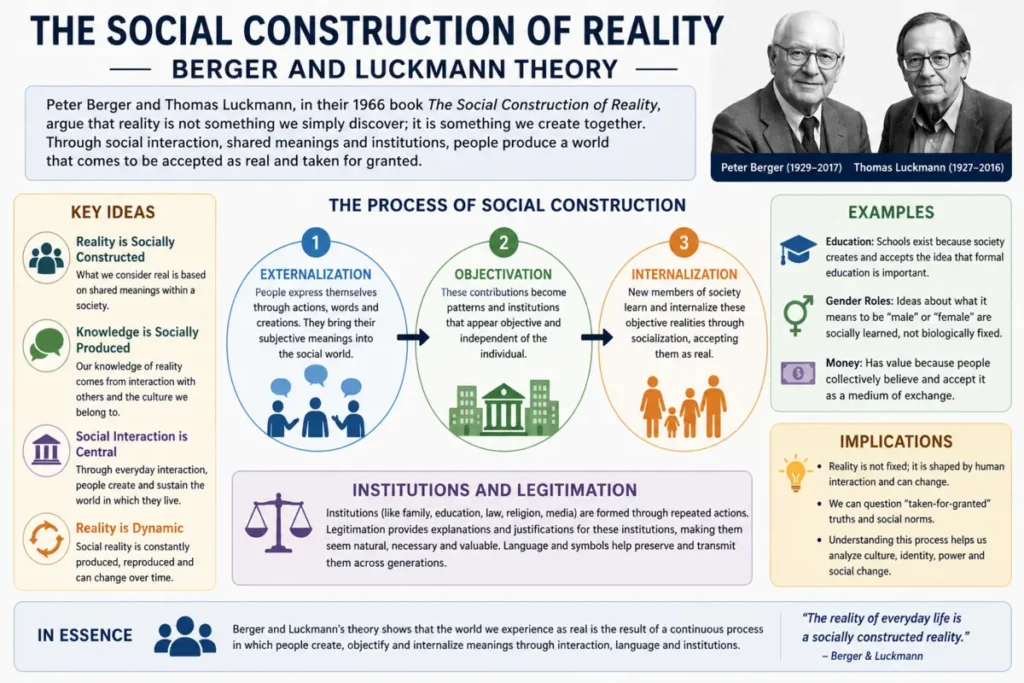
How Social Construction of Realities Takes Shape: Summary
The process through which social realities take shape can be understood as an ongoing interaction between individuals and society.
According to Berger and Luckmann, people first create meanings through everyday actions and communication. These repeated actions form patterns that are shared and recognized by others. Over time, these patterns become stable and appear objective, as if they exist independently of human activity. Institutions such as family, education, and religion help organize and preserve these shared meanings.
Through socialization, individuals learn and internalize these norms, accepting them as natural and real.
Language plays a central role by allowing meanings to be expressed, stored, and transmitted across generations. As a result, social reality is continuously produced and reproduced.
This process shows that reality is not fixed but is shaped through collective human experience and maintained through ongoing social interaction.
Read Here: Examples of Social Structure in Everyday Life