
Do Babies Naturally Believe in God? What Science Says About Children and Faith
Are human beings born with a natural belief in God, or do we learn about God from our parents, families, cultures, and religious traditions?
This is one of the most interesting questions in the psychology of religion. Many people believe that children enter the world with an innate awareness of a Creator. In some religious traditions, childhood is even associated with a special closeness to the divine. But can science support the idea that humans are naturally born believers?
Interestingly, research in developmental psychology and cognitive science suggests that the answer is more complicated than a simple yes or no.
Newborn babies do not appear to have an actual concept of God. They cannot understand religious teachings or consciously believe in a supernatural being. However, as children grow, their minds develop certain natural abilities that may make ideas about God, invisible beings, purpose, and creation feel intuitive.
Researchers have found that young children often look for purpose in nature, understand the intentions of other people, and find it relatively easy to imagine invisible agents with special abilities.
Some scientists argue that these tendencies make belief in God cognitively natural. Other researchers emphasize that religious beliefs depend heavily on cultural learning and social experience.
So, are we born believing in God? Let’s explore what scientific research actually tells us.
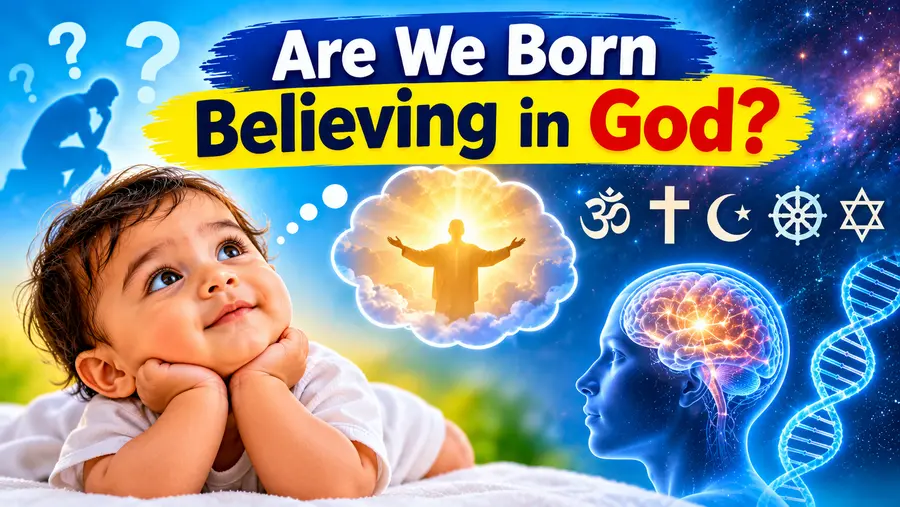
Are Human Beings Born Believing in God?
There is no strong scientific evidence that babies are born with an actual belief in God. A newborn does not have a developed understanding of a Creator, religion, morality, or supernatural existence.
However, being naturally prepared to develop a belief is different from already possessing that belief at birth.
Consider language as an example. Human beings are born with biological abilities that make language learning possible, but a baby is not born speaking Hindi, English, Arabic, or any other language. The language a child eventually learns depends heavily on the surrounding environment.
Some researchers use a similar idea to explain religious belief. They suggest that humans may possess natural cognitive tendencies that make certain religious concepts easier to understand and accept as they grow.
This is sometimes described as the idea of intuitive theism or the naturalness of religious belief.
In her influential 2004 paper, psychologist Deborah Kelemen explored whether young children are naturally inclined to interpret the world in terms of purpose and nonhuman design. Her research suggested that some aspects of children’s thinking may make creator-like explanations intuitively attractive. However, this does not mean children are born with a complete religious belief system. Research: Kelemen, Are Children “Intuitive Theists”?
What Does It Mean to Be a Born Believer?
The expression “born believer” can mean two very different things.
The first meaning is that babies are born already knowing that God exists. This is a theological or spiritual claim, and developmental psychology has not established it scientifically.
The second meaning is that humans are born with certain mental abilities and natural tendencies that make belief in a God-like being more likely to develop under ordinary conditions.
For example, children naturally learn to recognize people, understand intentions, search for explanations, and ask why things happen. As these abilities develop, they may become receptive to the idea that an intelligent being created or controls the natural world.
This second meaning is what cognitive scientists investigate.
The difference is important because a natural tendency to develop a belief does not mean that the belief is present at birth, universal, or necessarily true.
5 Psychological Factors That May Make Belief in God Feel Natural
Researchers have identified several aspects of human cognitive development that may help explain why religious ideas are widespread across human societies.
These findings do not prove that God exists. Instead, they help explain how the human mind understands supernatural concepts.
1. Humans Naturally Look for Purpose in the World
One interesting feature of children’s thinking is their tendency to look for purposes behind things.
When children observe the natural world, they often ask questions such as:
- Why do birds have wings?
- Why do trees grow?
- Why does the Sun rise?
- Why do rivers flow?
- Why are mountains so high?
They may not be satisfied with a description of how something works. They also want to know why it exists.
Developmental psychologist Deborah Kelemen studied this tendency, known as teleological reasoning. It refers to explaining something in terms of its purpose or function.
In several experiments, young children showed a tendency to explain not only living things but also some non-living natural features in terms of a purpose. For instance, they might suggest that mountains exist to provide a place for animals or that rocks have a particular shape for a reason. Research: Kelemen, Why Are Rocks Pointy?
This does not mean children always believe everything has been deliberately designed. Rather, they often find purpose-based explanations attractive.
Now consider how this tendency could connect to religious thinking.
When a child observes the complexity of nature, the next question may be: Who made it?
If the child already understands that houses, toys, and machines are made by people, the idea that the natural world also has an intelligent creator may seem intuitive.
This is one reason some psychologists argue that human beings are naturally receptive to creator concepts.
However, purpose-based thinking is not evidence that a divine designer actually exists. Scientific explanations, such as evolution by natural selection and geological processes, explain many features of nature without assuming that they were intentionally created for a purpose.
2. Children Naturally Think About Invisible Agents and Minds
Human beings are highly social. From early childhood, we learn to recognize other people, understand their intentions, and respond to their emotions.
Psychologists often use the term theory of mind to describe the developing ability to understand that other people have thoughts, beliefs, desires, intentions, and knowledge that may differ from our own.
This ability helps children understand everyday situations.
For example, a child learns that:
- A person may want something.
- Someone may know something that another person does not.
- A person can make decisions intentionally.
- Someone may act for a particular reason.
As this ability develops, children also become capable of thinking about agents they cannot directly see.
Consider imaginary companions. Some children create imaginary friends with whom they play, talk, and share experiences. These companions may have personalities, preferences, and intentions, even though they are not physically present.
This illustrates the human capacity to think about invisible or imagined agents.
The cognitive science of religion explores whether similar mental abilities help people understand concepts such as angels, spirits, ancestors, and God.
A God concept does not necessarily require a visible human body. A child can imagine an invisible being that thinks, knows, wants, and acts.
However, being able to imagine an invisible agent is not the same as believing that a particular supernatural being exists. It simply means that the mind has the cognitive tools to represent such an idea.
3. Children Can Imagine Beings With Superhuman Knowledge
Another interesting area of research concerns how children understand knowledge and information.
Young children sometimes assume that other people know more than they actually do. They may initially struggle to understand that someone else cannot see something hidden, does not know a particular fact, or has a different belief.
As their cognitive abilities develop, they become better at distinguishing what different people know and do not know.
The idea of a God who knows everything introduces another level of this understanding.
A child may learn that human beings have limited knowledge, while God is believed to know things that humans cannot know.
A 2017 cross-cultural study by psychologists Melanie Nyhof and Carl Johnson examined how children understand God’s mental and physical characteristics.
The researchers studied children aged 3 to 7 from different religious backgrounds, including Christian, Muslim, and Latter-day Saint communities. They found that even the youngest children in these samples distinguished God from ordinary human beings and attributed special mental properties to supernatural agents. Older children’s ideas increasingly reflected the specific religious teachings of their traditions. Research: Nyhof and Johnson, Is God Just a Big Person?
This suggests that children can develop an understanding of a being with extraordinary knowledge and mental abilities quite early.
But there is an important distinction: children in these studies were already growing up in religious environments. The findings do not show that babies independently discover the concept of an all-knowing God without cultural influence.
4. Children Develop Ideas About Life, Death, and the Afterlife
The idea that a person can continue to exist after physical death is central to many religious traditions.
Children gradually develop an understanding of death as they grow. They learn that living things need food, breathe, grow, and eventually die.
However, understanding biological death does not automatically settle questions about the mind, soul, or afterlife.
Some children may believe that a person who has died can still think, remember, or feel in some way. These beliefs are influenced by their developing understanding of the mind as well as the explanations they receive from adults and their communities.
A review by Harvard psychologist Paul Harris, published in 2018, examined how children understand death from both biological and religious perspectives. It discussed why children may recognize the biological reality of death while remaining receptive to ideas about continued existence after death. Research: Harris, Children’s Understanding of Death: From Biology to Religion
This is relevant to the development of religious ideas because many concepts of God involve immortality or existence beyond ordinary human life.
Children may find it easier to imagine a being that never dies than to understand all the implications of human mortality.
Nevertheless, the ability to imagine an immortal being does not establish a belief in a particular God or prove that an afterlife exists.
5. Humans Naturally Search for Explanations
Children are curious about almost everything.
They repeatedly ask questions such as:
- Why is the sky blue?
- Where do stars come from?
- Why do people die?
- Who created the universe?
- Why do good and bad things happen?
This curiosity reflects a basic feature of human intelligence: we seek explanations for what happens around us.
Sometimes we can observe the cause directly. For example, a child can see that a ball moves when someone kicks it.
Other questions are more difficult. The origin of the universe, the existence of consciousness, and the purpose of human life are not everyday questions that can be answered through simple observation.
In some situations, people turn to scientific explanations. In others, they consider religious or philosophical explanations.
Some researchers argue that the human tendency to look for causes and intentions may make supernatural explanations cognitively accessible.
However, curiosity itself does not necessarily lead to religious belief. Children can also develop scientific, philosophical, or nonreligious explanations as they learn.
Does This Mean Children Are Naturally Intuitive Theists?
The term intuitive theism is associated with the argument that some natural patterns of children’s thinking make belief in a creator-like being relatively intuitive.
Deborah Kelemen’s 2004 paper brought together findings about children’s reasoning, agency detection, imaginary companions, and explanations of natural phenomena.
The basic argument is that children may find it natural to interpret certain features of the world in terms of intention and purpose. A nonhuman creator can fit into this way of thinking.
For example, consider a child who sees a tree and asks why it exists.
An adult may explain that trees grow through biological processes involving seeds, sunlight, water, and nutrients. But a young child may also wonder who made the tree or what purpose it serves.
The idea of a creator can provide an intuitive answer to that question.
Some authors, including psychologist Justin Barrett in his book Born Believers: The Science of Children’s Religious Belief, have explored how ordinary human cognitive development may contribute to religious thinking.
However, researchers do not all agree that these tendencies are enough to generate belief in God spontaneously.
Being naturally able to understand a concept is not the same as independently developing a belief in it.
Why Some Scientists Disagree That Humans Are Born Believers
The naturalness of religious belief is an active area of academic debate.
Some researchers argue that humans have cognitive tendencies that make religious ideas intuitive. Others believe that these tendencies cannot explain religious belief without significant cultural and social influence.
The Argument That Religious Belief Is Learned
In a 2013 article titled Would Tarzan Believe in God?, psychologists Konika Banerjee and Paul Bloom examined whether a person raised without exposure to religious ideas would automatically develop beliefs in God, the afterlife, or divine creation.
Their argument was that children do not simply develop full theistic beliefs spontaneously. Cultural exposure plays a crucial role in the development of religion.
In other words, children may have the cognitive ability to imagine supernatural beings, but they generally learn which beings exist and what those beings are believed to do from their social environment. Research: Banerjee and Bloom, Would Tarzan Believe in God?
This is an important challenge to the idea that all humans are automatically born believers.
The Importance of Family and Culture
Religious concepts are not usually learned in the same way as directly observable objects.
A child can see a tree, touch a stone, or watch a bird fly. But a child cannot directly observe God, heaven, or many other supernatural concepts.
Instead, children learn about these ideas through explanations, stories, conversations, rituals, and the behaviour of trusted people.
A major review of developmental psychology research by Rebekah Richert and Kathleen Corriveau, published in the Annual Review of Developmental Psychology in 2022, highlights the relationship between children’s cognitive development and the cultural transmission of religious concepts. Research: Development of Religious Cognition
Family discussions, religious practices, community participation, and social identity can all shape how children understand God and religion.
For example, a child growing up in a Muslim family may learn about Allah through Islamic teachings, prayer, and family conversations. A child growing up in a Hindu family may learn about Brahman, particular deities, and different religious traditions.
A child raised in a nonreligious household may instead learn to approach questions about the universe and human existence through secular, scientific, or philosophical explanations.
The child’s natural cognitive abilities are important, but the content of their beliefs is strongly shaped by their environment.
Read Here: Why Is It So Hard for Some Scientists to Believe in God?
What Does Recent Research Say About Children and Religious Belief?
Research in this field continues to develop. A particularly important point is that scientists are increasingly examining cognitive development and cultural learning together rather than treating them as completely separate explanations.
A 2023 review by Ayse Payir, Kathleen Corriveau, and Paul Harris examined children’s beliefs in invisible agents, including both religious and scientific ones.
The authors challenged the idea that children have a general natural inclination to believe in supernatural powers. They highlighted evidence that children often prefer naturalistic explanations, even when something unusual happens.
They also argued that cultural learning and childhood religious exposure play major roles in the development of religious belief. Children can be receptive to claims about invisible divine agents, but they can also learn about invisible natural agents through scientific education. Research: Payir, Corriveau and Harris, Children’s Beliefs in Invisible Causal Agents—Both Religious and Scientific
Another useful contribution is a 2026 Cambridge University Press publication by Emily Rachel Reed Burdett, titled Cognitive and Socio-Cultural Development of Religious Belief in Children.
This work reviews different approaches to how children develop concepts of God and emphasizes the importance of studying both cognitive abilities and social-cultural experiences. It also highlights the diversity of religious cognition across different contexts. Cambridge University Press, 2026
Taken together, this research suggests that religious belief cannot be explained by one simple factor. Human cognitive development may make certain religious ideas understandable, while social learning helps determine which beliefs children actually adopt.
Are Children From Different Religions Born With the Same Idea of God?
An interesting question is whether children across different cultures independently develop the same understanding of God.
Research suggests that children can share some broad cognitive patterns, but their religious concepts are also shaped by the traditions in which they grow up.
For example, different religious communities may describe God or the divine in different ways:
- Some traditions emphasize one all-powerful, all-knowing Creator.
- Some Hindu philosophical traditions describe Brahman as the ultimate reality.
- Some traditions include multiple deities with different characteristics and roles.
- Some religious communities emphasize ancestors, spirits, or other supernatural beings.
- Secular households may teach children to approach supernatural claims with skepticism.
The 2017 study by Nyhof and Johnson is especially interesting because it compared children’s understanding across different Christian and Muslim backgrounds, as well as traditions with different ideas about God’s physical nature.
The researchers found that younger children in the study shared some broad understandings of God’s special mental attributes, while older children increasingly reflected the specific teachings of their religious traditions.
This suggests that human cognition can influence how children understand supernatural beings, but cultural and religious education also shape the details.
Does Being Naturally Receptive to God Prove That God Exists?
No. This is perhaps the most important distinction in the entire debate.
Psychology can investigate how people develop religious beliefs, why certain ideas feel intuitive, and how children learn about supernatural beings.
But these findings cannot establish whether God actually exists.
Suppose human beings are naturally inclined to believe that the universe has a purpose. That psychological tendency does not prove that the universe was intentionally designed.
Likewise, explaining how humans develop religious beliefs does not disprove the existence of God.
There are two different questions:
The psychological question: Why do people believe in God, and how does this belief develop?
The philosophical or theological question: Does God actually exist?
The first question can be investigated through psychology, neuroscience, anthropology, and developmental science. The second involves philosophical arguments, theological claims, and questions about the interpretation of scientific evidence.
Confusing these questions can lead to incorrect conclusions. A belief may have psychological or cultural origins without being automatically true or false.
Can a Child Become Religious Without Being Taught About Religion?
This is a difficult question, and researchers do not have a simple universal answer.
Children can develop ideas about purpose, intention, and invisible agents without receiving detailed religious instruction. These are ordinary parts of cognitive development.
However, developing a specific belief in God, understanding a religious tradition, or accepting ideas about divine creation and an afterlife involves more than simply recognizing that agents have intentions.
The available research suggests that social interaction and cultural learning are very important. Family members, teachers, peers, stories, and rituals provide children with the information they need to develop particular religious ideas.
It is therefore reasonable to say that children may be naturally prepared to understand some supernatural concepts, but that does not mean every child will independently become religious.
So, Are We Born Believers in God or Do We Learn to Believe?
The most balanced scientific answer is that we are not born with a fully developed belief in God, but our minds may possess cognitive abilities that make religious beliefs easier to develop.
Children naturally learn to understand other minds, recognize intentional behaviour, search for purposes, and think about invisible agents. Some of these tendencies may make the concept of a creator or supernatural being intuitively attractive.
At the same time, scientific reviews emphasize that religion is also transmitted through family, culture, education, social interaction, and community traditions.
So, the evidence points toward an interaction between human cognitive development and cultural learning, not a simple claim that belief in God is completely hardwired or entirely imposed from outside.
Whether these natural tendencies reflect something spiritually meaningful is a separate philosophical and theological question.
Read Here: Is There Definitive Proof of the Existence of God?
Frequently Asked Questions (FAQs)
Are babies born believing in God?
There is no strong scientific evidence that babies are born with an actual concept or conscious belief in God. Newborns do not have the developed conceptual abilities needed to understand religious teachings. However, some cognitive tendencies that emerge during childhood may make religious ideas easier to understand later.
Is belief in God innate or learned?
Research suggests that both cognitive development and cultural learning matter. Human beings may naturally develop abilities that make concepts such as invisible agents, purpose, and extraordinary knowledge understandable. However, specific religious beliefs are strongly influenced by family, culture, education, and social experience.
What is intuitive theism?
Intuitive theism is the idea that ordinary patterns of human thinking make belief in a God-like creator relatively natural. For example, young children often reason about the natural world in terms of purpose and may find intentional explanations attractive.
What did Deborah Kelemen discover about children’s belief in God?
Psychologist Deborah Kelemen studied children’s tendency to explain natural phenomena in terms of purpose and intention. Her 2004 paper, Are Children “Intuitive Theists”?, suggested that this tendency may make children receptive to the idea of a nonhuman designer. It did not establish that children are born with religious beliefs.
Do children naturally believe in a Creator?
Some studies suggest that young children are inclined to use purpose-based explanations and can understand creator-like agents. However, researchers disagree about whether these tendencies are sufficient to produce belief in a Creator without cultural influence.
Does science prove that humans are born religious?
No. Science has not established that humans are born with an actual religious belief. Developmental psychology investigates how religious concepts emerge and how cognitive abilities interact with cultural learning. These findings do not prove or disprove God’s existence.
Why do children believe in invisible beings?
Children develop the ability to understand agents, thoughts, intentions, and information that cannot always be directly observed. This allows them to think about imaginary companions and supernatural beings. Cultural learning helps determine which invisible agents they consider real.
Can a child grow up without believing in God?
Yes. Children can grow up in religious or nonreligious environments, and not every child develops religious beliefs. Their understanding is influenced by family, education, personal experiences, culture, and individual differences.
What is the difference between being born with faith and learning religion?
Being born with faith would mean having an actual religious belief from birth. Learning religion means developing religious concepts through social experiences, teachings, traditions, and personal reflection. Current scientific research supports the importance of developmental abilities and social learning, not the claim that babies possess fully developed faith.
Does the natural tendency to believe in God mean God exists?
No. A natural tendency to develop a belief does not establish whether that belief corresponds to reality. Psychology can explain how religious ideas develop, but the existence of God remains a separate philosophical and theological question.
Read Here: Why Religion Is Not Going Away and Science Will Not Destroy It
Conclusion
Are we born believing in God? Science does not provide a simple yes-or-no answer, but it offers fascinating insights into how religious beliefs develop.
Human beings appear to have natural cognitive abilities that help them recognize intentions, understand minds, search for explanations, and think about invisible agents. These abilities may make the idea of God intuitively attractive to many children.
However, actual religious beliefs are also shaped by family, culture, education, and social experiences. Children do not all grow up with the same understanding of God, and some develop no religious belief at all.
Perhaps the most interesting conclusion is that the human mind seems naturally curious about questions of existence, purpose, and the unseen world.
Religion is one way people have explored those questions throughout history, while science and philosophy provide other ways of understanding them.