Does God Exist? Science, Logic and Philosophy Explained
Does God really exist? Is there definitive proof of God’s existence, or is belief in a Creator ultimately a matter of faith?
For centuries, philosophers, scientists, mathematicians, and religious thinkers have tried to answer these questions. Some have argued that the existence of the universe points towards a Creator. Others have used mathematics and formal logic to develop arguments for God’s existence. Meanwhile, scientific discoveries about the Big Bang, the origin of life, and the structure of the universe have created new questions about whether the cosmos could exist without a creator.
One particularly interesting attempt came from Kurt Gödel, one of the greatest mathematicians of the 20th century. He developed a formal logical argument intended to demonstrate that God exists.
Another influential argument is the cosmological argument (Kalam), which begins with a simple question: If everything that begins to exist has a cause, what caused the universe to exist?
The cosmological argument suggests that the universe must have a cause beyond itself and that this cause has characteristics traditionally associated with God.
But does this establish God’s existence beyond reasonable doubt?
Let’s examine the philosophical arguments, scientific evidence, and objections to understand how strong the case really is.
Is There Definitive Proof That God Exists?
There is currently no universally accepted scientific or mathematical proof that establishes God’s existence beyond all possible disagreement.
However, this does not mean there are no serious arguments for God’s existence.
Several philosophical arguments attempt to demonstrate that a Creator or necessary being exists. These include:
- The Kalam cosmological argument: Everything that begins to exist has a cause, and the universe began to exist. Therefore, the universe has a cause.
- The ontological argument: The concept of a maximally great or necessary being may logically entail that such a being exists.
- The fine-tuning argument: The physical conditions of the universe appear remarkably compatible with the existence of complex structures and life.
- The moral argument: Objective moral values, if they exist, may require a foundation beyond human preferences and social conventions.
- The argument from contingency: Things that could have failed to exist require an explanation for why they exist rather than nothing.
Each argument approaches the question from a different direction.
Some people find these arguments persuasive because they believe the existence of the universe, its laws, and its apparent order are better explained by an intelligent Creator than by an unexplained chain of physical events.
Others argue that these arguments contain assumptions that have not been conclusively established.
To understand the debate, let’s begin with an unusual attempt to prove God’s existence using mathematical logic.
Kurt Gödel’s Logical Proof of God’s Existence
Kurt Gödel was an Austrian-American mathematician and logician widely regarded as one of the most influential thinkers in mathematical logic.
He is best known for his incompleteness theorems, which transformed our understanding of mathematics and formal systems.
However, Gödel also worked on a philosophical argument for God’s existence.
Around 1970, he developed a formal version of the ontological argument, using modal logic. His handwritten notes were later published and studied by other logicians.
Gödel’s argument was based on the idea of a God-like being possessing all positive properties.
In traditional perfect-being theism, God is understood as an all-powerful, all-knowing, and morally perfect being. Such a being is also described as necessarily existing rather than existing only by chance.
Gödel attempted to express this idea through a mathematical system of definitions, axioms, and logical deductions.
How Does Gödel’s Ontological Argument Work?
The basic idea behind the argument can be explained in a simplified way:
- A God-like being possesses all positive properties.
- These positive properties are understood as compatible with one another.
- A God-like being, if possible, possesses necessary existence.
- In the modal logic system used by the argument, if a necessary being is possible, then it exists necessarily.
- Therefore, if the existence of such a God-like being is possible, God exists necessarily.
The central idea is that the possibility of a necessarily existing God would imply God’s actual existence.
This is a modal argument. It uses the philosophical concepts of possibility and necessity, rather than observations of the physical universe.
What Does “Necessary Existence” Mean?
It is important to distinguish between necessary and contingent existence.
A contingent thing is something that exists but could have failed to exist.
For example:
- A tree exists, but it could never have grown.
- A planet exists, but it could have formed differently or not formed at all.
- Human beings exist, but the universe could have developed without us.
A necessary being, by contrast, is understood as something that cannot fail to exist if it is genuinely possible.
Gödel’s argument attempts to show that God’s existence belongs to this second category.
Does Gödel’s Proof Definitively Establish God’s Existence?
Not necessarily.
Gödel’s argument is mathematically sophisticated, but a formally valid deduction does not automatically establish that its starting assumptions are true.
Philosophers debate whether the axioms defining positive properties are justified, whether the properties are mutually consistent, and whether the modal assumptions are appropriate.
In other words, the argument may demonstrate what follows if its assumptions are accepted. It does not independently prove that every assumption is correct.
Nevertheless, Gödel’s work demonstrates that the question of God’s existence is not limited to religious belief. It can also be examined through formal logic and philosophy.
For further reading, see the academic paper The Development of Gödel’s Ontological Proof.
The Kalam Cosmological Argument: Does the Universe Need a Creator?
Among the philosophical arguments for God’s existence, the Kalam cosmological argument is particularly interesting because it connects philosophy with questions about the origin of the universe.
The argument has a long history in Islamic theology. Medieval Muslim philosophers and theologians, including Al-Ghazali, developed and defended versions of the idea that the universe could not have an infinite past and must therefore have a beginning and a cause.
In modern philosophy, William Lane Craig has become one of the best-known defenders of the Kalam cosmological argument.
The argument is usually presented in three simple statements:
- Everything that begins to exist has a cause.
- The universe began to exist.
- Therefore, the universe has a cause.
This is a logically valid argument if its premises are true.
But what do these three statements actually mean?
Premise 1: Everything That Begins to Exist Has a Cause
The first premise says that things do not simply appear from absolute nothingness.
Consider some familiar examples:
- A house is built by construction workers using materials.
- A tree grows from a seed under suitable environmental conditions.
- A computer is manufactured using components and an industrial process.
- A star forms through physical processes involving clouds of gas and gravity.
In each example, something brings about the existence of something new.
The Kalam argument applies this principle to the universe itself.
If objects and events that begin to exist require causes, its supporters argue, the universe should not be treated as an exception without a convincing explanation.
However, critics question whether our everyday understanding of causation can be applied to the origin of the entire universe. The conditions at the earliest stages of the cosmos may be very different from anything we experience in ordinary life.
Quantum physics also raises difficult questions about how causation operates at very small scales. Some quantum events are probabilistic, although this does not automatically mean that they occur from absolute nothingness.
The first premise is therefore a philosophical principle that requires examination, not simply a scientific measurement.
Premise 2: The Universe Began to Exist
The second premise is central to the Kalam argument.
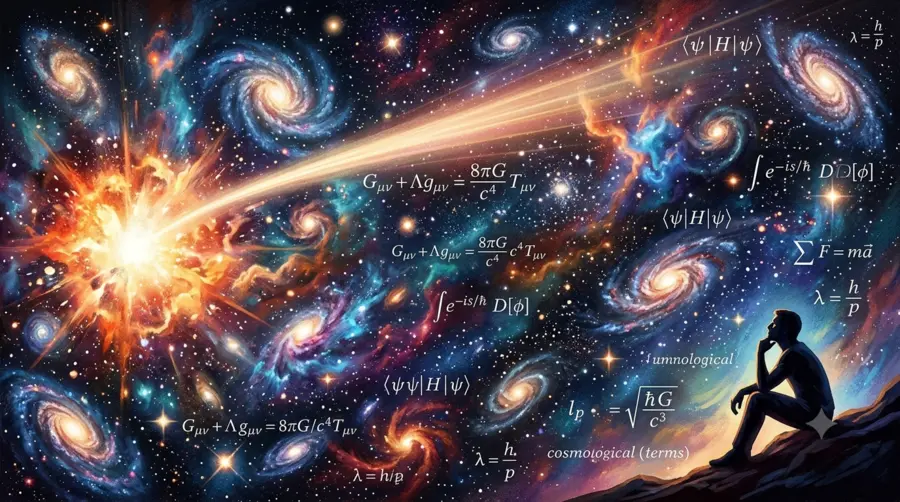
Modern cosmology tells us that the observable universe has been expanding from an extremely hot and dense early state for approximately 13.8 billion years.
This model is commonly known as the Big Bang theory.
The discovery of the expansion of the universe, the cosmic microwave background radiation, and the abundance of light elements provides strong evidence for the hot Big Bang model.
But what does this tell us about the beginning of everything?
The Big Bang model describes the early evolution of the observable universe. It does not, by itself, answer every question about the ultimate origin of space, time, matter, and energy.
Some interpretations of cosmology suggest that time itself may have a finite past. Other theoretical proposals explore possibilities such as bouncing cosmologies, earlier phases of cosmic evolution, and quantum descriptions of the universe.
These possibilities remain subjects of scientific investigation.
Kalam supporters argue that the universe cannot have an infinite series of past events and therefore must have begun to exist.
One of their philosophical arguments concerns the idea of an actual infinite.
They distinguish between a potential infinity, which can continue indefinitely, and an actual infinite, which would contain infinitely many completed members.
They argue that an actually infinite series of past events cannot be completed by successive addition. Therefore, the past must be finite.
Critics dispute whether this reasoning successfully rules out every possible infinite-past model.
Nevertheless, the Big Bang model gives the Kalam argument an important point of contact with modern cosmology: the universe has a finite age in its standard hot Big Bang description.
Premise 3: Therefore, the Universe Has a Cause
If the first two premises are true, the conclusion follows:
The universe has a cause of its existence.
But what kind of cause could bring the universe into existence?
According to the Kalam argument, the cause cannot simply be another ordinary physical object within the universe.
Why?
Because the universe includes the totality of physical space, time, matter, and energy.
If the cause brought the entire physical universe into existence, it would have to be something that is not dependent on the physical universe in the ordinary way.
This leads to an important philosophical question:
What characteristics would such a cause need to possess?
What Would the Cause of the Universe Be Like?
The Kalam argument’s supporters often suggest that the cause of the universe would have several remarkable characteristics.
The Cause Would Be Beyond Physical Space
If physical space began with the universe, its ultimate cause could not be an ordinary object located somewhere within that same space.
The cause would have to be non-spatial in the relevant sense.
The Cause Would Not Be Dependent on Physical Time
If time itself has a beginning, the cause of the universe cannot simply be an earlier physical event in an already existing timeline.
It would have to be understood as existing independently of physical time or as being responsible for the beginning of time.
The Cause Would Not Be Ordinary Matter
Matter and energy are part of the physical universe.
If the cause explains the existence of the physical universe as a whole, it cannot simply be another ordinary material object inside it.
The Cause Would Have Extraordinary Power
Bringing an entire universe into existence would require a cause capable of producing an extraordinary effect.
Kalam defenders therefore associate the cause with immense or unlimited creative power.
The Cause May Be Personal
This is one of the most interesting steps in the argument.
William Lane Craig and other defenders argue that a personal agent is a plausible explanation for why a universe with a beginning exists.
Their reasoning is that an impersonal set of conditions, if sufficient and eternally present, would seem to produce its effect whenever those conditions were present. A personal agent, by contrast, could freely choose to create.
However, this is a philosophical inference, not a conclusion directly established by the first three premises.
Other explanations may be proposed, and philosophers disagree about whether the cause must be personal.
Still, Kalam supporters argue that a timeless, non-physical, powerful, and personal cause has characteristics that closely resemble the traditional concept of God.
Does the Big Bang Prove That God Exists?
The Big Bang is often discussed in debates about God’s existence because it describes an early stage of the universe’s evolution.
For some theists, the universe’s finite age supports the idea that it was created.
If the universe began to exist, they argue, it makes sense to ask what brought it into existence.
However, it is important to understand what cosmology has and has not established.
The Big Bang theory does not directly identify a supernatural creator. It is a scientific model describing the expansion and evolution of the observable universe from an early hot, dense state.
Nor does it establish with certainty that no physical reality or earlier phase could have existed before that state.
Scientists are still investigating the earliest moments of cosmic history, including questions that require a better understanding of quantum gravity.
Therefore, the Big Bang is relevant to the Kalam argument, but it is not a standalone scientific proof of God.
The philosophical argument goes further by asking whether the universe’s existence requires an ultimate cause beyond the physical cosmos.
The Most Important Objections to the Kalam Argument
A strong argument should be examined from both sides.
Although the Kalam cosmological argument is influential, philosophers have raised several objections.
Objection 1: Who Created God?
This is probably the most familiar question.
If everything needs a cause, then who caused God?
Kalam defenders respond that the argument does not say everything needs a cause.
Its first premise says that everything that begins to exist has a cause.
God, as understood in classical theism, is not supposed to have begun to exist. God is described as eternal or necessary.
Therefore, the argument does not require God to have a cause.
Critics may still ask why the universe cannot be eternal or necessary in some different sense. That is a separate philosophical question.
Objection 2: Can Something Come Into Existence Without a Cause?
Some critics argue that causation may not operate in the same way at the quantum level as it does in everyday experience.
Quantum events can be probabilistic, and some interpretations of quantum cosmology attempt to describe the emergence of a universe through quantum processes.
However, the phrase “something from nothing” can be misleading.
A quantum vacuum is not absolute philosophical nothingness. It is a physical state described by quantum fields and physical laws.
Whether a quantum theory can ultimately explain the existence of the universe, rather than merely describe a process within a deeper physical framework, remains an open question.
Objection 3: Did the Universe Really Have an Absolute Beginning?
The standard Big Bang model describes the universe’s evolution from an early hot and dense state.
But scientists do not yet have a complete, experimentally confirmed theory describing the ultimate origin of spacetime.
Some theoretical models explore a preceding cosmic phase, a bounce, or other possibilities.
If the universe had an earlier phase, the argument that it began in an absolute sense would need further support.
Kalam defenders respond that even an eternal or cyclic physical universe might still require an explanation for its existence.
That response brings the discussion closer to other cosmological arguments, especially arguments from contingency.
Objection 4: Does a First Cause Have to Be God?
Even if the universe has a cause, why should we identify that cause as God?
A first cause, by itself, does not automatically establish that it is all-knowing, morally perfect, loving, or interested in human beings.
Kalam supporters try to infer some of these characteristics from the nature of the proposed cause.
But additional philosophical arguments are needed to establish the full attributes of the God of a particular religion.
This is an important distinction: establishing a cause of the universe and establishing the complete theological description of God are not exactly the same task.
Other Arguments That Support the Existence of God
The Kalam argument is not the only philosophical approach to the question.
Some thinkers believe that several independent arguments can be combined to make a stronger cumulative case.
The Fine-Tuning Argument
The laws and constants of physics appear to fall within ranges that permit complex structures and life.
For example, gravity, electromagnetic interactions, and the properties of fundamental particles are important to the formation of stars, galaxies, and chemical elements.
Some philosophers argue that this apparent fine-tuning is better explained by an intelligent designer.
Critics suggest other possibilities, including selection effects, unknown physical principles, or a multiverse.
The fine-tuning debate remains open.
The Moral Argument
Many people believe that some actions are objectively right or wrong, regardless of individual preferences.
For example, deliberately torturing an innocent person for entertainment is widely considered morally wrong.
Some philosophers argue that objective moral values require a foundation beyond human opinion and that God provides such a foundation.
Others believe morality can be explained through human well-being, reason, social cooperation, or other non-religious approaches.
The Argument from Contingency
Everything we observe appears to depend on other things for its existence.
People depend on biological processes, planets depend on physical conditions, and stars depend on the laws of physics.
The argument from contingency asks why anything exists at all.
It suggests that a chain of dependent things ultimately requires a necessary reality that does not depend on something else for its existence.
Unlike the Kalam argument, this approach does not necessarily depend on the universe having a beginning in time.
These arguments do not all prove the same thing, but together they explore different aspects of the question of why the universe exists.
Can Science Prove or Disprove the Existence of God?
Science is exceptionally powerful at explaining the natural world.
It investigates physical processes, tests hypotheses, develops mathematical models, and compares predictions with observations.
It has helped us understand the formation of stars, the evolution of life, the structure of matter, and the history of the observable universe.
However, science primarily investigates questions that can be examined through empirical evidence and testable explanations.
The existence of a transcendent God raises additional philosophical and theological questions.
For example:
- Why does anything exist rather than nothing?
- Why are there laws of nature?
- Does the universe have an ultimate explanation?
- Is consciousness entirely explainable through physical processes?
- Are moral truths objective?
- Is there a reality beyond the observable universe?
Scientific discoveries can inform these questions, but they do not automatically settle every philosophical interpretation.
It is therefore inaccurate to say that science has definitively proved God exists. It is equally inaccurate to claim that science has definitively disproved every possible concept of God.
A more reasonable approach is to distinguish between what scientific evidence establishes and what philosophical arguments attempt to infer from it.
So, Does God Exist? What Can We Reasonably Conclude?
The question of God’s existence remains one of humanity’s most important philosophical questions.
Kurt Gödel’s ontological argument shows how modal logic can be used to construct a formal argument for a necessarily existing God.
The cosmological argument approaches the question differently. It begins with the idea that everything that begins to exist has a cause. It then argues that because the universe began to exist, it must have a cause beyond itself.
If its premises are accepted, the Kalam argument reaches a significant conclusion: the universe has a cause.
Its defenders argue that the cause’s characteristics point towards a powerful, timeless, non-physical, and personal Creator.
This is a serious philosophical case for theism.
However, the argument does not settle every question. Its premises are debated, the ultimate beginning of the universe remains a subject of scientific and philosophical investigation, and identifying the universe’s cause with the God of a particular religion requires further reasoning.
The strongest reasonable conclusion is that the Kalam cosmological argument offers a substantial philosophical case for the existence of a Creator, but it is not a universally accepted, definitive proof of God.
For believers, the argument can provide a rational foundation for faith. For skeptics, its assumptions invite further questions about causation, time, and the origin of the universe.
Perhaps the most important point is that belief and reason do not have to be enemies. The existence of God is a question that deserves careful examination, intellectual honesty, and a willingness to consider evidence and arguments from different perspectives.
Read Here: Why Is It So Hard for Some Scientists to Believe in God?
Frequently Asked Questions (FAQs)
Is there scientific proof that God exists?
No universally accepted scientific experiment or observation has established God’s existence. However, philosophical arguments based on the origin of the universe, fine-tuning, morality, and contingency are used to support belief in a Creator.
What is the strongest argument for God’s existence?
There is no universal agreement about which argument is strongest. The Kalam cosmological argument, the argument from contingency, the fine-tuning argument, and the ontological argument are among the most widely discussed philosophical arguments.
What is the Kalam cosmological argument in simple words?
The Kalam argument states that everything that begins to exist has a cause. The universe began to exist. Therefore, the universe has a cause. Its supporters argue that this cause is consistent with the concept of God.
Who developed the Kalam cosmological argument?
The argument has roots in medieval Islamic theology, particularly the work of Muslim theologians such as Al-Ghazali. In modern philosophy, William Lane Craig has been one of its most influential defenders.
Did Kurt Gödel prove that God exists?
Gödel developed a formal ontological argument using modal logic. The argument attempts to show that if a necessarily existing God is possible, God exists necessarily. However, philosophers debate its axioms and assumptions, so it is not considered a universally accepted proof.
Does the Big Bang prove that God created the universe?
No. The Big Bang theory describes the early evolution and expansion of the observable universe. Some theists interpret its implications as supporting creation, but the theory itself does not identify a supernatural creator.
If God created the universe, who created God?
In classical theism, God is understood as an eternal or necessary being who did not begin to exist. The Kalam argument therefore applies its causal premise to things that begin to exist, not to everything without exception.
Can science and belief in God coexist?
Yes. Many people, including scientists, accept scientific explanations of the natural world while also believing in God. Others adopt non-religious philosophical views. Scientific research alone does not determine every person’s metaphysical beliefs.
Final Takeaway
The search for definitive proof of God involves more than one scientific discovery or mathematical formula. Gödel’s ontological argument explores whether God’s existence can be established through modal logic, while the Kalam cosmological argument asks whether the universe’s beginning points towards a Creator.
Neither argument has ended the debate, but both demonstrate that the question can be examined through serious reasoning rather than faith alone.
The ultimate question remains: Is the existence of the universe better explained by an independent Creator, or can reality be understood without one? The answer depends on how we evaluate the evidence, philosophical assumptions, and competing explanations.