India’s rapidly expanding gig economy has transformed the way people work, offering flexibility, quick income opportunities, and easy entry into the labour market. However, behind this growth lies a critical concern—rising job insecurity.
From app-based delivery workers and ride-hailing drivers to freelancers and platform professionals, millions of Indian workers now depend on short-term, task-based jobs with little legal protection.
The absence of formal contracts, unpredictable earnings, lack of social security benefits, and algorithm-driven work allocation have made gig employment increasingly precarious.
Let’s explain how the gig economy increases job insecurity in India, examine its structural weaknesses, economic implications and impact on workers’ livelihoods and highlight why regulatory reforms are urgently needed for sustainable and fair employment.
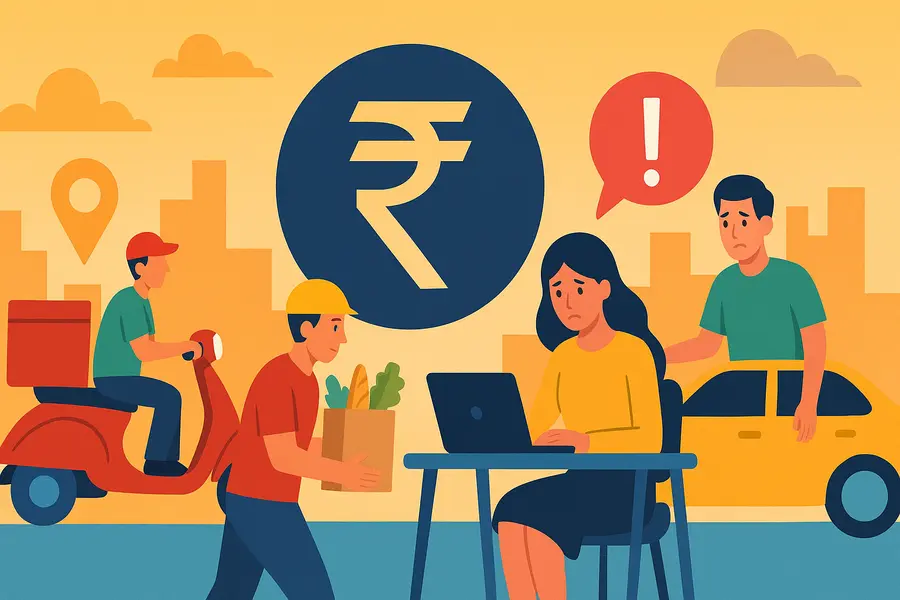
How Does the Gig Economy Increase Job Insecurity in India?
In the last decade, India’s labour market has undergone a remarkable transformation. The rapid expansion of digital platforms, the proliferation of smartphones, and the rise of on-demand services have given birth to a booming gig economy.
From ride-hailing drivers and food delivery riders to freelance designers and online tutors, millions of workers now rely on gig work for their livelihood.
While the gig economy has created new avenues for employment and flexibility, it has also brought with it a wave of uncertainty and insecurity.
Unlike traditional jobs with stable salaries, defined roles, and statutory benefits, gig work is precarious by design—characterised by short-term engagements, unpredictable earnings, and minimal legal protection.
In India, where a large proportion of the workforce already operates outside formal structures, the gig economy’s growth exacerbates existing vulnerabilities and amplifies job insecurity across sectors.
In this article, we will explore how the gig economy increases job insecurity in India, drawing on empirical studies, policy reports, and academic research to offer a nuanced understanding of this critical labour market issue.
What Is the Gig Economy?
The gig economy refers to a labour market characterised by short-term, task-based work arrangements facilitated through digital platforms or transactions. Gig workers are typically classified as independent contractors or freelancers rather than employees. This model contrasts with traditional employment, which involves formal contracts, stable wages, and statutory benefits such as provident funds, paid leave, and health insurance.
In India, the gig economy spans multiple segments:
- Transport and mobility services (e.g., cab drivers, bike taxis)
- Delivery services (e.g., food, groceries, parcels)
- Professional freelancing (e.g., designers, content creators)
- Micro-tasks and crowd work
Across these segments, workers find flexible earning opportunities but often lack security.
Read Here: The Social Dynamics of Gig Economy Labor
Gig Economy Growth in India: Expansion Without Stability
India’s gig economy has witnessed exponential growth. Research indicates that the gig workforce in India has risen significantly over the past decade, expanding into urban and semi-urban employment markets.
Key Growth Drivers
- Technology penetration: Smartphones and internet access significantly lowered barriers to participation for workers and customers alike.
- Service demand: E-commerce, on-demand delivery, and mobility services expanded rapidly.
- Flexible participation: Workers from diverse socio-economic backgrounds can take up gig tasks without formal training or qualifications.
However, this growth has not been paired with robust worker protections or social safety nets.
Absence of Formal Employment Contracts
One of the most significant contributors to job insecurity in the gig economy is the lack of formal employment contracts. A recent survey found that 62% of gig workers in Pune reported having no formal agreement with the platforms they work for—meaning no guaranteed hours, job stability, or enforceable terms of employment.
Why This Matters
Without written contracts:
- Workers cannot legally enforce fair treatment.
- Platforms are not obligated to offer minimum wages or job security.
- Workers are treated as “independent contractors,” not employees.
The result is a systemic vulnerability where workers’ incomes and job continuity depend entirely on platform discretion rather than any statutory obligation.
Irregular and Unpredictable Income
Gig work is inherently contingent on customer demand, platform algorithms, and task availability. Unlike traditional employment with fixed monthly wages, gig earnings fluctuate significantly from week to week and season to season.
Evidence of Income Volatility
- Studies consistently point to income volatility as a key challenge for gig workers in India. Earnings depend on factors like demand spikes, competition, and algorithmic task assignment—a process over which workers have little control.
- Surveys suggest that many gig workers face unpredictable income, making financial planning difficult and limiting access to credit or loans.
This uncertainty discourages long-term financial commitments and increases workers’ vulnerability to economic shocks.
Lack of Social Security and Employment Benefits
Employees in formal sectors in India are entitled to a range of benefits, including:
- Provident Fund (retirement savings)
- Health insurance
- Paid leave
- Gratuity
- Maternity benefits
Gig workers, however, are usually excluded from these protections due to their classification as independent contractors.
Consequences
- No retirement savings or pension
- No paid sick or annual leave
- No employer-funded healthcare
- No compensation for job loss
This absence of benefits means workers must bear all risk associated with health crises, aging, and unemployment. As India’s population ages and life expectancy rises, the lack of safety nets becomes a growing economic and social challenge.
Regulatory Gaps and Legal Ambiguity
One of the structural reasons behind job insecurity in India’s gig economy is the regulatory vacuum. Indian labour laws have traditionally been designed for the formal sector and struggle to classify and regulate gig work effectively.
Classification Issues
- Gig workers are often labelled “partners” or “independent contractors,” a legal categorisation that exempts platforms from standard employer obligations.
- This ambiguity allows platforms to avoid obligations related to minimum wages, social security, and worker rights.
Policy Responses
India has taken steps towards regulating gig and platform work (for example, updated labour codes aiming to define gig work and extend some protections). However, practical implementation and enforcement remain uneven.
Algorithmic Management and Worker Vulnerability
Unlike traditional jobs with human supervision and predictable schedules, gig work is often governed by opaque algorithms that determine:
- Job assignment
- Earnings per task
- Performance ratings
Workers rarely understand how these systems operate or how to appeal decisions.
Effects of Algorithmic Control
- Sudden deactivations (loss of access to jobs) without clear explanation
- Earnings reduced through high platform commission rates
- Performance scores affecting future work opportunities
This algorithmic control intensifies job insecurity, as workers can lose income or access to work without warning.
Occupational Risks and Lack of Protections
Gig workers, particularly those in delivery and transport, often face physical risks without adequate institutional support.
Insurance and Claims Challenges
Although some regulations mandate insurance coverage for delivery workers, many struggle to claim compensation due to administrative hurdles, incomplete documentation, or unclear policy terms—leaving injured workers and their families financially exposed.
These conditions add to workers’ economic insecurity and demonstrate how regulatory gaps translate into real-world vulnerabilities.
Psychological Stress and Mental Health Impact
Job insecurity isn’t limited to financial instability—it also affects mental health. Research on gig workers shows a strong correlation between precarious work conditions and psychological stress, including anxiety and depression.
Additional Stressors
- Unpredictable earnings
- Lack of work-life balance
- Isolation (no workplace community or union support)
- Constant performance pressure
These factors collectively undermine workers’ well-being and long-term productivity.
Gender Dimensions of Gig Work Insecurity
Women gig workers often face compounded challenges:
- Digital exclusion and safety concerns
- Unequal access to high-paying tasks
- Greater vulnerability due to limited social safety nets
Studies show that job insecurity and lack of protections disproportionately affect women in gig roles, exacerbating their economic and social marginalisation.
The Broader Economic Context
India’s labour market already bears high levels of informality. Even before the surge in gig work:
- A large share of workers lacked formal employment contracts
- Many depended on seasonal or casual labour
The gig economy extends this trend, but often without even the minimal protections that exist in some informal sectors.
Wider Market Pressures
During economic downturns, gig workers face the first and deepest impact:
- Reduced customer demand
- Tasks cut by platforms to save costs
- No unemployment benefits
Thus, job insecurity in the gig economy is not isolated—it reflects broader structural weaknesses in India’s labour market.
Policy & Reform Pathways
Addressing gig job insecurity in India requires multi-layered policy interventions:
Clear Legal Definition of Gig Work: A statutory classification that recognises gig workers as a distinct labour category with tailored protections.
Social Security and Minimum Standards: Mandatory inclusion in social security schemes, minimum wage protection, and benefits such as health and accident insurance.
Grievance Redressal Mechanisms: Platforms must establish transparent, accessible systems for dispute resolution.
Data and Worker Registries: State and federal efforts to map and register gig workers can help in policy design and benefit delivery. Some states like Maharashtra are already drafting policies to protect gig workers’ rights and benefits.
Worker Organisations and Collective Bargaining: Support for unions or worker associations to strengthen bargaining power and ensure fair treatment.
Conclusion
India’s gig economy offers vital opportunities for labour market participation, flexibility, and income generation. Yet this growth has come with a significant trade-off: heightened job insecurity. From the lack of contracts and irregular earnings to deficient social protections and regulatory gaps, gig workers face vulnerabilities that undermine both economic stability and personal well-being.
Addressing job insecurity in India’s gig economy requires thoughtful policies, legal reform, and stakeholder engagement that balances flexibility with fundamental worker rights.
With proper safeguards, the gig economy can evolve from a source of precarious work to a sustainable engine of inclusive employment.