Working women play a powerful role in driving social mobility by increasing household income, investing in children’s education, strengthening financial inclusion, and challenging traditional gender norms.
When women earn and lead, families gain stability, communities grow stronger, and future generations access better opportunities. Their workforce participation doesn’t just change individual lives — it reshapes economic trends and accelerates long-term upward mobility across society.
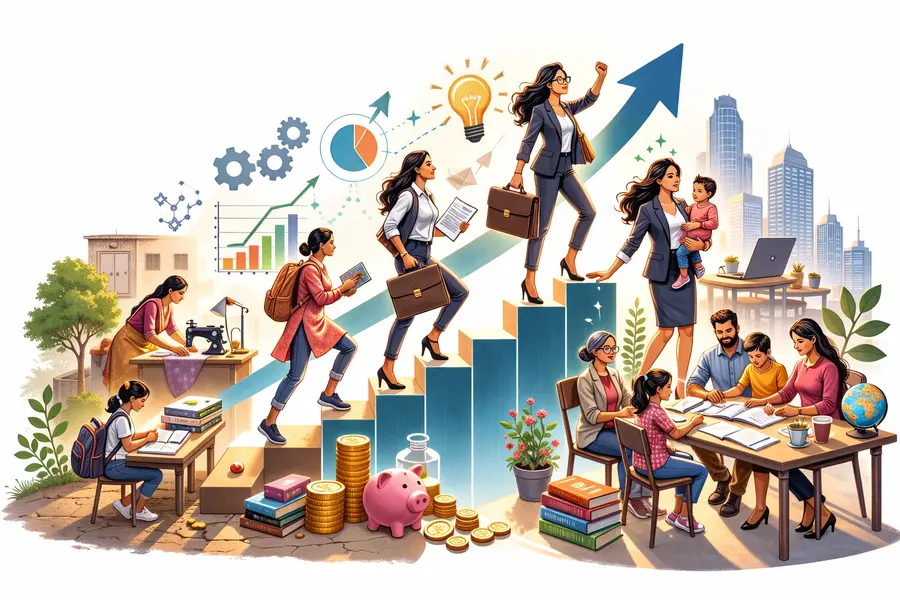
How Working Women Drive Social Mobility: Decoded
What role do working women play in social mobility trends? The answer is both powerful and measurable. Across developing and developed economies alike, women’s participation in the workforce has reshaped income distribution, education access, health outcomes, and long-term generational progress.
When women earn, families invest differently. When women lead, institutions evolve. And when barriers fall, entire communities rise.
From urban corporate offices to rural self-help groups, working women are accelerating economic transformation. Their impact goes beyond salaries — it influences children’s education, financial literacy, entrepreneurship, healthcare access, and policy reform.
In countries like India, where demographic dividends and digital expansion intersect, women’s employment is directly tied to inclusive growth.
Let’s explore how working women act as catalysts of upward mobility — and why empowering them is one of the smartest long-term investments any society can make.
Working Women Increase Household Income Stability
One of the most direct impacts of working women on social mobility is improved household income stability. Dual-income families are less vulnerable to economic shocks, job losses, and inflationary pressures. When women contribute financially, families diversify their income streams, reducing risk and increasing savings potential.
Research from organizations such as World Bank consistently shows that higher female labor force participation correlates with poverty reduction. In lower-income households, a woman’s earnings often represent the difference between subsistence living and financial growth.
Importantly, women are more likely to allocate income toward essential needs — education, healthcare, nutrition, and housing improvements. These investments build long-term resilience rather than short-term consumption patterns.
This financial stability enables families to move from survival mode to strategic planning mode — saving for higher education, investing in businesses, or purchasing property. Over time, this creates a measurable shift in social class positioning and economic security across generations.
Working Women Invest More in Children’s Education
When women earn, children benefit — especially daughters. Multiple global studies demonstrate that mothers prioritize education spending more consistently than fathers. This creates a compounding effect on intergenerational mobility.
Data from UN Women highlights that increased female income significantly boosts school enrollment and completion rates. Educated children are more likely to access better employment opportunities, higher salaries, and leadership roles.
In many households, working mothers also model ambition and resilience. Children grow up witnessing financial independence and professional responsibility. This shifts cultural expectations around gender roles and career aspirations.
The result? A generation that sees education not as optional but essential. Social mobility accelerates when knowledge replaces limitation. By directly influencing how household resources are spent, working women play a foundational role in breaking cycles of poverty and enabling upward economic movement.
Read Here: How to improve access to quality education for girls in India
Working Women Strengthen Financial Inclusion
Financial inclusion is a cornerstone of social mobility. When women enter the workforce, they open bank accounts, access credit, purchase insurance, and participate in digital payments. This expands their economic footprint.
Initiatives like India’s Jan Dhan Yojana, supported by institutions such as the Reserve Bank of India, have significantly increased women’s formal financial participation. Financial independence allows women to build credit histories, start businesses, and manage assets.
Access to financial tools empowers women to move from informal labor markets to structured economic systems. It also improves decision-making power within households.
Over time, this shifts economic agency. Women who control income are better positioned to negotiate investments, support entrepreneurship, and protect against financial emergencies. Social mobility is not just about earning more — it is about accessing systems that multiply wealth. Working women are central to that transition.
Working Women Drive Entrepreneurship and Job Creation
Working women are not only employees — they are employers. Female entrepreneurship is a powerful social mobility engine.
From microenterprises to tech startups, women-led businesses create local employment opportunities and stimulate regional economies.
According to data from the International Labour Organization, women-owned businesses are rising globally, particularly in emerging markets. These ventures often reinvest profits locally, strengthening community development.
Entrepreneurship offers women control over time, income, and expansion strategies. It also challenges structural barriers in traditional labor markets.
Importantly, women entrepreneurs tend to hire more women, creating inclusive growth cycles.
When female employment expands, household incomes diversify across entire communities. This collective upliftment pushes social mobility beyond individual families into broader economic transformation.
Workforce Participation Changes Social Norms
Social mobility is not purely economic — it is cultural. When women participate in the workforce, perceptions about gender roles evolve. Societies begin to value merit over tradition.
Employment provides visibility. Women in leadership, education, medicine, government, and technology challenge stereotypes and inspire policy reform. Their presence in public spaces normalizes equality.
Over time, this reduces discriminatory hiring practices and improves workplace inclusivity. Countries with higher female labor force participation often show stronger gender equality indicators.
Changing norms also impacts marriage age, fertility rates, and educational aspirations. Working women shift the narrative from dependence to partnership within families. Cultural evolution creates an environment where both boys and girls can pursue ambition without structural limitations.
This transformation fuels sustainable social mobility that extends far beyond income levels.
Working Women Improve Health and Nutrition Outcomes
Economic independence directly affects health decisions. Women with income have greater autonomy in seeking medical care, accessing preventive services, and investing in nutrition.
Studies cited by the World Health Organization indicate that maternal employment correlates with improved child health indicators. Financial control allows timely healthcare access and balanced diets.
Healthier families are more productive, more educated, and more financially secure. Reduced medical debt also protects families from falling back into poverty.
This connection between income and health creates a powerful cycle: healthy individuals are better positioned to pursue education and employment, which further strengthens economic mobility.
Working women serve as gatekeepers of this virtuous loop, ensuring that financial gains translate into long-term well-being.
Working Women Influence Policy and Institutional Reform
As women gain economic power, they also gain political voice. Working women often advocate for workplace protections, maternity benefits, equal pay, and childcare support.
Global bodies like the International Monetary Fund have emphasized that gender equality in labor markets contributes to macroeconomic stability. Policy reform increasingly reflects this understanding.
When women participate in governance, policies become more inclusive and family-focused. This improves education systems, healthcare access, and social security frameworks.
Institutional reform strengthens the foundation of upward mobility. Laws protecting employment rights, property ownership, and inheritance rights empower future generations.
Thus, working women influence not just households but entire governance structures — reinforcing systems that support long-term social advancement.
Digital Employment Is Expanding Opportunities
The digital economy has unlocked new pathways for women’s employment. Remote work, e-commerce, online education, and freelance platforms allow women to overcome mobility and cultural restrictions.
Digital inclusion initiatives have expanded access to smartphones and internet connectivity in rural areas. This has enabled participation in online marketplaces and skill development programs.
Technology reduces geographical limitations. Women can work globally while residing locally. This shifts income possibilities and reduces migration pressures.
Moreover, digital literacy strengthens confidence and adaptability — key drivers of social mobility in a rapidly changing economy.
As digital ecosystems grow, women who embrace technology gain access to higher-paying and scalable opportunities.
The digital shift represents one of the most promising accelerators of upward mobility for working women worldwide.
Conclusion
Working women are not just participants in economic systems — they are architects of social mobility.
Through income generation, educational investment, financial inclusion, entrepreneurship, health improvements, policy influence, and digital adoption, they transform the trajectory of families and nations.
When women work, societies grow smarter, stronger, and more resilient. Empowering women in the workforce is not a social obligation alone — it is an economic imperative for sustainable progress.