Natural inequality arises from biological differences like age, health, or physical ability, while social inequality is created by societal structures such as class, caste, and gender. Sociologically, this distinction is important because natural differences become unequal outcomes only through social processes. Understanding both helps explain how inequality is formed, justified, and challenged in society.
Let’s explore the distinction between natural and social inequalities and their sociological relevance.
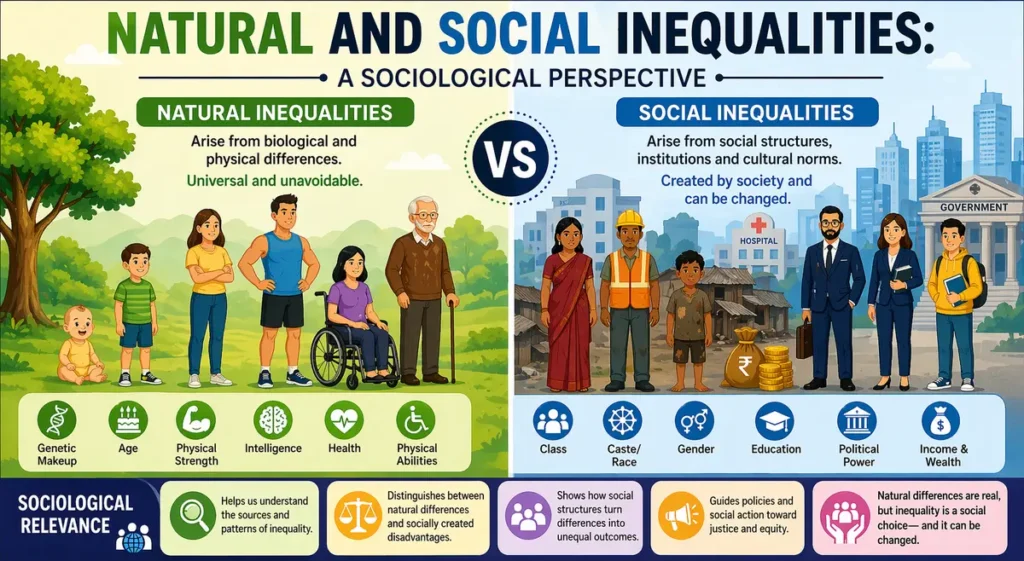
The Distinction between Natural and Social Inequalities and Their Sociological Relevance
Inequality is a central concern in sociology because it shapes how individuals experience life, access opportunities, and interact within society. Broadly, inequalities can be understood as either natural or social in origin.
Natural inequalities arise from biological or physical differences such as age, health, or genetic traits. In contrast, social inequalities are created and maintained by social structures, institutions, and cultural norms.
While natural differences are inevitable, their interpretation and consequences are often influenced by society.
This distinction is important because it helps us understand how certain inequalities become entrenched and unjust.
Sociologists do not merely observe differences; they critically examine how societies assign value to these differences and how this affects power, privilege, and access to resources.
If we distinguish between natural and social inequalities, we can gain a clearer understanding of how inequality operates and how it can be challenged or reduced in modern societies.
Understanding Natural Inequality
Natural inequality refers to differences among individuals that arise from biological or physical characteristics. These include variations in age, sex, physical strength, intelligence, and health. Such inequalities are considered inherent because they are largely beyond human control and exist in all societies.
For example, an elderly person may have less physical strength than a young adult, or a person with a disability may face certain physical limitations. These differences are not created by social systems but are part of human diversity.
However, sociology emphasizes that natural inequalities do not automatically lead to disadvantage. The impact of these differences depends on how society responds to them.
For instance, modern societies often provide support systems such as healthcare and assistive technologies to reduce the effects of physical limitations.
Thus, while natural inequality is unavoidable, its consequences are socially mediated. Understanding this helps us avoid assuming that all inequalities are justified simply because they are based on natural differences.
Understanding Social Inequality
Social inequality, unlike natural inequality, is created through social processes and institutional arrangements. It refers to unequal access to resources, opportunities, and privileges within a society.
Social inequalities are shaped by factors such as class, caste, gender, race, and education. For example, individuals born into wealthy families often have better access to education and healthcare than those from poorer backgrounds.
What makes social inequality significant is that it is not inevitable; it is constructed and can therefore be changed.
Sociologists study how systems like the economy, education, and politics contribute to maintaining these inequalities.
Social norms and cultural beliefs also play a role in justifying or challenging unequal arrangements. For instance, gender inequality persists in many societies due to deeply rooted cultural expectations.
If we understand social inequality, we can recognize that many disadvantages are not natural but are the result of human decisions and structures.
This awareness is crucial for developing policies and movements aimed at creating a more equitable society.
Key Differences Between Natural and Social Inequality
The distinction between natural and social inequality lies primarily in their origins and implications.
Natural inequality arises from biological differences, while social inequality is a product of human-made systems.
Natural inequalities are generally universal and unavoidable, whereas social inequalities vary across societies and historical periods.
Another key difference is in their moral and political significance. Natural inequalities are often seen as neutral, but social inequalities are subject to ethical evaluation because they involve questions of fairness and justice.
For example, differences in physical ability are natural, but denying opportunities to someone based on caste or gender is socially constructed and unjust.
Furthermore, social inequality often amplifies natural differences. A person with a physical disability may face greater challenges not because of the disability itself, but because society fails to provide adequate support.
This shows how social factors can intensify or reduce the impact of natural inequalities. Recognizing these differences helps sociologists analyze inequality more effectively and propose meaningful solutions.
Sociological Relevance of Natural Inequality
Natural inequality is sociologically relevant because it interacts with social systems in complex ways. While biological differences exist independently, their social interpretation determines their impact.
For example, age-based differences can lead to ageism, where older individuals are marginalized despite their experience and knowledge.
Similarly, physical differences can result in discrimination if society values certain traits over others.
Sociologists study how societies accommodate or fail to accommodate natural differences. Welfare systems, healthcare policies, and inclusive education are examples of how societies attempt to address the effects of natural inequality. These measures reflect the idea that while differences are natural, inequality in outcomes is not inevitable.
The study of natural inequality also helps in understanding the limits of equality. It raises important questions about fairness, such as whether equal treatment is always appropriate or whether equity requires different treatment based on individual needs.
Thus, natural inequality remains an important area of sociological inquiry, especially in discussions about justice and inclusion.
Sociological Relevance of Social Inequality
Social inequality is one of the core concerns of sociology because it directly affects life chances and social mobility. It determines who has access to education, employment, healthcare, and political power.
Sociologists analyze patterns of inequality to understand how they are produced and reproduced over time.
One key concept in this context is the idea of structural inequality, where social systems systematically disadvantage certain groups.
For example, caste-based inequality in India or racial inequality in other societies illustrates how deeply embedded these patterns can be.
Social inequality also influences identity and social relations, shaping how individuals perceive themselves and others.
Studying social inequality is essential for addressing issues of justice and human rights. It provides the basis for policy interventions and social movements aimed at reducing disparities.
By examining social inequality, sociology not only explains how inequality exists but also offers pathways for creating a more just and inclusive society.
Read Here: The Impact of Social Stratification on Our Society
Interplay Between Natural and Social Inequality
Natural and social inequalities are not entirely separate; they often interact and reinforce each other.
A natural difference, such as a disability, may become a source of social inequality if society fails to provide adequate support or opportunities.
Similarly, biological traits like gender can be used as a basis for social discrimination, leading to unequal treatment.
This interplay highlights the role of social structures in shaping the consequences of natural differences.
For example, a society with inclusive policies and accessible infrastructure can minimize the disadvantages associated with physical limitations. On the other hand, a lack of such measures can exacerbate inequality.
Understanding this interaction is crucial for developing effective strategies to reduce inequality. It shifts the focus from merely accepting differences to actively addressing the social conditions that create disadvantage.
By recognizing how natural and social inequalities are interconnected, sociologists can better analyze the roots of inequality and advocate for more equitable social arrangements.
Read Also: The Intersectionality of Gender, Race and Class in Social Experiences