Various theories explain the origin of the caste system in India, including traditional (divine), occupational, racial, political, religious, and economic perspectives. These theories suggest that caste developed through factors like division of labor, social control, cultural differences, and belief systems. Rather than a single origin, the caste system evolved gradually over time, shaped by multiple social, historical, and cultural influences.
Understanding Various Theories on the Origin of Caste System in India
The caste system in India is one of the most debated and complex social structures in human history. Its origins have fascinated scholars, historians, and sociologists for centuries.
While many people associate caste with rigid social hierarchy and inherited status, its beginnings are far from simple or universally agreed upon.
Different theories attempt to explain how and why this system emerged, each offering a unique perspective shaped by historical, cultural, and political contexts.
Some theories trace caste to ancient religious texts, while others link it to economic roles, racial distinctions, or power structures.
Understanding these theories is important because it helps us see caste not as a fixed or timeless system, but as something that evolved over time.
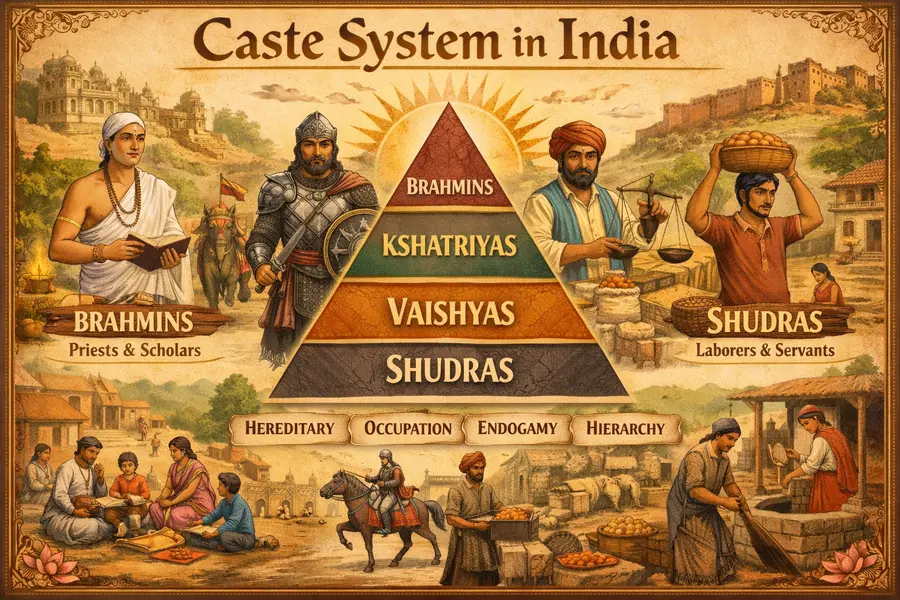
Caste System in India
The caste system is a traditional social stratification framework that organizes society into hierarchical groups based on birth and occupation.
Caste is defined as a rigid form of social division that regulates status, roles and interactions within communities. Its characteristics include hereditary membership, endogamy (marriage within the same caste), occupational specialization, and social restrictions that maintain hierarchy.
The system historically emphasized purity and pollution, shaping social behavior and access to resources.
The caste system originated during the Vedic period (c. 1500–500 BCE) as the varna system, initially a functional division of labor (Brahmins, Kshatriyas, Vaishyas, Shudras) based on occupation rather than rigid birthright. Over time, this evolved into a hereditary social hierarchy, influenced by notions of ritual purity, Aryan migration, and the social stratification of different occupations.
This framework evolved into thousands of jatis (sub-castes), reflecting local customs and professions.
While deeply embedded in Indian society, the caste system has been legally challenged in modern times, though its cultural and social influence continues to persist in various forms.
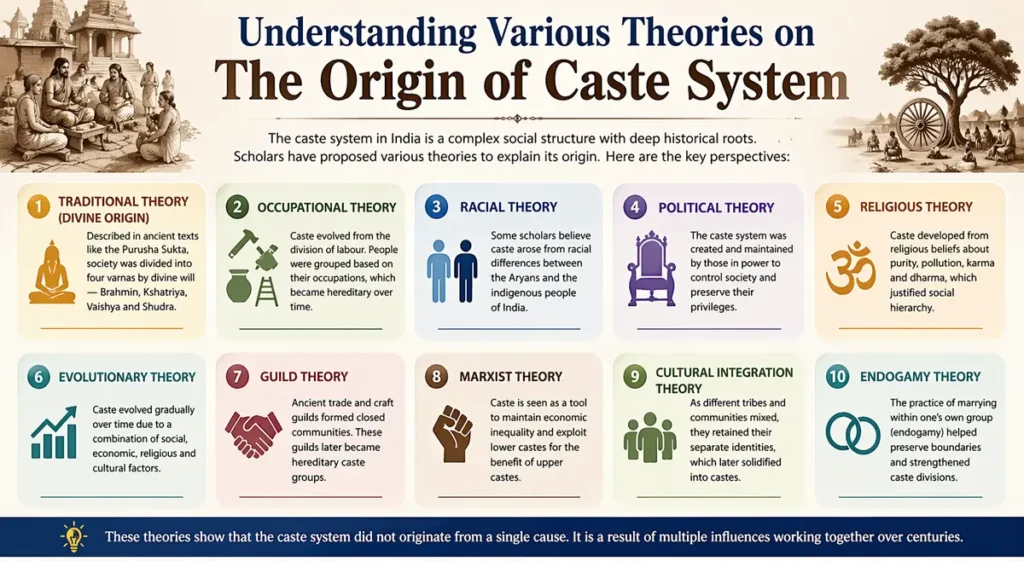
Key Theories on the Origin of Caste system
Let’s explore various major theories on the origin of the caste system in India in a clear, academic manner, making it easier to grasp this deeply layered subject.
Traditional Theory (Divine Origin)
The traditional theory suggests that the caste system originated from divine will, as described in ancient Hindu texts.
According to the Purusha Sukta hymn in the Rigveda, society was divided into four varnas based on the body parts of a cosmic being, Purusha.
The Brahmins emerged from the head, Kshatriyas from the arms, Vaishyas from the thighs, and Shudras from the feet. This symbolic representation aimed to justify social hierarchy as natural and sacred.
Supporters of this theory believe that caste divisions were meant to maintain order and balance in society. However, critics argue that this explanation was created later to legitimize existing inequalities.
While the theory holds religious significance, it does not fully explain the social and economic complexities of caste formation.
Occupational Theory
The occupational theory explains the caste system as a result of division of labor in ancient Indian society.
According to this view, people were grouped based on their professions, such as priests, warriors, traders, and laborers. Over time, these occupational groups became hereditary, meaning children followed the profession of their parents. This gradually led to rigid social categories, forming castes.
The theory highlights how practical needs of society, like specialization and efficiency, contributed to the development of caste divisions. It also suggests that caste was not initially about hierarchy but about organization.
However, critics argue that this theory cannot explain why certain occupations were considered superior or inferior. It also does not fully address how social mobility became restricted over time.
Racial Theory
The racial theory connects the origin of caste with the arrival of different racial groups in India, particularly the Indo-Aryans.
According to this theory, the fair-skinned Aryans who migrated into India considered themselves superior to the darker-skinned indigenous people.
To maintain their dominance, they created social divisions that later evolved into caste. The higher castes were associated with Aryans, while lower castes were linked to indigenous groups.
This theory was widely supported by early European scholars. However, modern research has challenged the idea of clear racial distinctions in ancient India.
Genetic and archaeological evidence suggests a more complex pattern of mixing among populations.
Therefore, while race may have influenced social divisions, it cannot fully explain the origin of caste.
Political Theory
The political theory argues that the caste system was created and maintained by those in power to control society.
According to this perspective, ruling classes, especially Brahmins and Kshatriyas, developed caste rules to preserve their authority and privileges.
By assigning fixed roles and limiting social mobility, they ensured that power remained concentrated within certain groups. Religious texts and rituals were used as tools to justify and reinforce this structure.
This theory emphasizes the role of social control and governance in shaping caste. It also explains why caste rules became stricter over time.
However, critics point out that this theory may oversimplify the origins by focusing mainly on power dynamics and ignoring cultural and economic factors that also played significant roles.
Religious Theory
The religious theory focuses on the role of rituals, purity, and pollution in the development of the caste system.
According to this view, caste divisions emerged from the need to maintain religious order and spiritual cleanliness.
Different groups were assigned varying levels of purity, with priests considered the purest and manual laborers often seen as impure. These beliefs influenced social interactions, such as marriage, food sharing, and occupation.
The concept of karma and rebirth also reinforced caste roles, as people believed their social position was a result of past actions.
This theory explains the strong connection between caste and religion in India. However, it does not fully account for the economic and political factors that also contributed to caste formation.
Evolutionary Theory
The evolutionary theory suggests that the caste system developed gradually over time rather than emerging from a single cause. It combines elements of occupational, religious, and political factors to explain caste formation.
According to this view, early social divisions based on work and function slowly became rigid due to cultural practices and social norms. Over generations, these divisions turned into hereditary groups with strict rules.
The theory highlights the dynamic nature of society and how multiple influences shaped caste. It also explains regional variations in caste practices across India.
Unlike other theories, it does not rely on a single explanation but sees caste as a result of continuous change. However, its broad approach can make it less precise in identifying specific causes.
Guild Theory
The guild theory links the origin of caste to ancient trade guilds or professional associations. In early Indian society, craftsmen and traders formed guilds to protect their economic interests and maintain quality standards.
These guilds often became closed groups, where membership was restricted and passed down within families. Over time, these professional guilds evolved into caste groups with fixed identities.
The theory highlights the role of economic organization in shaping social structure. It also explains how occupational groups gained social recognition and stability.
However, critics argue that guilds alone cannot explain the rigid hierarchy and social restrictions seen in the caste system. While the theory adds an economic dimension, it does not fully capture the cultural and religious aspects involved.
Marxist Theory
The Marxist theory views the caste system through the lens of class struggle and economic exploitation.
According to this perspective, caste divisions were created to maintain control over resources and labor. The upper castes, who owned land and wealth, used the system to exploit the lower castes, who provided labor.
This theory emphasizes inequality and power relations, suggesting that caste is closely linked to economic class. It also highlights how caste has been used to justify social and economic disparities over time.
However, critics argue that the Marxist approach may overlook the cultural and religious dimensions of caste. While it offers valuable insights into inequality, it cannot fully explain the unique features of the caste system in India.
Cultural Integration Theory
Cultural Integration Theory was proposed by S.C. Roy. It states that caste resulted from the integration and assimilation of the Indo-Aryan varna system and the tribal systems of the Dravidians.
As different tribes, communities, and migrants came into contact, they brought their own customs, beliefs, and social practices. Instead of merging completely, many groups preserved their distinct identities. Over time, these differences became formalized into separate social categories, which later developed into castes.
This theory highlights how caste acted as a mechanism to manage diversity while maintaining social order. It also explains why India has a large number of castes and sub-castes with unique traditions.
However, critics argue that this theory does not fully explain the rigid hierarchy and inequality associated with caste, focusing more on diversity than power relations.
Theory of Endogamy (Marriage-Based Theory)
The theory of endogamy emphasizes the role of marriage restrictions in the origin of the caste system.
According to this view, castes developed when social groups began practicing strict endogamy, meaning individuals were required to marry within their own group. This practice helped preserve cultural identity, occupation, and social status across generations. Over time, these closed marriage circles became rigid and hereditary, forming distinct castes.
The theory gained importance through the work of sociologists who studied how marriage rules shape social structure. It explains why caste boundaries are so strictly maintained even today.
However, critics note that endogamy alone cannot explain the origin of caste, as it may be more of a reinforcing factor rather than the initial cause of caste divisions.
Read Here: How Sociology Explains Natural and Social Inequalities
Conclusion
The origin of the caste system in India cannot be explained by any single theory. As discussed, different perspectives—ranging from divine and religious explanations to occupational, political, and economic interpretations—offer valuable insights into its complex development.
Each theory highlights a specific factor, such as social organization, cultural diversity, or power dynamics, that contributed to the formation of caste over time.
Rather than emerging suddenly, the caste system evolved gradually through a combination of historical processes and societal changes.
This multi-dimensional understanding helps us move beyond simplistic explanations and recognize caste as a dynamic institution shaped by various influences.
Studying these theories is important not only for academic purposes but also for understanding the social realities of India today. It encourages critical thinking and provides a deeper awareness of how deeply rooted structures can evolve, adapt, and continue to influence society across generations.
Read Here: How Caste-Based Violence Affects Rural India