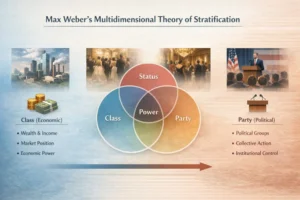
Comparative Perspectives on Power: Insights from Marx, Weber, Michels and Foucault
Power is the capacity of individuals, groups, or institutions in society to influence, command, or shape the actions, beliefs and lives of others.
Power is conceptualized differently across sociological theory. Karl Marx, Max Weber, Robert Michels, and Michel Foucault provide distinct, foundational perspectives on power.
Marx focused on economic power and class struggle, while Weber emphasized rational-legal authority and social domination. Michels introduced the “iron law of oligarchy,” highlighting inevitable elite control, and Foucault redefined power as pervasive, disciplinary, and embedded in knowledge.
Let’s elaborate the concept of power based on the contribution of Max Weber, Karl Marx, Robert Michels and Michel Foucault.
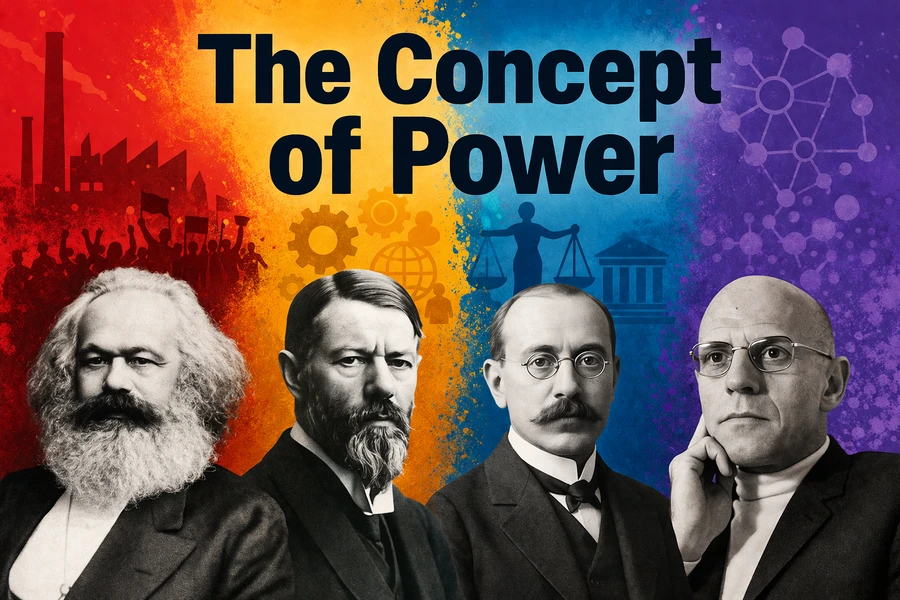
Understanding the Concept of Power Based on the Contributions of Marx, Weber, Michels and Foucault
Power is a central concept in sociology and political thought. It helps us understand how individuals, groups, and institutions influence decisions, shape behavior, and control resources.
Power operates at many levels, from everyday interactions to large political systems. It is not always visible or forceful; often, it works through ideas, norms, and accepted rules.
Different thinkers have explained power in different ways depending on their theoretical perspectives and historical contexts.
Some see power as tied to economic control, while others view it as embedded in social institutions or knowledge systems. Studying power allows us to understand inequality, authority, resistance, and social change.
The contributions of Max Weber, Karl Marx, Robert Michels, and Michel Foucault provide diverse and influential interpretations of how power functions in society.
Marx focuses on structural domination, Weber on legitimized authority, and Michels on the organizational aspects of power, specifically within democratic organizations and Foucault on omnipresent, decentralized, productive power.
What is the Concept of Power?
Power refers to the ability of an individual or group to influence or control the behavior of others, even against their will. It can exist in different forms such as political power, economic power, social power, and cultural power.
Power is not limited to force or coercion; it can also operate through persuasion, authority, and legitimacy. In many cases, people obey power because they believe it is rightful or normal.
Power is present in all social relationships, including family, education, workplace, and government institutions. It shapes access to resources, opportunities, and decision-making processes.
Power can be visible, like laws and rules, or invisible, like social norms and expectations. Understanding power helps explain how inequality and order are maintained or challenged in society.
Sociological Theories of Power by Marx, Weber, Michels and Foucault
Karl Marx: Power as Class Exploitation (Macro-Perspective)
Karl Marx (1818 – 1883) viewed power as deeply connected to economic structures. He argued that power lies in the control of the means of production, such as land, factories, and capital.
In capitalist societies, the ruling class (bourgeoisie) holds power because it owns these resources. The working class (proletariat) has less power because it depends on wages.
Marx believed that this unequal distribution of economic power leads to exploitation and class conflict. He also argued that dominant ideas in society reflect the interests of the ruling class.
Power, therefore, is not neutral but serves to maintain inequality. For Marx, social change occurs through class struggle, where the oppressed challenge the power of the dominant class.
Max Weber: Power as Domination and Authority (Multi-Dimensional)
Max Weber (1864–1920) defines power as the ability to impose one’s will despite resistance, acting as a broad, multi-dimensional force. He refines this into domination (Herrschaft), the probability that a command will be obeyed. Domination becomes authority when it is deemed legitimate by those who obey.
Weber focused on how power becomes stable through legitimate authority. According to him, people accept power when they believe it is justified. He identified three types of authority: traditional, charismatic, and legal-rational.
Traditional authority is based on customs and long-standing practices. Charismatic authority depends on the personal qualities of a leader. Legal-rational authority is based on formal rules and laws, common in modern bureaucracies.
Weber emphasized that authority is more effective than force because it is accepted by people. His analysis shows how institutions maintain order by making power appear legitimate and acceptable in everyday life.
Robert Michels: Power as Organizational Bureaucracy (Elite Theory)
Robert Michels (1876–1936) focused on power within organizations. He developed the concept of the “Iron Law of Oligarchy,” which states that all organizations, regardless of how democratic they are, tend to become controlled by a small group of leaders.
He argued that all large-scale organizations, including democratic parties, inevitably evolve into oligarchies run by a small, self-serving leadership class. He believed power concentration is a technical necessity of bureaucracy, which destroys democratic participation.
According to Michels, large organizations need structure, leadership, and decision-making efficiency. Over time, leaders gain more control over information and resources, which increases their power. Ordinary members become less involved in decision-making. As a result, power becomes concentrated in the hands of a few.
Michels argued that this process is almost unavoidable in complex societies. His theory highlights how power can shift from the masses to elites, even in systems that aim to promote equality and participation.
Michel Foucault: Power as Knowledge and Discipline (Micro-Perspective)
Michel Foucault (1926–1984) offered a different perspective by arguing that power is not only held by individuals or groups but is spread throughout society.
Michel Foucault’s analysis of power, particularly in his middle period (represented by works like Discipline and Punish), shifts focus away from “macroscopic” views—such as the state, law, or ruling classes—to a “micro-perspective” or “microphysics of power.
Foucault believed that power operates through knowledge, language, and social practices. According to him, institutions such as schools, hospitals, and prisons shape how people think and behave.
Power works by creating norms and defining what is considered true or acceptable. This form of power is subtle and often unnoticed.
Foucault also introduced the idea that power and knowledge are closely connected; those who control knowledge can influence reality.
Unlike other thinkers, he did not see power only as repressive but also as productive, as it creates identities, behaviors, and social systems.
His theories are vital for understanding how institutions (schools, hospitals, prisons) shape individual subjectivity in the modern world.
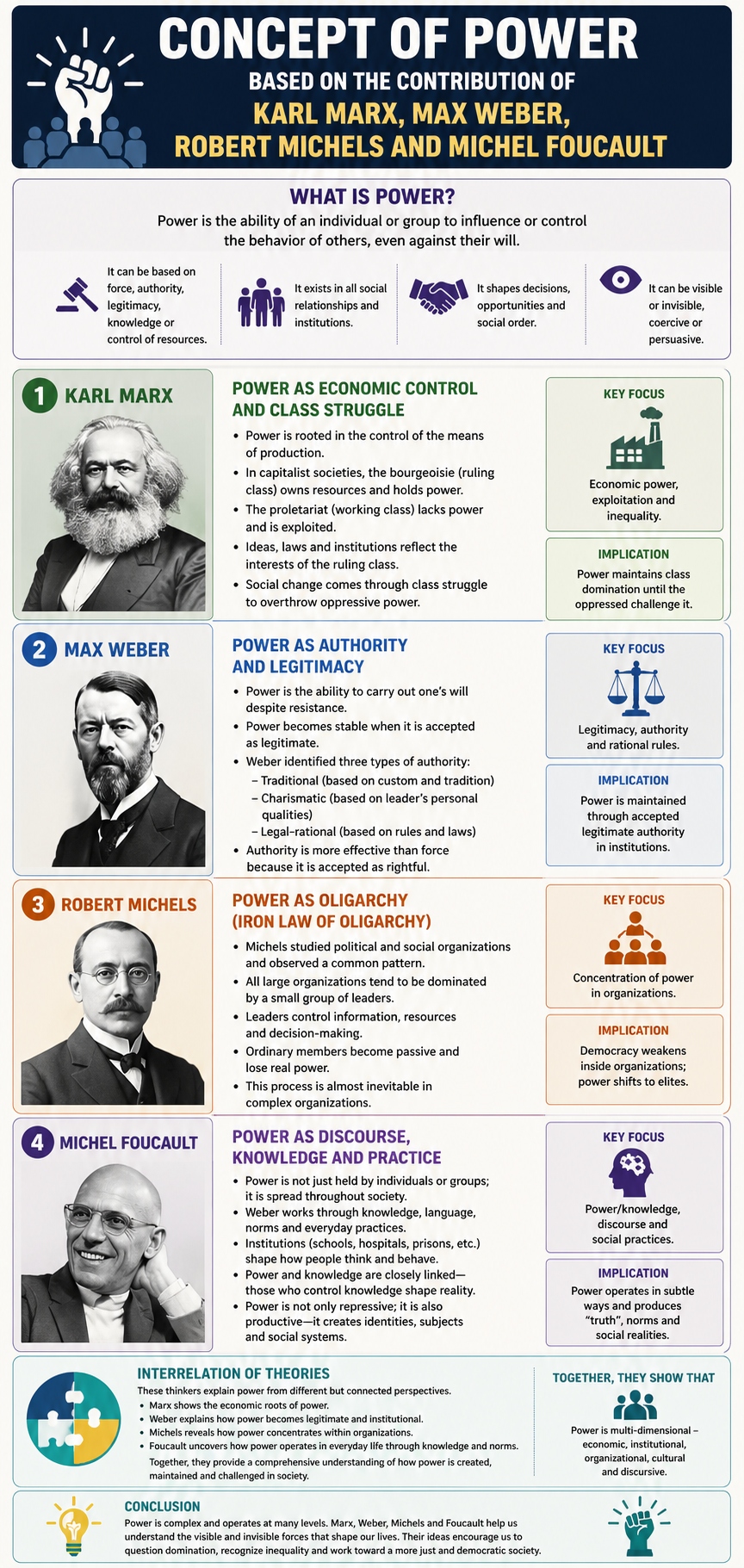
Interrelation of Different Theories of Power
Although these thinkers offer different views, their ideas can be connected.
Karl Marx focuses on economic power, while Max Weber expands this by including legitimacy and authority. Both recognize inequality but explain it differently.
Robert Michels adds an organizational perspective, showing how power becomes concentrated even in democratic settings.
Michel Foucault further broadens the concept by explaining how power exists in everyday practices and knowledge systems.
Together, these theories show that power is not limited to one area. It operates through economic control, social structures, institutions, and cultural norms.
While Marx emphasizes conflict, Weber highlights legitimacy, Michels shows organizational concentration, and Foucault reveals hidden mechanisms.
Their ideas complement each other by providing a multi-dimensional understanding of power. This combined approach helps explain how power is created, maintained, and challenged in complex societies.
Read Here: Exploring Power in Local Communities: Contributions of Miller and Dahl
Conclusion
The concept of power is complex and multi-layered, as shown by different sociological perspectives. Power is not only about force or domination but also about legitimacy, structure, and knowledge.
Max Weber explains how power becomes stable through authority, while Karl Marx highlights its roots in economic inequality. Robert Michels shows how power concentrates within organizations, and Michel Foucault reveals how it operates through everyday practices and knowledge.
These perspectives provide a deeper understanding of how power functions in society. They show that power is present in all areas of life and affects both individuals and institutions.
If we study these theories, we can better understand inequality, control, and resistance, and how societies maintain order or move toward change.
Read Here: The Sociological Foundations of Legitimacy and Authority