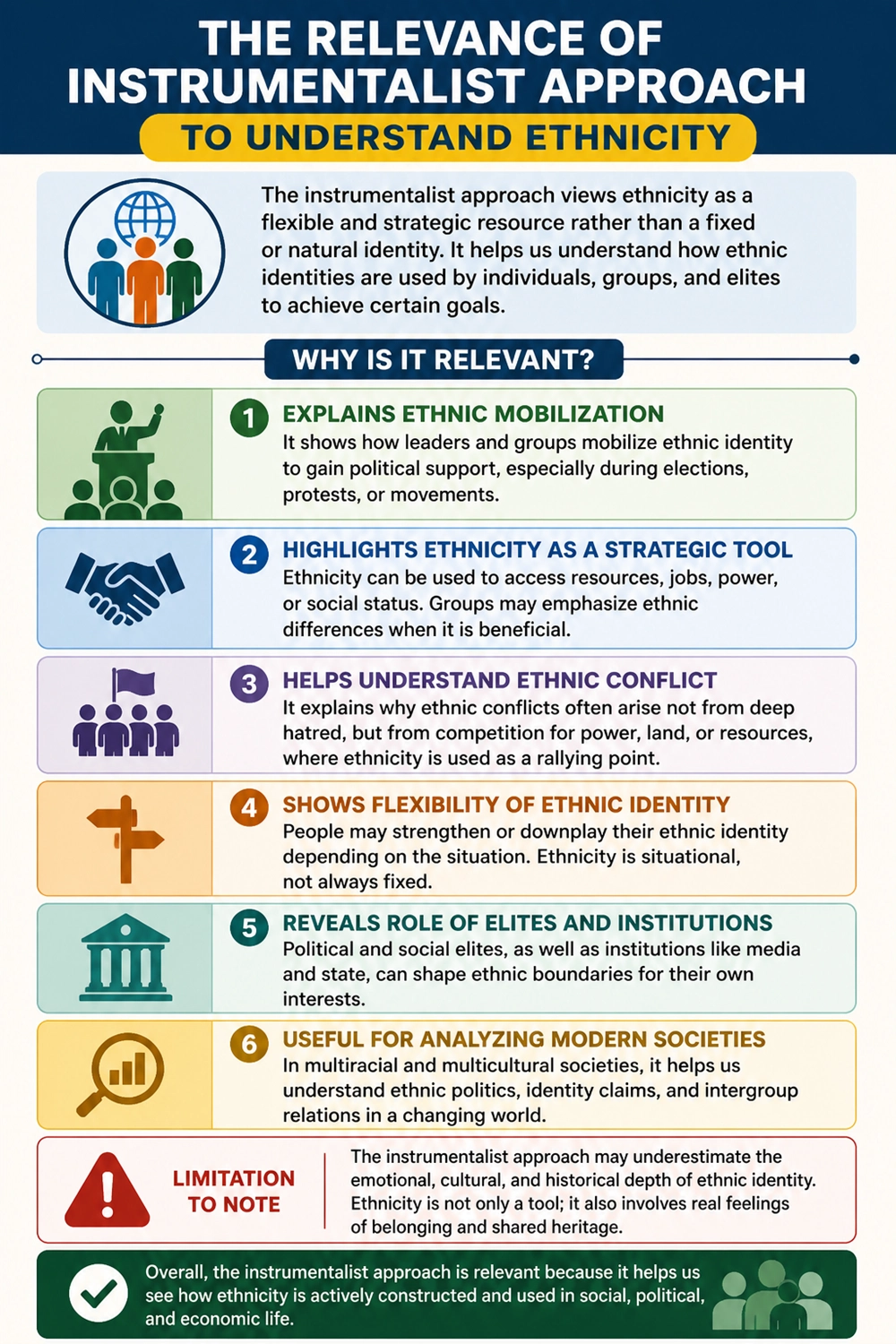
The instrumentalist approach is highly relevant for understanding ethnicity in modern societies. It explains that ethnic identity is flexible and can be used as a tool to achieve political, economic, or social goals. Leaders and groups may highlight ethnic differences to gain support or resources.
This approach helps explain ethnic mobilization, conflict, and cooperation in different contexts. It shows that ethnicity is not always fixed or natural, but often shaped by circumstances. However, it may overlook emotional and cultural attachments linked to ethnic identity.

The Relevance of Instrumentalist Approach to Understand Ethnicity: A Sociological Analysis
Ethnicity is a complex and dynamic social phenomenon that shapes identities, relationships, and power structures in societies.
Sociologists study ethnicity to understand how cultural differences, shared histories, and social boundaries influence human interaction.
One important way to analyze ethnicity is through the instrumentalist approach, which views ethnic identity as flexible and often used strategically for political or economic gain.
Alongside this, several sociological perspectives—such as primordialism, constructivism, and conflict theory—offer different explanations of how ethnic identities emerge and function.
Key thinkers in the field of race and ethnicity have contributed to these debates by examining inequality, discrimination, and identity formation.
Let’s explore the relevance of the instrumentalist approach, outline major sociological perspectives, and highlight influential scholars. These ideas help explain how ethnicity operates in both everyday life and broader social systems.
The Instrumentalist Approach to Ethnicity
The instrumentalist approach argues that ethnicity is not fixed or natural but is shaped and used by individuals or groups for specific purposes. It suggests that ethnic identities can be mobilized to gain political power, economic advantages, or social influence.
Leaders and elites often emphasize ethnic differences to unite people for collective goals, especially during elections or conflicts. This approach highlights how ethnicity can be flexible and situational rather than permanent. For example, people may stress or downplay their ethnic identity depending on the context.
Instrumentalism is especially useful in understanding ethnic conflicts, where identity is used as a tool rather than a deep-rooted cause.
However, critics argue that this view may overlook emotional attachments and cultural depth associated with ethnicity.
Despite this limitation, the instrumentalist approach remains relevant because it explains how ethnicity is actively constructed and strategically used in modern societies.
Primordialism: Ethnicity as Fixed Identity
Primordialism presents ethnicity as a natural and deeply rooted aspect of human identity. According to this perspective, ethnic ties are based on shared ancestry, language, religion, and culture. These connections are seen as emotional and long-lasting, often passed down through generations.
Primordialists argue that people feel a strong sense of belonging to their ethnic group, which cannot easily be changed or manipulated. This approach helps explain why ethnic conflicts can be intense and persistent, as they are linked to deep emotional bonds.
However, critics argue that primordialism is too rigid and does not account for changes in identity over time. It assumes that ethnicity is unchanging, which is not always true in diverse and globalized societies.
Despite its limitations, primordialism remains important because it highlights the emotional and cultural significance of ethnic identity in shaping human behavior and social relationships.
Constructivism: Ethnicity as Socially Created
Constructivism views ethnicity as a social construct that is created and shaped through historical, political, and social processes.
Unlike primordialism, it argues that ethnic identities are not fixed but can change over time. Social institutions, such as the state, education systems, and media, play a key role in defining and reinforcing ethnic categories.
Constructivists emphasize that ethnicity is produced through interaction and shared meanings rather than inherited traits alone. This perspective helps explain how new ethnic identities can emerge and how existing ones can be redefined.
It also highlights the role of power in shaping ethnic boundaries. For example, governments may classify populations into ethnic groups for administrative or political purposes.
Constructivism is widely accepted in sociology because it accounts for both continuity and change in ethnic identities. It provides a flexible framework to understand ethnicity in modern, multicultural societies.
Conflict Theory and Ethnicity
Conflict theory explains ethnicity in terms of power, inequality, and competition for resources. It argues that ethnic divisions often arise because of economic and political struggles between groups.
Dominant groups may use ethnicity to justify inequality and maintain control over resources and opportunities.
Minority groups, in turn, may mobilize their ethnic identity to resist oppression and demand rights. This perspective highlights how racism and discrimination are linked to broader systems of inequality.
Conflict theorists also examine how institutions, such as law and education, can reinforce ethnic hierarchies. This approach is useful in understanding issues like racial segregation, ethnic violence, and social exclusion.
However, critics argue that conflict theory may overemphasize economic factors and ignore cultural aspects of ethnicity.
Despite this, it remains a powerful tool for analyzing how ethnicity is connected to social justice and structural inequality.
Max Weber and Ethnic Identity
Max Weber provided an influential sociological understanding of ethnicity by defining ethnic groups as those who believe in a shared ancestry. He argued that this belief does not have to be based on actual biological ties but on perceived common origins.
Weber emphasized that ethnicity is a subjective and social phenomenon rather than a purely biological one. He also linked ethnicity to social status and group closure, where groups maintain boundaries to protect their privileges.
Weber’s ideas bridge the gap between primordial and constructivist approaches, as he recognized both emotional attachment and social construction. His work is important because it highlights how identity is shaped by both belief and social interaction.
Weber’s perspective continues to influence modern studies of ethnicity, especially in understanding how group identities are formed and maintained in complex societies.
Fredrik Barth and Ethnic Boundaries
Fredrik Barth shifted the focus of ethnic studies from cultural content to social boundaries. He argued that what defines an ethnic group is not the cultural traits themselves but the boundaries that separate one group from another.
According to Barth, these boundaries are maintained through social interaction and can persist even when cultural differences change. This approach highlights the dynamic nature of ethnicity and the importance of social processes in maintaining group identity.
Barth’s work supports the constructivist view by showing that ethnicity is not fixed but continuously negotiated. His theory is especially useful in studying multicultural societies, where different groups interact regularly.
It also explains how ethnic identities can remain stable despite changes in language, customs, or traditions.
Barth’s contribution is significant because it provides a clear framework for understanding how ethnic groups are formed and sustained over time.
W.E.B. Du Bois and Race Consciousness
W.E.B. Du Bois made major contributions to the study of race and ethnicity, especially through his concept of “double consciousness.” He explained how marginalized groups, particularly African Americans, experience a sense of divided identity by seeing themselves through their own perspective and through the eyes of a dominant society.
Du Bois emphasized that race is not a biological reality but a social construct shaped by history and power. He also highlighted the role of racism in creating inequality and limiting opportunities. His work combines elements of conflict theory and constructivism, focusing on both structural inequality and identity formation.
Du Bois’s ideas remain relevant in understanding how race affects social experiences and self-perception. His emphasis on awareness and resistance has influenced both academic research and social movements. He is widely regarded as a foundational thinker in the sociology of race and ethnicity.
Read Here: Exploring Racial Inequality in the Workplace
Symbolic Interactionism and Ethnicity
Symbolic interactionism focuses on everyday social interactions and how people create and interpret meanings. In the study of ethnicity, this approach examines how individuals express, negotiate, and perform their ethnic identities in daily life.
Ethnicity is not just a large social structure; it is also shaped through language, symbols, dress, food, and behavior. People learn what their ethnic identity means through interaction with others. This perspective shows that ethnicity is dynamic and situational. For example, a person may emphasize their ethnic background in one setting and minimize it in another.
Symbolic interactionism also highlights how stereotypes and labels influence social interactions and self-identity. It is especially useful for understanding micro-level experiences, such as discrimination or cultural expression.
However, critics argue that it may ignore larger structures of power and inequality. Despite this, it provides valuable insight into how ethnicity is lived and experienced.
Postcolonial Theory and Ethnicity
Postcolonial theory examines how colonial histories have shaped modern ethnic identities and relations. It argues that many ethnic divisions today are influenced by colonial rule, where European powers classified and categorized populations for control.
These classifications often created or reinforced ethnic differences that continue after independence.
Postcolonial scholars highlight how knowledge, language, and representation were used to justify domination.
Ethnicity, in this view, is linked to power, history, and global inequality. This approach also explores how formerly colonized societies resist and redefine imposed identities. It emphasizes the importance of voice and perspective, especially of marginalized groups.
Postcolonial theory is useful in understanding ethnic conflicts in regions like Africa and South Asia, where colonial boundaries disrupted social structures.
Critics argue that it may overemphasize colonial impact and overlook internal dynamics. Still, it remains crucial for analyzing the global and historical dimensions of ethnicity.
Intersectionality and Ethnicity
Intersectionality examines how ethnicity interacts with other social categories such as gender, class, religion, and age. It argues that individuals experience identity and inequality in multiple, overlapping ways.
For example, the experience of an ethnic minority woman may differ significantly from that of a man from the same group. This approach helps move beyond simple categories and shows the complexity of social life. It also highlights how systems of power, such as racism, sexism, and class inequality, are interconnected.
Intersectionality is important for understanding diverse experiences within the same ethnic group. It challenges the idea that ethnicity alone can explain social outcomes. This perspective is widely used in contemporary sociology because it promotes a more inclusive and nuanced analysis.
However, some critics argue that it can become too complex to apply easily. Despite this, it remains essential for understanding the layered nature of identity and inequality.
Assimilation Theory
Assimilation theory explains how ethnic minorities gradually adopt the culture of a dominant group. It suggests that over time, differences in language, customs, and values decrease as groups integrate into mainstream society.
Early versions of this theory assumed a one-way process, where minorities were expected to give up their original identity. This is often referred to as “melting pot” assimilation.
However, modern versions recognize that assimilation can be partial and varied. Some groups may retain key aspects of their culture while adapting in other areas. This approach helps explain patterns of integration, especially among immigrants.
Critics argue that assimilation theory can ignore inequality and pressure minorities to conform. It may also overlook the value of cultural diversity. Despite these criticisms, it remains useful for understanding long-term social integration and identity change in multicultural societies.
Multiculturalism and Ethnicity
Multiculturalism is both a sociological perspective and a policy approach that values cultural diversity within a society. It argues that different ethnic groups should be recognized, respected, and allowed to maintain their cultural identities.
Unlike assimilation theory, multiculturalism does not expect minorities to abandon their traditions. Instead, it promotes coexistence and mutual respect. This approach is often linked to democratic values, human rights, and inclusion. It is especially relevant in diverse societies where multiple ethnic groups live together.
Multiculturalism helps reduce discrimination by encouraging acceptance and understanding. However, critics argue that it may lead to social fragmentation or weaken national unity.
Others suggest that it may overlook inequalities within ethnic groups. Despite these debates, multiculturalism remains an important framework for managing diversity and promoting social harmony in modern societies.
Conclusion
The instrumentalist approach remains highly relevant for understanding ethnicity in contemporary societies. It shows that ethnic identity is not always fixed or natural, but can be shaped and used strategically by individuals and groups.
This perspective helps explain how ethnicity becomes a powerful tool in politics, economic competition, and social organization. It is especially useful in analyzing ethnic mobilization, conflict, and identity-based movements. At the same time, it highlights the role of leaders, institutions, and changing contexts in shaping ethnic boundaries.
However, the approach has limits, as it may overlook the deep emotional and cultural meanings attached to ethnicity. Therefore, it is best used alongside other perspectives.
Overall, the instrumentalist approach provides a practical and realistic framework to understand how ethnicity operates in modern, diverse, and dynamic societies.
Read Here: The Intersectionality of Gender, Race and Class in Social Experiences