Why Do People Still Believe in Religion Despite Scientific Progress?
For centuries, people have predicted that scientific progress would eventually make religion disappear. As humanity discovered the laws of nature, explored the universe, developed modern medicine, and understood the origins of life, many thinkers believed that religious explanations would gradually become unnecessary.
But history has not followed that simple prediction.
Science has transformed almost every aspect of human life, yet religion remains an important part of societies across the world.
Millions of people continue to attend religious services, celebrate religious festivals, follow spiritual traditions, and find meaning through their beliefs.
At the same time, many people in scientifically advanced countries are becoming less religious. A growing number identify as atheists, agnostics, or people with no religious affiliation.
So, what is really happening? Is science slowly replacing religion, or are science and religion answering different questions about human existence?
The evidence suggests that science will continue to challenge some religious beliefs and interpretations, but scientific progress does not automatically lead to the disappearance of religion.
Religion is connected not only to explanations of the natural world but also to identity, morality, community, culture, meaning, and human experiences.
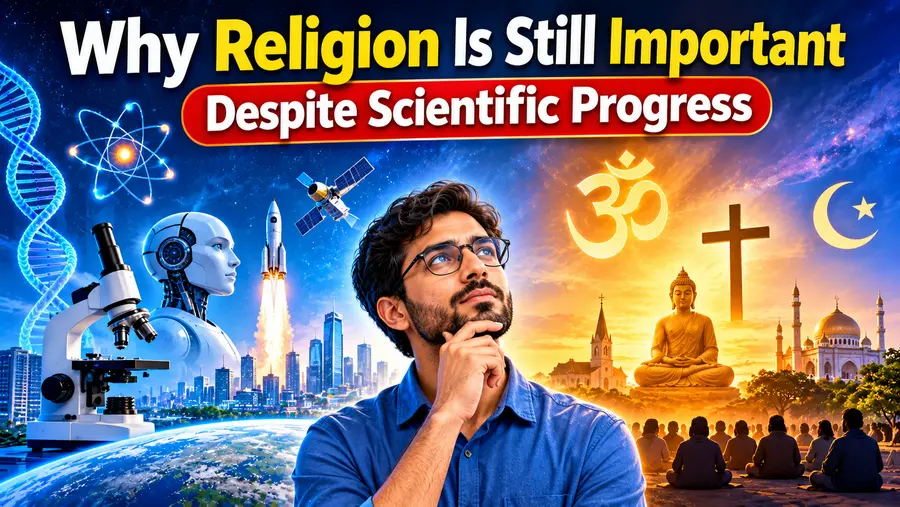
Let’s explore why religion is not going away, why the prediction of its global disappearance has not come true, and how science and religion can coexist.
Why Did People Predict That Science Would Destroy Religion?
The idea that science would eventually replace religion became particularly influential during the 19th century.
During this period, Europe experienced major scientific, industrial, and intellectual changes. Discoveries in biology, physics, astronomy, and medicine challenged traditional explanations of the natural world.
Many intellectuals believed that human societies were moving through predictable stages of development. According to this view, people would gradually abandon supernatural explanations as scientific knowledge expanded.
One influential thinker was the French philosopher Auguste Comte, who proposed that human thought passed through three broad stages:
- The theological stage: People explain natural events through gods, spirits, and supernatural forces.
- The metaphysical stage: People replace supernatural explanations with abstract philosophical ideas.
- The positive or scientific stage: People rely on observation, experimentation, and scientific laws to understand the world.
Comte believed that scientific knowledge represented a more advanced stage of human development.
This way of thinking influenced some later social scientists, who expected religion to decline as societies became more educated, industrialized, urbanized, and scientifically advanced.
In 1966, anthropologist Anthony Wallace expressed a similar prediction. He expected belief in supernatural powers to disappear globally as scientific knowledge became more widespread.
However, the prediction turned out to be too simple.
Scientific knowledge expanded dramatically, but religion did not disappear. In some countries, religious movements became politically influential, while in others, traditional beliefs remained deeply rooted in everyday life.
The assumption that every society would eventually become secular was not supported by the complexity of global history.
Is Religion Actually Declining Around the World?
The answer depends on which country, religious group, and measurement we examine.
Some societies have experienced substantial declines in religious identification and participation. Others remain highly religious, while some religious populations have grown because of demographic changes.
A major Pew Research Center study published in June 2025 examined global religious changes between 2010 and 2020 using more than 2,700 censuses, surveys, and population registers.
Its findings provide a useful picture of the global situation.
According to the study:
- Approximately 76% of the world’s population identified with a religion in 2020.
- The share of Christians declined from 31% in 2010 to 29% in 2020.
- The Muslim share increased from 23% to 26%.
- The share of religiously unaffiliated people increased from 23% to 24%.
- The Hindu share remained relatively stable at around 15%.
- The Buddhist share declined from 5% to 4%.
These figures show that religious change is real, but it is not happening in the same direction everywhere. Pew Research Center’s global religious landscape report provides the detailed findings.
Why Are Some Countries Becoming Less Religious?
Several Western countries have experienced increasing religious disaffiliation.
For example, the United States, Australia, the United Kingdom, France, and several European countries have seen growing numbers of people identify as having no religion.
There are several possible explanations:
- Greater social acceptance of atheism and non-religious identities.
- Declining trust in some religious institutions.
- Changes in family structures and religious upbringing.
- Greater individual freedom to choose or reject religious traditions.
- Cultural changes associated with urbanization and education.
- Disagreement with religious institutions over social and political issues.
These developments are important, but they do not demonstrate that religion will disappear worldwide.
A decline in religious affiliation in one country cannot automatically be treated as a universal pattern.
Why Does Religion Remain Strong in Other Societies?
Religion remains deeply influential in many parts of Asia, Africa, the Middle East, and Latin America.
In these societies, religious traditions often shape family life, festivals, marriage customs, community relationships, moral values, and cultural identity.
For many people, religion is not simply a collection of beliefs about supernatural beings. It is also a way of understanding their place in the world and maintaining connections with family and community.
Demographic factors matter too.
Pew Research Center’s analysis found that the Muslim population grew faster than other major religious groups between 2010 and 2020, largely because Muslims had a relatively young population and higher fertility rates.
This demonstrates that religious populations can change because of demographic patterns, not necessarily because more people are being converted by religious arguments. Read Pew’s analysis of the factors driving religious change.
Why Scientific Progress Does Not Automatically Make People Non-Religious
One of the biggest misunderstandings in discussions about science and religion is the assumption that scientific knowledge and religious belief must always move in opposite directions.
This assumption overlooks the different roles that science and religion often play in people’s lives.
Science investigates the natural world through observation, experimentation, mathematical models, and evidence.
Religion often deals with questions of meaning, purpose, moral responsibility, spiritual experience, and humanity’s relationship with what believers understand as the divine.
These areas can overlap, especially when religious claims concern the physical world. But they are not identical.
For example, science can investigate how stars form, how the human brain works, and how life evolved.
However, the philosophical question of why the universe exists at all is broader than simply describing its physical development.
A person may accept the scientific explanation of the Big Bang and biological evolution while also believing that the universe ultimately depends on a Creator.
Another person may accept exactly the same scientific findings but conclude that no supernatural explanation is necessary.
Scientific knowledge alone does not force everyone to adopt the same philosophical worldview.
Read Here: Is There Definitive Proof of the Existence of God?
Science and Religion Are Not Always Enemies
The popular idea that science and religion have always been engaged in a permanent war is often called the conflict thesis.
This view became influential through books such as John William Draper’s History of the Conflict Between Religion and Science (1874) and Andrew Dickson White’s A History of the Warfare of Science with Theology in Christendom (1896).
These works presented the history of science and religion largely as a struggle between two competing ways of understanding reality.
The conflict thesis remains popular in public discussions, but historians of science generally consider the historical relationship more complicated.
There have certainly been conflicts between religious authorities and scientific ideas. However, there have also been periods of cooperation, mutual influence, and intellectual exchange.
Religious Traditions Also Helped Shape Scientific History
Modern science developed through the contributions of thinkers from many religious and cultural backgrounds.
For example:
- Ibn al-Haytham, a medieval Muslim scholar, made important contributions to optics and emphasized systematic investigation.
- Al-Biruni, another Muslim scholar, contributed to astronomy, mathematics, geography, and the study of different cultures.
- Nicolaus Copernicus, a Renaissance-era astronomer and church canon, developed a mathematical model placing the Sun near the center of the planetary system.
- Johannes Kepler, a Christian astronomer, discovered the mathematical laws describing planetary motion.
- Isaac Newton, who studied theology as well as mathematics and physics, made foundational contributions to classical mechanics and gravity.
These examples do not prove that religion caused modern science. Nor do they mean that religious institutions always supported scientific discoveries.
They demonstrate something more important: scientific inquiry has not historically belonged exclusively to non-religious people.
Many scientists have been religious, and many non-religious scientists have made equally important contributions.
The Galileo Affair Was More Complicated Than a Simple Science-versus-Religion Story
The conflict involving Galileo Galilei is frequently presented as the perfect example of religion opposing science.
Galileo supported the heliocentric model, according to which Earth moves around the Sun.
His position challenged the traditional interpretation of the cosmos and brought him into conflict with the Roman Catholic Church.
In 1633, the Inquisition found him strongly suspected of heresy, and he was placed under house arrest.
This was a serious historical conflict, and religious authority played a major role in the outcome.
However, the episode also involved political pressures, institutional authority, competing interpretations of evidence, and disagreements among scholars.
It cannot be reduced to the claim that every religious person opposed science or that every scientific development has been resisted by religion.
History is more complicated than that.
Religion Provides More Than Scientific Explanations
If science can explain natural phenomena, why do people continue to follow religions?
One reason is that religion serves several purposes beyond explaining how the physical universe works.
Religion Gives People a Sense of Meaning and Purpose
Human beings naturally ask questions about existence.
Why are we here? What makes life meaningful? How should we live? What happens after death?
Science can investigate human origins, consciousness, and biological survival. But questions about ultimate purpose involve philosophical and personal interpretations.
Religious traditions provide frameworks through which believers understand these questions.
For many people, the belief that life has a deeper purpose offers comfort, direction, and motivation.
Religion Provides Community and Belonging
Religion is often a shared social experience.
People gather in temples, mosques, churches, gurdwaras, monasteries, and other religious spaces.
They celebrate festivals, participate in ceremonies, support one another, and build relationships across generations.
These social connections can be important sources of emotional and practical support.
Even people whose religious beliefs are uncertain may continue participating in religious traditions because of their family, culture, and community.
Religion Helps People Deal With Uncertainty
Human life involves uncertainty.
People experience illness, grief, financial difficulties, natural disasters, relationship problems, and the loss of loved ones.
Religious beliefs can provide comfort during difficult experiences by offering hope, prayer, rituals, and a sense of connection with something greater than oneself.
This does not mean religion is the only source of emotional support. Family, friendships, psychological care, philosophy, and non-religious communities can also help people cope with uncertainty.
However, religion remains an important source of comfort for many people.
Religion Connects People With Their Cultural Identity
Religious traditions are often closely connected with language, history, family customs, architecture, music, literature, and national identity.
For example, Hindu festivals, Islamic celebrations, Christian holidays, Buddhist ceremonies, and Sikh traditions are not merely private acts of belief.
They also form part of the cultural heritage of millions of people.
Even when people become less religious, they may continue to identify with traditions inherited from their families and communities.
This helps explain why religious identity can survive even when personal belief and religious participation change.
Religion Offers Moral and Ethical Frameworks
Religious traditions often teach values such as compassion, honesty, generosity, forgiveness, justice, self-discipline, and responsibility.
These teachings influence how many believers understand their duties towards other people.
Of course, religion is not the only foundation for morality. Secular philosophers, humanists, and non-religious individuals also develop strong ethical systems.
Nevertheless, religious moral traditions remain influential in many societies.
Does Education and Scientific Knowledge Make People Less Religious?
This is a complicated question.
In some countries, higher levels of education and scientific literacy are associated with lower levels of traditional religious belief or participation.
However, the relationship is not universal.
Education can encourage people to question inherited assumptions, examine religious claims critically, and consider alternative worldviews.
At the same time, many highly educated people remain religious.
Scientists, doctors, engineers, professors, and mathematicians can hold religious beliefs while accepting established scientific findings.
It is therefore inaccurate to assume that religious people are necessarily less educated or less familiar with science.
It is equally inaccurate to assume that scientific education automatically makes people religious.
A person’s worldview is shaped by many factors, including family background, culture, social conditions, personal experiences, philosophical beliefs, and education.
The United States Shows Why the Relationship Is Not Simple
The United States provides an interesting example.
It has a highly developed scientific and technological system, world-leading research universities, and major contributions to medicine, physics, engineering, and space exploration.
At the same time, religion has historically played a significant role in American public and private life.
However, the country has also experienced a substantial rise in religious disaffiliation.
Pew Research Center’s 2025 global analysis found that the share of Americans identifying as religiously unaffiliated increased considerably between 2010 and 2020.
This suggests that scientific advancement and religious change do not follow a simple, universal relationship.
A society can be scientifically advanced and religiously active at the same time, while also experiencing growing secularization.
How Political Conflicts Can Turn Science and Religion Against Each Other
Another important reason the science-versus-religion debate continues is politics.
Scientific research sometimes becomes associated with political movements, social identities, or ideological positions.
When this happens, people may begin judging scientific ideas based on their political or cultural associations rather than examining the evidence itself.
This can create unnecessary hostility.
The Debate Over Evolution
Evolution by natural selection is one of the foundations of modern biology.
It explains how populations of living organisms change over generations and how species share common ancestry.
The evidence comes from genetics, fossils, comparative anatomy, observed evolutionary changes, and many other fields.
However, some religious communities reject evolutionary theory because they interpret sacred texts as providing a different account of biological origins.
Other religious thinkers accept evolution and interpret their religious traditions in ways they consider compatible with modern biology.
The important distinction is between the scientific theory of evolution and the philosophical claim that life has no purpose or divine origin.
Evolutionary biology does not, by itself, establish philosophical atheism.
When people treat acceptance of evolution as equivalent to rejecting every form of religion, they create a false choice between scientific knowledge and religious belief.
Political Identity Can Encourage Distrust of Science
Similar problems occur when scientific findings become associated with political or cultural disputes.
For example, disagreements over climate change, public health, reproductive technologies, and environmental policies can become entangled with religious and political identities.
In such situations, people may reject scientific conclusions because they associate them with a political group or social agenda.
This is harmful because scientific evidence should be evaluated on its own merits.
Religious leaders and communities can contribute positively to discussions about public health, environmental protection, education, and social welfare when they engage honestly with reliable evidence.
Science also benefits when researchers communicate respectfully with communities that hold different cultural and religious beliefs.
Can Religious People Accept Modern Science?
Yes. Many religious people accept mainstream scientific explanations while maintaining their religious beliefs.
For example, a religious person may accept that:
- Earth is approximately 4.54 billion years old.
- The universe has been expanding for about 13.8 billion years.
- Living organisms evolved through natural processes.
- Human beings share common ancestry with other living organisms.
- Diseases have biological causes and can be investigated through medical science.
- Climate change is supported by extensive scientific evidence.
They may interpret these discoveries as descriptions of how the natural world operates rather than as evidence against the existence of God.
There are also religious scientists who work in areas such as genetics, astronomy, medicine, physics, and neuroscience.
However, religious communities are not uniform. Some accept scientific explanations readily, while others reject particular findings when they conflict with their interpretations of religious teachings.
The relationship between religion and science therefore depends partly on how religious beliefs are interpreted and how scientific evidence is understood.
Read Here: Why Is It So Hard for Some Scientists to Believe in God?
Will Religion Become Less Important in the Future?
It is possible that religion will become less influential in some societies.
Changing lifestyles, declining institutional trust, education, urbanization, demographic shifts, and cultural transformation may continue to reduce religious affiliation in certain regions.
But predicting the disappearance of religion worldwide would be premature.
The global religious landscape is influenced by several different forces:
Demographics: Different religious populations have different age structures, fertility rates, and mortality patterns.
Religious switching: People may leave their childhood religion, adopt another religion, or become unaffiliated.
Migration: Migration can change the religious composition of individual countries and communities.
Cultural transmission: Families and communities pass religious traditions from one generation to another.
Social and political conditions: Religious institutions and identities can become more or less influential depending on the political and social environment.
Pew Research Center’s 2025 research highlights the importance of these factors. It found that the global religious landscape changed through a combination of natural population growth and religious switching, rather than through one universal movement towards or away from religion.
The future is therefore likely to be diverse. Some countries may become increasingly secular, while religious communities remain influential or grow in others.
Why Science Needs Religious Communities as Partners, Not Enemies
Science depends on evidence, critical thinking, open debate, and public trust.
Scientific discoveries can improve society only when people are willing to understand and apply them.
Religious communities are important parts of society. They include teachers, parents, doctors, business owners, community leaders, volunteers, and ordinary citizens.
Treating all religious people as enemies of science can create unnecessary distrust.
Instead, scientific institutions should encourage public understanding of scientific evidence while respecting people’s freedom of belief.
Religious leaders can also play a constructive role by supporting scientific education, encouraging medical treatment, promoting environmental responsibility, and correcting misinformation within their communities.
There is no need for scientists to attack religion simply because they disagree with particular theological claims.
Likewise, religious institutions should not reject reliable scientific findings merely because those findings challenge traditional interpretations.
The goal should be intellectual honesty and mutual respect, not a permanent war between two major parts of human civilization.
Frequently Asked Questions (FAQs)
Why is religion not going away?
Religion is not disappearing because it serves several social, cultural, psychological, and philosophical purposes. It provides meaning, community, moral guidance, cultural identity, and spiritual support. Scientific progress does not automatically eliminate these human needs.
Will science eventually replace religion?
There is no reliable evidence that science will eventually replace religion everywhere. Science can explain natural processes and challenge specific religious claims, but religious beliefs also involve questions of meaning, purpose, morality, and spirituality.
Does scientific progress reduce religious belief?
Scientific progress and declining religious belief sometimes occur together, but there is no universal relationship between them. Some scientifically advanced societies remain religious, while others have experienced substantial secularization.
Can science and religion coexist?
Yes. Many people accept modern scientific findings while maintaining religious beliefs. Conflict can arise when religious interpretations contradict strong scientific evidence, but science and religion do not have to be in permanent opposition.
Are educated people less religious?
Not necessarily. Education can encourage critical thinking and questioning, but many highly educated people remain religious. Religious belief is influenced by family, culture, personal experience, philosophy, and social conditions.
What is the secularization theory?
Secularization theory describes the idea that modernization, education, urbanization, and scientific progress may reduce the influence of religion in society. Some versions predict that religion will gradually disappear. However, global religious trends show that secularization is neither universal nor inevitable.
Does evolution disprove religion?
No. Evolution is a scientific explanation of how populations of living organisms change over generations. It challenges certain literal interpretations of creation, but it does not logically disprove every religious or philosophical belief about God.
Is the world becoming more religious or less religious?
The answer varies by region and religious group. Pew Research Center estimated that approximately 76% of the global population identified with a religion in 2020. Some religious groups have grown, while others have experienced declining affiliation. The unaffiliated population has also increased in many countries.
Why do some scientists believe in God?
Scientists have different philosophical and religious beliefs. Some believe that the existence of the universe, the laws of nature, consciousness, or morality points towards a Creator. Others find naturalistic explanations sufficient. Scientific expertise does not automatically determine a person’s religious worldview.
Conclusion: Science Will Advance, but Religion Is Not Disappearing
The prediction that science would eventually destroy religion was based on an overly simple understanding of human society.
Scientific knowledge has expanded enormously, but religion continues to influence the lives of billions of people.
Some societies are becoming more secular, and religious institutions must respond to changing social expectations. At the same time, religious traditions remain deeply connected to family life, cultural identity, moral values, community, and questions about human existence.
Science and religion can disagree, especially when religious interpretations make claims about the physical world that conflict with strong scientific evidence. But these disagreements do not prove that the two must always be enemies.
Science explains many important questions about how the natural world works. Religion addresses questions of meaning, purpose, morality, and spiritual belief for those who follow it.
Neither perspective should be used to misrepresent the other.
Religion is not going away simply because science is advancing. The future is more likely to involve changing religious traditions, growing secular communities, and continuing debates about how scientific knowledge and spiritual beliefs fit into human life.
Rather than expecting science to destroy religion, or religion to defeat science, we should encourage a society in which evidence, reason, freedom of belief, and respectful discussion can coexist.