How Islam can Represent a Model for Environmental Stewardship: Faith, Sustainability and Climate Action
The environmental crisis is one of the most serious challenges facing humanity. Climate change, deforestation, pollution, water shortages, biodiversity loss, and the destruction of natural habitats are affecting ecosystems and communities across the world.
Scientific research explains how human activities contribute to many of these problems. Burning fossil fuels increases greenhouse gas emissions, excessive consumption puts pressure on natural resources, and habitat destruction threatens countless species.
However, solving these challenges requires more than scientific discoveries and technological innovations. It also requires changes in human behaviour, social values, economic priorities, and our relationship with the natural world.
This is where religion and ethical traditions can make an important contribution.
Islam offers a model of environmental stewardship based on human responsibility, moderation, justice, compassion, and respect for the balance of creation. Its teachings encourage people to avoid waste, protect living creatures, use resources responsibly, and recognize that human beings are accountable for their actions.
The Qur’an describes the appearance of corruption on land and sea as a consequence of human actions (30:41). It also emphasizes balance in creation (55:7–9), warns against excessive consumption (7:31), and describes animals and birds as communities like human beings (6:38).
These teachings offer a valuable foundation for Islamic environmental ethics.
In recent years, international initiatives such as the 2015 Islamic Declaration on Climate Change and the United Nations Environment Programme’s Al-Mizan: A Covenant for the Earth have brought renewed attention to the relationship between Islam and sustainability.
Let’s understand how Islamic values can contribute to environmental protection and help build a more sustainable future.
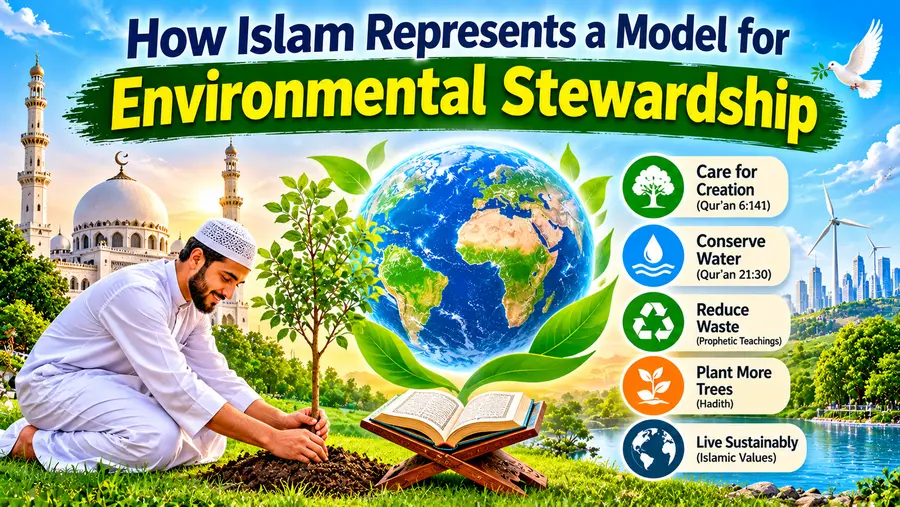
What Is Environmental Stewardship?
Environmental stewardship means taking responsibility for protecting the natural world and using its resources carefully.
It involves understanding that humans depend on healthy ecosystems for food, water, clean air, energy, shelter, and survival.
Environmental stewardship includes activities such as:
- Protecting forests, rivers, oceans, and wildlife.
- Conserving water and energy.
- Reducing pollution and unnecessary waste.
- Preventing the destruction of natural habitats.
- Supporting sustainable agriculture.
- Protecting endangered species.
- Addressing climate change.
- Using natural resources responsibly for future generations.
Environmental stewardship is not limited to planting trees or cleaning public spaces. It also involves making responsible decisions about production, consumption, transportation, agriculture, energy, and economic development.
From an Islamic perspective, protecting nature can also be understood as a moral and spiritual responsibility.
Human beings are part of creation, not separate from it. Their actions affect other living creatures, ecosystems, and future generations.
Why Does Islam Emphasize Environmental Protection?
Islam teaches that the natural world is part of God’s creation and that human beings should treat it with responsibility and respect.
The Qur’an repeatedly draws attention to the Earth, mountains, rivers, plants, animals, rain, stars, and the changing seasons. These are presented as signs that invite people to observe, reflect, and recognize the order and significance of creation.
The relationship between humanity and nature can be understood through several important Islamic principles.
Tawhid: The Unity of Creation
Tawhid is the Islamic belief in the oneness of God.
In environmental ethics, this principle can inspire an understanding that the universe and all its living and non-living components belong to one interconnected creation.
Human beings, animals, plants, mountains, rivers, oceans, and the atmosphere are all part of the same natural world.
This perspective encourages people to look beyond immediate human interests and recognize the importance of ecological relationships.
For example, forests provide habitats for wildlife, absorb carbon dioxide, regulate water cycles, and support human communities. Destroying forests can therefore affect many interconnected systems.
Similarly, polluting rivers can harm fish, aquatic ecosystems, agricultural communities, and human health.
An Islamic ecological perspective encourages people to recognize these connections and treat the natural world with respect.
It does not mean that every aspect of ecology is directly described in religious texts. Modern environmental science explains the physical relationships, while the concept of Tawhid can provide a spiritual and ethical motivation for protecting them.
Khalifah: Human Beings as Stewards of the Earth
One of the important concepts in Islamic environmental discussions is Khalifah.
The Arabic word Khalifah can refer to a successor, representative, or vicegerent. The Qur’an mentions the appointment of a Khalifah on Earth in Surah Al-Baqarah (2:30).
Another relevant passage is Surah Al-An’am (6:165), which describes human beings as successors on Earth and discusses differences in their circumstances and responsibilities.
Environmental thinkers interpret these teachings as emphasizing that human beings have responsibilities toward the world in which they live.
Being a steward does not mean having unlimited permission to exploit natural resources. It means exercising responsibility, avoiding destruction, and recognizing accountability for one’s actions.
For example, a person who owns agricultural land should not simply focus on maximizing short-term production by exhausting the soil, contaminating groundwater, or destroying nearby habitats.
A responsible approach should consider the long-term health of the land and the communities that depend on it.
In practical terms, the concept of Khalifah can encourage:
- Responsible use of natural resources.
- Protection of forests and biodiversity.
- Sustainable agriculture.
- Prevention of environmental pollution.
- Care for future generations.
- Responsible development and environmental planning.
Human stewardship should therefore be understood as a responsibility rather than unrestricted control over nature.
Amanah: The Earth as a Trust
Another important Islamic concept is Amanah, which means trust, responsibility, or something entrusted to someone.
The Qur’an discusses the concept of Amanah in Surah Al-Ahzab (33:72), describing a profound trust associated with human responsibility.
Contemporary Islamic environmental thinkers use this principle to explain that the natural world should be treated as a responsibility entrusted to humanity.
If people consider the Earth a trust, they should not use its resources carelessly or destroy the systems that support life.
For example, water is essential for agriculture, sanitation, drinking, and the survival of ecosystems. Wasting clean water unnecessarily can harm communities, particularly in regions where water is already scarce.
Similarly, forests should not be destroyed simply to obtain short-term economic benefits without considering biodiversity, local livelihoods, and the long-term consequences.
The concept of Amanah encourages people to think beyond personal convenience and consider the wider effects of their decisions.
It also raises an important question: What kind of environment are we leaving for future generations?
Mizan: Respecting the Balance of Nature
Mizan means balance, measure, or proportion.
It is one of the most important Qur’anic concepts used in contemporary Islamic environmental ethics.
In Surah Ar-Rahman (55:7–9), the Qur’an refers to the balance established in creation and instructs people not to transgress that balance.
These verses are frequently discussed in relation to environmental harmony, fairness, and responsible resource use.
The idea is particularly relevant to modern ecological challenges.
Natural systems depend on complex relationships between living organisms, water, soil, air, temperature, and energy.
For example:
- Forests help regulate the carbon cycle.
- Wetlands support biodiversity and water management.
- Oceans influence climate and support marine ecosystems.
- Pollinators contribute to agricultural production.
- Healthy soil supports food production and stores carbon.
When human activities seriously disturb these systems, the consequences can extend across entire ecosystems.
Climate change, deforestation, soil erosion, overfishing, and pollution are examples of pressures that can disrupt environmental balance.
The principle of Mizan can therefore be understood as an ethical reminder that human development should respect ecological limits and social justice.
It does not replace scientific measurements of environmental systems. Rather, it provides a moral perspective that supports responsible behaviour.
Fitrah: Living in Harmony With the Natural Order
Fitrah is generally understood in Islamic thought as the natural disposition or original state associated with human beings.
It is commonly discussed in relation to humanity’s innate orientation toward recognizing God.
In contemporary Islamic environmental writing, the idea of Fitrah is sometimes extended to a broader discussion of harmony between human life and the natural world.
This interpretation encourages people to reflect on the natural order rather than pursue lifestyles that create unnecessary destruction.
For example, a healthy relationship with nature involves respecting ecological processes, using resources carefully, protecting biodiversity, and avoiding excessive consumption.
A person who chooses sustainable food, avoids unnecessary waste, and supports environmental conservation may be applying this broader ethical perspective.
Fitrah should not be presented as a scientific theory of ecology. It is a theological and philosophical concept that can help inspire an environmentally responsible way of life.
Avoiding Israf: The Islamic Principle of Moderation
One of the clearest connections between Islam and environmental sustainability is the prohibition of wastefulness.
The Qur’an says:
“Eat and drink, but do not be excessive. Surely He does not like the wasteful.” (Qur’an 7:31, translation of the Clear Quran)
The Arabic term Israf is commonly used for excess, extravagance, or going beyond proper limits.
This principle has important environmental implications.
Modern lifestyles often involve unnecessary consumption, disposable products, food waste, excessive packaging, and the overuse of energy and water.
Such behaviour increases pressure on natural resources and contributes to environmental pollution.
Islamic teachings encourage moderation rather than unlimited consumption.
The practical meaning is simple:
- Buy what you actually need.
- Avoid wasting food.
- Use electricity responsibly.
- Reduce unnecessary water consumption.
- Reuse products whenever practical.
- Avoid unnecessary purchases.
- Choose durable and repairable goods.
Moderation does not mean rejecting comfort or economic development. It means avoiding unnecessary excess and using resources responsibly.
What Does the Qur’an Say About Protecting Nature?
Several Qur’anic passages are relevant to environmental responsibility. They provide ethical guidance about corruption, balance, waste, and the relationship between human beings and other living creatures.
Qur’an 30:41: Human Actions and Environmental Corruption
One of the most frequently discussed verses in Islamic environmental ethics is Surah Ar-Rum (30:41).
It states:
“Corruption has spread on land and sea as a result of what people’s hands have done, so that Allah may cause them to taste the consequences of some of their deeds, and perhaps they might return.”
This verse is particularly relevant to discussions about environmental responsibility.
It encourages reflection on the consequences of human behaviour and the damage caused by wrongdoing.
Modern Islamic environmental thinkers connect this ethical message with problems such as:
- Water and air pollution.
- Deforestation.
- Destruction of natural habitats.
- Soil degradation.
- Biodiversity loss.
- Unsustainable consumption.
- Climate change.
The verse does not provide a scientific explanation of modern climate change. However, its warning about the consequences of human actions offers a useful moral framework for thinking about environmental damage.
It reminds people that destructive behaviour can have consequences beyond their immediate actions.
Qur’an 6:38: Animals Are Communities Like Human Beings
Another important passage is Surah Al-An’am (6:38), which describes animals and birds as communities similar to human communities.
The verse draws attention to the existence and significance of other living creatures.
This idea has important implications for biodiversity conservation.
Animals are not simply objects or resources that exist for human convenience. They are part of the natural world and play important roles in ecological systems.
For example:
- Bees and other pollinators support plant reproduction and food production.
- Birds help disperse seeds and control insect populations.
- Earthworms contribute to soil health.
- Predators help regulate animal populations.
- Marine organisms contribute to the balance of ocean ecosystems.
Protecting biodiversity is therefore important not only for humans but also for the wider community of life.
Qur’an 55:7–9: The Importance of Balance
Surah Ar-Rahman refers to the balance established in creation and warns people against transgressing that balance.
These verses are widely used in Islamic environmental discussions to highlight the importance of moderation, justice, and proportion.
For modern society, the principle can inspire a more balanced relationship between economic development and environmental protection.
Development should improve human wellbeing without destroying the ecological systems that support life.
What Did Prophet Muhammad Teach About Environmental Protection?
Islamic environmental ethics also draws on the teachings and reported practices of Prophet Muhammad.
Several authentic hadith emphasize the value of planting, agriculture, caring for animals, and avoiding harmful behaviour.
Planting Trees Is a Form of Charity
One well-known narration appears in Sahih al-Bukhari 2320.
The Prophet Muhammad said that when a Muslim plants a tree or sows seeds, and a person, animal, or bird benefits from it, that act is counted as charity.
This teaching offers a powerful connection between environmental protection and religious responsibility.
Planting trees can provide several benefits:
- Absorbing and storing carbon dioxide.
- Providing habitats for birds and insects.
- Reducing soil erosion.
- Supporting local biodiversity.
- Providing shade and improving urban environments.
- Helping regulate local water systems.
However, tree planting should be appropriate to the local ecosystem. Native species, suitable locations, long-term maintenance, and water availability are important.
The hadith encourages beneficial planting, while environmental science helps determine how to do it effectively.
Animals Deserve Care and Compassion
Islamic teachings emphasize kindness toward animals and prohibit cruelty.
This is consistent with the Qur’anic description of animals as communities and with Islamic ethical traditions concerning the treatment of living creatures.
Responsible animal care includes:
- Providing adequate food and water.
- Avoiding unnecessary suffering.
- Protecting natural habitats.
- Preventing cruelty and neglect.
- Supporting humane treatment in agriculture.
- Respecting wildlife and biodiversity.
Modern environmental discussions also recognize the importance of animal welfare and ecosystem protection.
Although animal welfare and biodiversity conservation are not identical subjects, both encourage people to consider the needs of living creatures beyond their immediate human interests.
Agriculture and Food Production Have Spiritual Value
Planting seeds, cultivating crops, and producing food can benefit people, animals, and communities.
The hadith about planting trees and sowing seeds emphasizes the continuing value of agricultural activity when others benefit from it.
This provides an ethical foundation for supporting responsible farming practices.
Sustainable agriculture can include:
- Protecting soil fertility.
- Reducing unnecessary pesticide use.
- Managing water carefully.
- Maintaining agricultural biodiversity.
- Preventing food waste.
- Supporting farmers and rural communities.
The objective is to produce enough food while protecting the environmental systems on which agriculture depends.
How Can Islamic Principles Help Address Climate Change?
Climate change is driven mainly by human activities that increase greenhouse gas concentrations in the atmosphere, particularly the burning of fossil fuels, deforestation, and certain industrial and agricultural processes.
Scientific solutions require major changes in energy systems, transportation, infrastructure, industry, agriculture, and land management.
Islamic environmental principles can support these efforts by encouraging responsible consumption, public participation, social justice, and protection of nature.
Here are some important areas where Islamic values can contribute.
Supporting Renewable Energy
Renewable energy technologies such as solar, wind, hydropower, and geothermal power can help reduce dependence on fossil fuels.
Islamic environmental ethics does not prescribe a particular energy technology, but its emphasis on avoiding harm and protecting future generations can support the responsible transition toward cleaner energy systems.
Mosques, schools, hospitals, and community institutions can consider:
- Installing rooftop solar panels where suitable.
- Improving energy efficiency.
- Using energy-saving lighting.
- Reducing unnecessary electricity consumption.
- Exploring renewable energy for community facilities.
These measures can lower operational costs while reducing environmental impacts.
Protecting Forests and Biodiversity
Forests are important for climate regulation, soil protection, rainfall patterns, and biodiversity.
Islamic teachings encouraging respect for living creatures and the protection of creation can provide motivation for conservation programmes.
Mosques, schools, charitable organizations, and local communities can participate in tree planting, habitat restoration, and biodiversity awareness.
The most effective programmes focus on native plants, ecological restoration, and long-term protection rather than simply counting the number of trees planted.
Conserving Water
Water is one of the most important resources for human survival and ecosystem health.
Islamic teachings encourage moderation and oppose wastefulness. This principle is particularly relevant in regions facing water scarcity.
Practical measures include:
- Repairing leaking taps and pipes.
- Installing water-efficient fixtures.
- Collecting rainwater where permitted and suitable.
- Reusing treated wastewater for appropriate purposes.
- Reducing water-intensive landscaping.
- Improving irrigation efficiency.
Mosques can also demonstrate water conservation through efficient ablution facilities and responsible maintenance of water systems.
Reducing Food Waste
Food waste is an important environmental problem.
Producing, transporting, processing, and storing food requires energy, water, land, and other resources. When food is discarded, these resources are wasted as well.
Islam’s emphasis on moderation provides a useful ethical foundation for reducing food waste.
Muslim households, restaurants, wedding organizers, and community institutions can:
- Prepare food according to actual demand.
- Store food properly.
- Donate safe surplus food.
- Avoid unnecessary food purchases.
- Compost suitable organic waste.
- Support responsible food distribution.
During Ramadan, Eid, weddings, and community gatherings, careful meal planning can help reduce unnecessary waste.
Encouraging Sustainable Consumption
Environmental protection requires more than technological changes.
It also requires people to reconsider patterns of consumption.
Islamic teachings about moderation, simplicity, and avoiding excess can encourage lifestyles that place less pressure on natural resources.
Examples include:
- Buying fewer unnecessary products.
- Repairing items instead of replacing them immediately.
- Reducing single-use plastics.
- Choosing durable products.
- Sharing resources when practical.
- Using public transportation when suitable.
- Avoiding unnecessary energy consumption.
This approach supports the idea of living well without consuming more resources than necessary.
Promoting Climate Justice
Climate change does not affect all people equally.
Poor communities, low-income households, coastal populations, farmers, and people living in climate-vulnerable regions often face serious risks despite contributing relatively little to historical greenhouse gas emissions.
Islamic principles of justice, compassion, and responsibility provide a strong ethical basis for supporting vulnerable communities.
Climate justice can involve:
- Supporting people affected by floods and droughts.
- Improving access to clean energy.
- Protecting farmers and rural livelihoods.
- Supporting climate-resilient housing.
- Promoting fair access to water and food.
- Encouraging responsible policies that protect vulnerable populations.
Environmental stewardship should therefore include both ecological protection and social justice.
What Is the Islamic Declaration on Global Climate Change?
A significant international development in Islamic environmental activism took place in August 2015.
Religious leaders, academics, development experts, and environmental advocates gathered in Istanbul for the International Islamic Climate Change Symposium.
The meeting produced the Islamic Declaration on Global Climate Change.
The declaration called on Muslims, governments, and international institutions to take climate change seriously and support an equitable global response.
It recognized the scientific consensus on human-caused climate change and called for urgent action to reduce greenhouse gas emissions.
Among its important recommendations were:
- Supporting a transition toward renewable energy.
- Moving toward zero-emission development.
- Encouraging governments to establish clear climate targets.
- Calling on wealthier and oil-producing nations to lead emissions reduction efforts.
- Protecting vulnerable communities from climate risks.
- Encouraging Muslim communities to participate in climate action.
The declaration was significant because it connected Islamic moral responsibility with the scientific evidence surrounding climate change.
It also demonstrated that religious institutions can contribute to international environmental discussions.
It was a faith-based declaration and call to action, not a legally binding climate treaty.
Read the Islamic Declaration on Climate Change through the UNFCCC.
What Is Al-Mizan: A Covenant for the Earth?
Another important initiative is Al-Mizan: A Covenant for the Earth, developed through collaboration involving the United Nations Environment Programme and Islamic scholars and organizations.
The initiative was published in 2024 and presents an Islamic perspective on environmental protection, climate change, biodiversity, and sustainable development.
The word Al-Mizan means balance.
The covenant draws attention to Qur’anic teachings about balance, justice, moderation, and humanity’s responsibility toward the natural world.
It seeks to connect Islamic values with contemporary environmental challenges and encourage Muslims and Islamic institutions to support sustainability.
The initiative involved organizations and experts connected with the Muslim Council of Elders, Hamad Bin Khalifa University, the Islamic Foundation for Ecology and Environmental Sciences, and other partners.
According to UNEP, the draft was shared with more than 300 Islamic institutions and international partners for feedback and consultation.
Al-Mizan encourages environmental responsibility at both individual and institutional levels.
Its broader message is that cultural and religious values can support behavioural change alongside scientific, technical, and political solutions.
This is important because environmental problems cannot be solved through technology alone. Public participation, responsible lifestyles, effective governance, and long-term cooperation are also necessary.
The Green JIZ Model: An Islamic Approach to Sustainability
Professor Odeh Al-Jayyousi, a scholar of sustainable innovation and a contributor to environmental discussions associated with UNEP’s Global Environment Outlook 6, has proposed an interesting conceptual framework for connecting Islamic values with climate action.
He calls it the Green JIZ Model.
The framework has three interconnected dimensions:
Green Activism: Jihad
In this context, jihad is used in the sense of striving or making an effort toward a meaningful goal.
Green activism involves working to protect the environment and encouraging society to take responsibility for ecological problems.
Examples include:
- Organizing community clean-up campaigns.
- Supporting environmental protection policies.
- Educating people about climate change.
- Protecting forests and wildlife.
- Encouraging responsible waste management.
- Participating in environmental restoration projects.
Here, the term refers to constructive environmental effort, not violence.
Green Innovation: Ijtihad
Ijtihad refers to independent reasoning and intellectual effort in Islamic legal and scholarly traditions.
In the Green JIZ framework, it is connected with innovation and the development of practical solutions to modern environmental problems.
Examples include:
- Developing renewable energy technologies.
- Creating better water-management systems.
- Improving sustainable agriculture.
- Developing biodegradable materials.
- Designing energy-efficient buildings.
- Using artificial intelligence to monitor ecosystems.
The idea is to combine knowledge, creativity, and responsible innovation to meet environmental challenges.
Green Lifestyle: Zuhd
Zuhd is generally associated with simplicity, detachment from excessive attachment to worldly possessions, and spiritual restraint.
In environmental discussions, it can inspire a lifestyle based on moderation and avoiding unnecessary consumption.
Examples include:
- Reducing food waste.
- Avoiding unnecessary purchases.
- Reusing and repairing products.
- Conserving electricity and water.
- Choosing more sustainable transport.
- Valuing wellbeing over excessive material consumption.
Professor Al-Jayyousi presents the Green JIZ framework as an Islamic response to sustainability challenges that includes activism, innovation, and lifestyle change.
The framework is a contemporary conceptual proposal, not a universally standardized Islamic environmental doctrine.
Its central message is nevertheless useful: environmental protection requires changes in both individual behaviour and broader social systems.
Read UNEP’s discussion of the Green JIZ Model.
What Is the Role of Waqf in Environmental Conservation?
Waqf is an Islamic charitable endowment in which property or assets are dedicated to a particular public or charitable purpose.
Historically, waqf institutions have supported mosques, schools, hospitals, water facilities, and other community services.
Contemporary Islamic environmental thinkers have suggested using the waqf model to support conservation and sustainability.
A green waqf could help finance activities such as:
- Planting and maintaining trees.
- Restoring wetlands and natural habitats.
- Supporting clean drinking-water projects.
- Installing solar panels in community institutions.
- Funding environmental education.
- Supporting sustainable agriculture.
- Protecting endangered species.
- Developing community recycling programmes.
For example, a mosque or charitable organization could establish a dedicated environmental fund to finance tree planting, water conservation, or renewable-energy projects.
Such a fund could receive charitable contributions and direct them toward clearly defined environmental objectives.
The success of a green waqf would depend on transparent management, suitable legal arrangements, independent oversight, and measurable environmental outcomes.
This approach demonstrates how traditional Islamic charitable institutions could be adapted to address contemporary sustainability challenges.
How Can Mosques and Islamic Institutions Become Centres of Environmental Protection?
Mosques have an important position in many Muslim communities.
They are not only places of worship but also centres for education, community activities, charitable work, and social interaction.
This gives them the potential to support practical environmental initiatives.
Green Mosques
A green mosque is a religious institution that takes steps to reduce its environmental impact.
Possible activities include:
- Installing solar power systems.
- Using energy-efficient lighting.
- Improving ventilation and building insulation.
- Installing water-efficient ablution facilities.
- Providing drinking-water refill stations.
- Reducing disposable plastic use.
- Separating waste for recycling.
- Planting native trees.
- Developing gardens where appropriate.
These measures can make mosques examples of responsible resource use.
Environmental Education Through Friday Sermons
Imams and religious educators can also help raise environmental awareness.
They can discuss the importance of avoiding waste, protecting animals, respecting natural resources, and helping communities affected by climate change.
For example, a Friday sermon could explain the Qur’anic teaching against excessive consumption and connect it with modern problems such as food waste, plastic pollution, and water scarcity.
Such discussions can help people understand that environmental responsibility is not separate from everyday religious and ethical life.
Community Tree-Planting and Clean-Up Campaigns
Mosques and Islamic organizations can organize regular community activities.
These may include planting appropriate native trees, cleaning public spaces, restoring local ponds, and protecting nearby green areas.
Community projects are particularly effective when they include long-term maintenance rather than one-time activities.
How Can Muslims Practise Environmental Stewardship in Daily Life?
Environmental responsibility does not always require large investments or complicated projects.
Small actions can make a meaningful difference when they become consistent habits and are adopted by communities.
Here are some practical ways Muslims can apply Islamic environmental values.
| Islamic principle | Practical environmental action |
| Khalifah | Protect forests, wildlife, and local ecosystems |
| Amanah | Use water, land, and natural resources responsibly |
| Mizan | Respect ecological balance and avoid unnecessary destruction |
| Fitrah | Develop respect and appreciation for the natural world |
| Avoiding Israf | Reduce food, water, and energy waste |
| Compassion for animals | Support animal welfare and biodiversity |
| Charity and community responsibility | Fund environmental and water-conservation projects |
A Muslim household can begin by reducing food waste, using energy-efficient appliances, avoiding unnecessary plastic, conserving water, and supporting local environmental initiatives.
Students can participate in environmental clubs, tree-planting activities, recycling programmes, and biodiversity education.
Businesses can improve energy efficiency, reduce material waste, and adopt more responsible supply chains.
The central principle is to connect environmental awareness with everyday decisions.
Read Here: Why Religion Is Not Going Away and Science Will Not Destroy It
Can Islamic Environmental Ethics Help Solve the Climate Crisis?
Islamic environmental ethics can make a positive contribution, but religious values alone cannot solve climate change.
Climate change is a complex scientific, economic, technological, and political problem.
Effective solutions require:
- Reliable scientific research.
- Lower greenhouse gas emissions.
- Clean-energy development.
- Sustainable transportation.
- Protection of forests and ecosystems.
- Climate-resilient infrastructure.
- Strong environmental governance.
- International cooperation.
- Financial support for vulnerable communities.
Islam can contribute by motivating people and institutions to support these actions.
For example, the Islamic Declaration on Climate Change calls for urgent emissions reductions and a transition toward renewable energy. Al-Mizan encourages Islamic institutions to incorporate sustainability into personal and community life.
These initiatives show that religious organizations can become partners in environmental protection.
However, their impact depends on implementation. Ethical statements must be translated into measurable actions, effective policies, and long-term commitments.
A society cannot claim to protect nature simply because it discusses environmental values. It must demonstrate that commitment through its actual decisions and behaviour.
Challenges in Turning Islamic Environmental Values Into Action
Although Islam contains teachings that can support environmental responsibility, there is sometimes a gap between ethical principles and everyday practices.
Some Muslim communities still face problems such as excessive consumption, plastic pollution, poor waste management, water wastage, and environmental degradation.
There are several reasons for this gap.
Lack of Environmental Awareness
Many people understand environmental protection as a modern political or scientific issue rather than a matter of personal and community responsibility.
Greater education can help connect Islamic teachings with contemporary environmental problems.
Economic and Infrastructure Limitations
Some communities cannot easily adopt solar energy, efficient water systems, or sustainable agricultural technologies because of financial limitations or inadequate infrastructure.
Environmental programmes should therefore consider affordability and local conditions.
Weak Environmental Governance
Pollution and habitat destruction are often linked to weak regulation, poor enforcement, unsustainable industrial practices, and inadequate planning.
Individual lifestyle changes are important, but they cannot replace effective public policy.
The Gap Between Religious Values and Daily Behaviour
People may support environmental protection in principle but continue practices that create unnecessary waste.
Religious institutions, schools, businesses, and community leaders can help address this gap by providing practical examples and encouraging consistent behaviour.
The Need to Combine Faith With Scientific Knowledge
Islamic environmental ethics can provide moral motivation, but environmental decisions must also rely on scientific evidence.
For example, planting trees is beneficial only when the species and location are appropriate. Renewable-energy projects require technical assessment. Water-conservation programmes need reliable information about local water resources.
The most effective approach combines religious motivation, scientific knowledge, responsible policy, and community participation.
Read Here: Muslim Inventions That Shaped the Modern World
Conclusion: Islam’s Environmental Vision Begins With Responsibility
Islam offers a meaningful ethical framework for environmental stewardship through its teachings about moderation, justice, compassion, responsibility, and respect for creation.
The concepts of Khalifah and Amanah encourage human beings to act responsibly toward the Earth. Mizan highlights the importance of balance, while the prohibition of Israf discourages wastefulness and excessive consumption.
The Qur’an also draws attention to the consequences of human actions, the significance of other living creatures, and the importance of maintaining balance.
These ideas have inspired contemporary initiatives such as the Islamic Declaration on Global Climate Change and Al-Mizan: A Covenant for the Earth.
However, the real value of Islamic environmental ethics lies in putting its principles into practice.
Protecting a forest, conserving water, reducing food waste, caring for animals, using clean energy, and supporting vulnerable communities are practical ways to demonstrate environmental responsibility.
Islamic environmental stewardship is ultimately about living responsibly, consuming moderately, protecting creation, and remembering that the Earth is a trust to be cared for rather than a resource to be exploited without limits.
A more sustainable future requires scientific knowledge, effective policies, technological innovation, social justice, and ethical responsibility. Islamic values can contribute to that future by encouraging people to make environmental protection part of their everyday lives.
Read Here: Why Is It So Hard for Some Scientists to Believe in God?