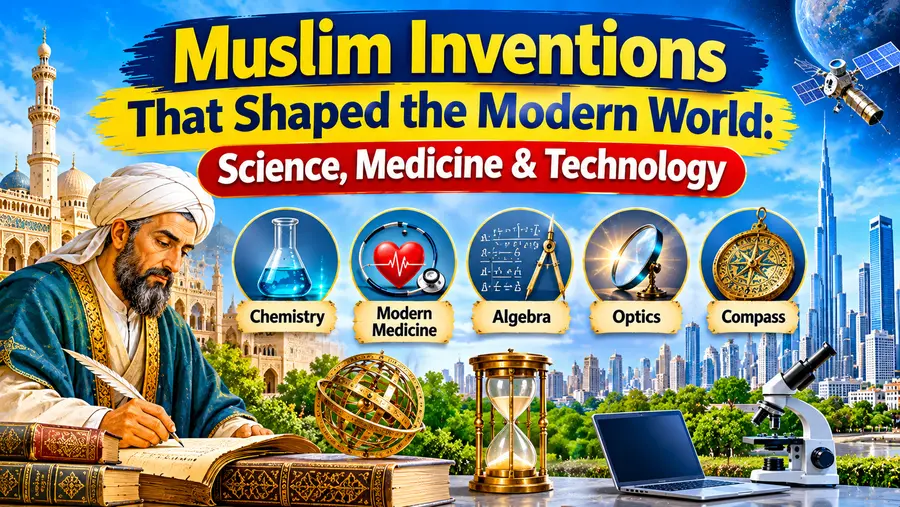
13 Muslim Inventions and Innovations That Shaped the Modern World: Science, Medicine & Technology
What do algebra, modern surgery, coffee culture, hospital systems, and mechanical engineering have in common? All have important connections to scholars, inventors, and institutions from the medieval Muslim world.
Between the eighth and fourteenth centuries, cities such as Baghdad, Cairo, Cordoba, Damascus, Fez, and Samarkand became important centres of learning, medicine, mathematics, astronomy, and technology. Scientists and scholars working in these societies developed new ideas, improved earlier discoveries, and helped transmit knowledge between different parts of the world.
Their contributions were not limited to one subject. They influenced mathematics, healthcare, engineering, education, navigation, astronomy, and everyday life.
Some familiar examples include Muhammad ibn Musa al-Khwarizmi’s work on algebra, Ibn al-Haytham’s research on optics, Al-Zahrawi’s surgical writings, and Al-Jazari’s ingenious mechanical devices.
However, the history is more interesting than a simple list of inventions. Many developments associated with Muslim civilization grew from the combined knowledge of Greek, Indian, Persian, Chinese, Arab, and other cultures. Muslim scholars often built on these foundations and made important original contributions.
In this article, we will explore 13 Muslim inventions and innovations that helped shape the modern world, discover the people behind them, and understand how their ideas continue to influence our lives.
What Was the Islamic Golden Age?
The Islamic Golden Age generally refers to a long period of intellectual and scientific development in Muslim-ruled societies, particularly from around the eighth to the thirteenth centuries. Its influence continued in many regions beyond that period.
During the Abbasid Caliphate, Baghdad became a major centre of scholarship. Scholars translated and studied works from Greek, Persian, Syriac, and Sanskrit traditions. They did not simply preserve this knowledge; they also criticized existing theories, conducted research, developed mathematical methods, and produced new scientific works.
The translation movement was a major international intellectual project. It brought together different languages, cultures, and scientific traditions, helping create a shared body of knowledge in Arabic.
Source: Mobilities of Science: The Era of Translation into Arabic, journal Isis.
It is also important to understand that the Muslim world was culturally and religiously diverse. Muslim, Christian, Jewish, Persian, Arab, Central Asian, and other scholars contributed to its intellectual life.
Therefore, the achievements of this period should be understood as part of a wider history of knowledge exchange rather than the work of one religious or ethnic group alone.
13 Muslim Inventions and Innovations That Changed the World
1. Algebra: The Mathematical Foundation of Modern Technology
One of the most influential contributions from the medieval Muslim world was the systematic development of algebra.
The word algebra comes from the Arabic word al-jabr, which appeared in the title of a famous mathematical book written by Muhammad ibn Musa al-Khwarizmi during the ninth century.
His influential work was called Kitab al-Jabr wa al-Muqabala, often translated as The Compendious Book on Calculation by Completion and Balancing.
Al-Khwarizmi developed systematic methods for solving linear and quadratic equations. He presented mathematical procedures that could be applied to practical problems involving inheritance, trade, land measurement, and business transactions.
His work helped establish algebra as a distinct mathematical subject rather than merely a collection of isolated calculations.
How did algebra shape the modern world?
Today, algebra is used in almost every major area of science, technology, and engineering.
For example:
- Engineers use algebra to calculate forces, distances, and electrical values.
- Computer scientists use mathematical equations in algorithms and programming.
- Economists use algebra to model markets and financial systems.
- Scientists use algebra to describe relationships between physical quantities.
- Architects use mathematical calculations when designing buildings and structures.
Al-Khwarizmi did not invent all the mathematical ideas that eventually became algebra. Earlier Babylonian, Greek, Indian, and other mathematical traditions provided important foundations. However, his systematic treatment of equations had an enormous influence on the subject’s development.
His work was later translated into Latin and helped transmit algebraic methods into medieval Europe.
Source: MacTutor History of Mathematics, University of St Andrews.
2. Algorithms and the Spread of Hindu-Arabic Numerals
Have you ever wondered where the word algorithm comes from?
It is derived from the Latinized form of the name of the mathematician al-Khwarizmi.
His writings on arithmetic helped spread systematic calculation methods based on the Hindu-Arabic numeral system.
The familiar digits 0, 1, 2, 3, 4, 5, 6, 7, 8, and 9 originated in Indian mathematical traditions. Muslim mathematicians studied and developed methods using this system, and Arabic-language works later helped transmit it to Europe.
This was a major development in the history of mathematics.
Earlier calculation systems could be complicated when dealing with large numbers. The place-value decimal system made arithmetic more practical and efficient.
For example, multiplication and division become easier to organize when numbers are written using positional notation.
Why are algorithms important today?
An algorithm is a clearly defined sequence of steps used to solve a problem or complete a task.
Modern examples include:
- Google Search ranking and retrieval systems.
- Navigation applications that calculate routes.
- Banking systems that process financial transactions.
- Artificial intelligence models that perform computations.
- Software that sorts, organizes, and analyzes data.
Al-Khwarizmi did not invent modern computer algorithms, but his mathematical writings helped establish a tradition of systematic calculation that became part of the foundation of modern mathematics and computing.
3. Modern Optics and the Science of Vision
One of the most important figures in the history of optics was Ibn al-Haytham, also known in Europe as Alhazen.
He lived around the tenth and eleventh centuries and made major contributions to the scientific understanding of light, vision, reflection, and lenses.
Before his work, some influential ancient theories suggested that vision occurred because rays travelled outward from the eyes toward objects.
Ibn al-Haytham challenged this explanation.
He argued that vision occurs when light from objects enters the eyes. His research included experiments on reflection, refraction, shadows, and the behaviour of light.
His famous work, Kitab al-Manazir, or Book of Optics, became an important text in the history of scientific optics.
He also investigated the camera obscura phenomenon, in which light passing through a small opening produces an image on an opposite surface.
This principle later became important in the development of cameras and optical instruments.
How does Ibn al-Haytham’s work influence modern life?
The science of optics is essential to many technologies, including:
- Cameras and photography.
- Microscopes and telescopes.
- Eyeglasses and contact lenses.
- Medical imaging and optical instruments.
- Fibre-optic communication.
- Laser technologies.
His work also demonstrates the importance of testing explanations through observation and experiment rather than simply accepting established opinions.
Ibn al-Haytham is widely regarded as a foundational figure in the history of optics, although the field developed through contributions from many earlier and later scientists.
Source: Ibn Al-Haytham: Father of Modern Optics, National Library of Medicine.
4. Surgical Instruments and the Development of Modern Surgery
Another remarkable contribution came from Abu al-Qasim al-Zahrawi, a physician and surgeon who lived in Al-Andalus, in present-day Spain.
He is widely known in European medical history as Albucasis.
Around the year 1000, he completed an extensive medical encyclopedia called Kitab al-Tasrif. It contained 30 sections covering different aspects of medicine, with its final section devoted to surgery.
One of the most important features of this work was its detailed presentation of surgical instruments and procedures.
Al-Zahrawi described instruments used for different operations, including forceps, probes, knives, cautery tools, and other surgical equipment.
He also discussed techniques related to wound treatment, fractures, dentistry, and obstetrics.
His work was later translated into Latin and became an important medical reference in Europe.
What was his contribution to modern surgery?
Al-Zahrawi helped make surgery a more systematically documented medical discipline.
His detailed illustrations and explanations allowed later practitioners to study surgical methods and instruments.
Modern surgical instruments are far more advanced, but the need for carefully designed tools, systematic training, and detailed procedural knowledge remains central to surgery.
It would be inaccurate to claim that he invented every instrument associated with his work or performed the world’s first Caesarean section. His importance lies in his substantial documentation, practical experience, and influence on the history of surgery.
Source: Library of Congress, The Method of Medicine; Al-Zahrawi’s surgical instruments, Historia Medica.
5. Hospitals and Organized Medical Care
Hospitals are essential institutions in modern society. They provide medical treatment, nursing care, surgery, diagnostic services, and emergency support.
The development of organized hospitals has a long history involving several ancient civilizations. However, medieval Islamic societies made important contributions to the development of institutional healthcare.
One important institution was the bimaristan, a Persian term meaning a place for the sick.
Bimaristans developed in different cities across the Islamic world. They offered medical treatment and could also provide spaces for medical teaching, training, and recovery.
Some institutions included different wards and employed physicians, pharmacists, and other healthcare workers.
A notable example was the Ahmad ibn Tulun Hospital, established in Cairo in 872 CE. Hospitals in later periods, including those in Baghdad and Damascus, also became important centres of medical care.
These institutions helped develop a more organized approach to healthcare, bringing treatment, medical knowledge, and public assistance together.
How did these hospitals influence modern healthcare?
Their historical importance can be seen in several areas:
- Organized medical treatment.
- Institutional medical teaching.
- Care for patients who could not afford treatment.
- The development of specialized medical services.
- The relationship between hospitals and medical knowledge.
It is important not to claim that Muslim societies invented hospitals altogether. Medical facilities existed in other civilizations before and alongside the Islamic world.
The important contribution of the bimaristan tradition was its development of distinctive institutions combining treatment, teaching, and charitable care.
Source: National Library of Medicine, A Literary History of Medicine; Romani, The Origins of the Islamic Model of Hospital.
6. Mechanical Engineering and Automated Machines
Long before modern factories and industrial robots, engineers in the medieval Muslim world were developing sophisticated mechanical devices.
One of the most famous engineers was Ismail al-Jazari, who lived during the twelfth and thirteenth centuries in the region of present-day Turkey.
In 1206, he completed a remarkable book called The Book of Knowledge of Ingenious Mechanical Devices.
It described numerous machines, including water clocks, automatic devices, water-raising machines, and mechanical systems.
One of his important engineering achievements involved the use of an early crankshaft and connecting-rod mechanism in a water pump.
This mechanism helped convert rotary motion into back-and-forth movement.
That principle is fundamental to many modern mechanical systems.
Where do we see similar technology today?
- Engines use crankshaft mechanisms to convert piston movement into rotation.
- Industrial machines use mechanical linkages to transfer movement.
- Pumps move water and other liquids.
- Automated equipment uses cams, gears, and connecting rods.
- Manufacturing systems depend on mechanical motion and control.
The crank itself was known before al-Jazari, including in ancient mechanical devices. His achievement was an important development and application of the crankshaft and connecting-rod system, not the invention of every form of crank mechanism.
Al-Jazari’s work is a powerful example of how medieval engineering contributed to the development of mechanical technology.
Source: CNRS Editions, Al-Jazari’s Compendium of Ingenious Devices; Donald R. Hill’s translation, The Book of Knowledge of Ingenious Mechanical Devices.
7. Astronomy and the Development of the Astrolabe
Astronomy was another important field of scientific research in the medieval Muslim world.
Scholars studied the movements of the Sun, Moon, planets, and stars. They developed astronomical tables, improved observational methods, and refined instruments used for measuring the positions of celestial objects.
One particularly important instrument was the astrolabe.
The astrolabe was not originally invented by Muslim astronomers. It had roots in ancient Greek science. However, astronomers in Islamic societies refined its design and developed additional applications.
An astrolabe is a portable instrument that represents the sky on a flat surface. It can help users estimate the time, measure the altitude of celestial objects, and solve certain astronomical problems.
In Muslim societies, astrolabes were also useful for determining prayer times and the direction of Mecca.
Astronomers such as al-Zarqali developed improved forms of the instrument, including a universal astrolabe designed to work at different latitudes.
Why was the astrolabe important?
Its applications included:
- Measuring the altitude of the Sun and stars.
- Estimating local time.
- Supporting astronomical observations.
- Assisting navigation and surveying.
- Calculating certain calendar and geographical information.
Astronomical research in the Islamic world also helped improve mathematical models inherited from earlier Greek, Persian, and Indian traditions.
These developments contributed to the wider history of astronomy and influenced later European scientific work.
Source: Science Museum Group, Islamic Astrolabe; The Metropolitan Museum of Art, Astronomy and Astrology in the Medieval Islamic World.
8. Coffee Culture: From Yemen to the World
Millions of people start their day with a cup of coffee. But the history of coffee is much older and more complicated than many people realize.
The coffee plant, Coffea arabica, is indigenous to the southwestern highlands of Ethiopia. Historical evidence about its earliest consumption is limited, but Yemen played a major role in the development and spread of coffee as a drink.
By the fifteenth century, coffee was being consumed in Yemen, where Sufi communities used it to help remain awake during nighttime prayers and religious gatherings.
Coffee drinking then spread through the Red Sea region to cities such as Mecca and Cairo, and later to Istanbul and other parts of the Ottoman Empire.
From there, coffee culture gradually reached Europe and eventually spread around the world.
Yemen also became an important centre for cultivating and trading coffee. Its port of Mocha became closely associated with the international coffee trade.
What was the Muslim world’s contribution to coffee?
Rather than inventing the coffee plant or proving that the beverage originated in Yemen, the important contribution was the development of coffee cultivation, drinking traditions, trading networks, and coffeehouse culture.
Today, coffee is one of the world’s most popular beverages and an important part of social and commercial life.
Source: Oxford Research Encyclopedia of Food Studies, The Ethiopian and Yemeni Roots of Coffee; Cambridge University Press, Coffee in the Red Sea Area.
9. Paper Manufacturing and the Spread of Books
Paper was invented in China, but its manufacture and use spread across Central Asia and the wider Islamic world, where it became increasingly important for education, administration, science, and commerce.
During the early medieval period, paper production expanded in regions under Muslim rule. By the late eighth century, paper was being manufactured in Baghdad.
Production later spread to Egypt and parts of North Africa and the Iberian Peninsula.
Paper was relatively convenient for producing and circulating written material. Its wider availability supported the expansion of libraries, government records, correspondence, scientific books, and educational activities.
How did this development influence the modern world?
The spread of paper manufacturing and written knowledge supported:
- The circulation of scientific discoveries.
- The development of libraries and educational institutions.
- The preservation of historical records.
- The growth of trade and administration.
- The translation and transmission of books between cultures.
Muslim societies did not invent paper, but their role in developing its manufacture, distribution, and use helped transform the intellectual and commercial landscape across a large region.
Source: Encyclopaedia Iranica, Paper in the Iranian World Prior to Printing; Research on paper instruments in medieval Northwest Africa.
10. Al-Qarawiyyin and the Development of Higher Education
One remarkable contribution to the history of education is associated with Fatima al-Fihri, a woman who founded an important mosque and educational institution in Fez, Morocco.
According to the traditional historical account, Fatima al-Fihri established the al-Qarawiyyin Mosque in 859 CE.
Over time, al-Qarawiyyin developed into a major centre of learning. Students and scholars gathered there to study religious subjects and, in later periods, other fields of knowledge.
Its legacy is frequently discussed in connection with the history of universities and higher education.
However, historians distinguish between the original mosque foundation and the later development of a formal institution of higher learning. The exact date at which al-Qarawiyyin became a university in the modern institutional sense is debated.
Why is Fatima al-Fihri’s contribution important?
Her foundation demonstrates the importance of education, philanthropy, and institutions in the intellectual history of the Muslim world.
It also highlights the role of women in supporting educational development during the medieval period.
L-qarawiyyin is still a major historic institution in Morocco and remains an important symbol of the country’s educational heritage.
It would be misleading to suggest that the modern university system was invented by one person or that there is no historical debate about which institution deserves the title of the world’s first university. Nevertheless, al-Qarawiyyin is an important part of global higher-education history.
11. Musical Instruments and the Exchange of Musical Ideas
Music has always travelled across geographical and cultural boundaries.
During the medieval period, the Muslim world developed rich musical traditions, particularly in regions such as Baghdad, Persia, North Africa, and Al-Andalus.
Instruments such as the oud and the rabab became important in different musical traditions. Their histories are connected to the development and exchange of stringed instruments across the Middle East, North Africa, and Europe.
The European lute, for example, is historically associated with the Arabic oud. The rebec is also commonly discussed in relation to the rabab and wider traditions of bowed string instruments.
Musical scholarship also developed through the writings of thinkers such as al-Farabi, who studied music as a mathematical and theoretical subject.
How did these contributions shape modern music?
The movement of instruments, performance techniques, and music theory helped create connections between European and Middle Eastern musical traditions.
However, the history of modern musical instruments is complex. It is not accurate to claim that a single Muslim invention directly produced the modern violin, guitar, or all modern musical scales. These instruments developed through centuries of experimentation and cultural exchange.
12. Miswak and Traditional Oral Hygiene
Long before modern plastic toothbrushes became common, people used natural materials to clean their teeth.
One example is the miswak, also known as siwak, a chewing stick commonly made from the roots or branches of the Salvadora persica tree.
The practice became particularly associated with Islamic culture because the Prophet Muhammad is traditionally reported to have used and encouraged the use of miswak.
It became an established part of oral hygiene and religious practice in many Muslim communities.
However, the use of tooth-cleaning sticks existed in other ancient civilizations before Islam. Archaeological and historical evidence shows that different cultures used twigs and other simple tools to clean their teeth.
Therefore, the miswak was not invented by the Prophet Muhammad or by Muslims. Its popularity and cultural importance grew significantly within Islamic traditions.
What makes miswak interesting today?
Modern research has examined its chemical composition and potential oral-health benefits. Miswak contains natural plant compounds and can help remove plaque when used correctly.
However, dental health depends on proper technique and regular cleaning. A miswak should not automatically be considered a complete replacement for a modern toothbrush and fluoride toothpaste.
Source: Cambridge University Press, The Siwāk: A Medieval Islamic Contribution to Dental Care; Review of the therapeutic effects of miswak on oral health.
13. Abbas ibn Firnas and Early Experiments in Human Flight
The dream of flying has fascinated human beings for centuries. One of the historical figures associated with early experiments in flight was Abbas ibn Firnas, an inventor and scholar who lived in ninth-century Al-Andalus.
Historical accounts describe an experiment in which Ibn Firnas attempted to glide using a winged apparatus.
His experiment is often presented as an early attempt at human flight, although the exact technical details and performance of the device remain uncertain.
It is important to distinguish this experiment from the invention of the modern aeroplane. There is no established evidence that Ibn Firnas developed a powered aircraft or that his design directly inspired Leonardo da Vinci’s later flying-machine sketches.
Nevertheless, his story represents the long-standing human interest in understanding flight and experimenting with mechanical ways to imitate birds.
Modern aviation eventually developed through many centuries of mathematical research, experimentation, advances in materials, aerodynamics, and engineering.
A 2024 Oxford University Press study by historian Glaire Anderson examined the earliest authoritative evidence for Ibn Firnas’s famous flight and its historical context. Source: Where Eagles and Vultures Dare.
Other Important Contributions From the Muslim World
The contributions discussed above are only part of a much wider history of scientific and technological activity.
Other notable scholars include:
| Scholar | Major contribution | Field |
| Al-Biruni | Research on astronomy, mathematics, geography, and the measurement of the Earth | Mathematics and physical science |
| Ibn Sina (Avicenna) | The Canon of Medicine, an influential medical encyclopedia | Medicine |
| Al-Razi (Rhazes) | Clinical observations and influential medical writings | Medicine |
| Al-Farabi | Important works on logic, philosophy, and music theory | Philosophy and music |
| Al-Idrisi | Influential geographical and cartographic work | Geography |
| Ibn al-Nafis | Important description of pulmonary circulation | Medicine |
| Al-Sufi | Detailed observations and descriptions of stars and constellations | Astronomy |
Their achievements demonstrate that scientific activity in the medieval Muslim world extended far beyond a few famous inventions.
How Did Muslim Contributions Reach Europe and the Rest of the World?
Scientific progress rarely happens in isolation. Knowledge moves through travel, trade, education, translation, and communication between societies.
During the medieval period, Arabic became an important language of scholarship across a large geographical region.
Scientific books written in Arabic were later translated into Latin and other European languages. Important centres of translation developed in places such as Toledo in Spain and Sicily.
These translations introduced European scholars to mathematical, medical, astronomical, and philosophical works that had been developed or preserved in the Islamic world.
For example, al-Khwarizmi’s mathematical writings helped spread algebraic methods, while translations of Al-Zahrawi’s surgical work influenced European medical education.
It is important to remember that this was not a one-way process. Knowledge also travelled into the Muslim world from India, Greece, Persia, China, and other regions.
The history of science is therefore a story of international cooperation, intellectual debate, and continuous improvement.
Why Are Muslim Contributions to Science Important Today?
Understanding these historical contributions is important for several reasons.
They Demonstrate the Universal Nature of Science
Scientific knowledge does not belong to one religion, nationality, or civilization. It develops through the combined efforts of people from different backgrounds.
The history of Islamic science demonstrates how knowledge can grow when societies support education, experimentation, and intellectual exchange.
They Help Us Understand the History of Modern Technology
Modern mathematics, medicine, engineering, and astronomy did not appear suddenly. They developed through centuries of research.
Studying earlier scientific achievements helps us understand the foundations of the technologies we use today.
They Inspire Young Scientists and Students
Learning about figures such as Al-Khwarizmi, Ibn al-Haytham, Al-Zahrawi, and Al-Jazari can inspire students to explore mathematics, medicine, physics, and engineering.
Their stories also demonstrate that scientific curiosity and creativity have existed across different cultures and historical periods.
They Encourage Respect for Cultural Exchange
The advancement of science depends on sharing ideas and examining different perspectives.
The scientific achievements of the medieval Muslim world show that progress becomes stronger when societies learn from one another.
Read Here: Are We Born Believing in God? What Science Says
Frequently Asked Questions (FAQs)
What are the most important Muslim inventions that shaped the modern world?
Some of the most influential contributions include algebra, systematic arithmetic methods, advances in optics, surgical instruments and medical writings, organized bimaristans, mechanical engineering, astronomy, and the spread of coffee culture. These developments influenced mathematics, healthcare, engineering, and everyday life.
Who was the most famous Muslim inventor?
There is no single answer because inventors and scholars contributed to different fields. Al-Khwarizmi is famous for algebra and arithmetic, Ibn al-Haytham for optics, Al-Zahrawi for surgery, and Al-Jazari for mechanical engineering.
Did Muslims invent algebra?
Algebra developed from mathematical traditions that existed before the medieval Islamic period. However, Muhammad ibn Musa al-Khwarizmi made a major contribution by presenting systematic methods for solving equations in his ninth-century book Kitab al-Jabr wa al-Muqabala. The English word “algebra” comes from the Arabic word al-jabr.
Did Muslims invent coffee?
No. The coffee plant is native to Ethiopia, particularly its southwestern highlands. Yemen played a major role in the early development of coffee cultivation, consumption, and trade. Coffee drinking spread from the Red Sea region to the Ottoman world and eventually Europe.
Did Muslims invent the first university?
The al-Qarawiyyin Mosque, traditionally founded by Fatima al-Fihri in Fez in 859 CE, developed into an important educational institution. It is frequently described as one of the world’s oldest continuously operating centres of higher learning. However, the definition of a university and the exact point at which al-Qarawiyyin became a formal university are subjects of historical discussion.
Did Muslims invent modern hospitals?
Muslim societies did not invent the hospital as a concept, but they contributed significantly to the development of organized medical institutions known as bimaristans. These institutions provided treatment and, in some cases, medical teaching, training, and recovery services.
Who was Al-Khwarizmi and why is he important?
Al-Khwarizmi was a ninth-century mathematician whose writings played a major role in the development of algebra and systematic arithmetic. The terms “algebra” and “algorithm” are both connected to his work and name.
What did Ibn al-Haytham contribute to science?
Ibn al-Haytham made important contributions to optics and the study of vision. He argued that light travels from objects into the eyes, investigated reflection and refraction, and studied the camera obscura phenomenon. His work influenced the later development of optical science.
Who invented the first mechanical machines in the Muslim world?
Al-Jazari was one of the most influential mechanical engineers of the medieval Muslim world. His 1206 book documented water clocks, automated devices, pumps, and mechanical systems. He made important contributions to the development of practical mechanical engineering.
What is the Islamic Golden Age?
The Islamic Golden Age refers to a period of significant intellectual and scientific activity in Muslim-ruled societies, particularly from the eighth to the thirteenth centuries. It was marked by developments in mathematics, medicine, astronomy, philosophy, engineering, and literature.
Did Muslims invent the toothbrush?
No. Tooth-cleaning sticks were used in several ancient civilizations before Islam. The miswak became particularly important in Islamic culture and was widely used as a traditional method of oral hygiene.
Why are Muslim contributions to science important?
These contributions help explain how modern scientific knowledge developed through centuries of cultural exchange. They also highlight the role of scholars from different civilizations in advancing mathematics, medicine, engineering, astronomy, and technology.
Read Here: Why Religion Is Not Going Away; Science Will Not Destroy It
Conclusion: The Lasting Legacy of Muslim Scientists and Inventors
The history of Muslim contributions to science is a fascinating story of discovery, creativity, and knowledge exchange.
From Al-Khwarizmi’s algebra and Ibn al-Haytham’s optics to Al-Zahrawi’s surgical writings and Al-Jazari’s mechanical inventions, scholars working in the medieval Muslim world helped develop ideas that influenced later generations.
Their achievements also remind us that scientific progress is not the property of one civilization. It is a shared human effort built on the discoveries, experiments, and ideas of countless people across different periods and cultures.
Understanding this history allows us to appreciate the diversity of scientific achievements and recognize how knowledge travels across borders to shape the modern world.
The modern world is not the product of a single civilization. It is the result of centuries of human curiosity, cooperation, and innovation.
Read Here: Why Is It So Hard for Some Scientists to Believe in God?