Why Should Scientists Care About Religion? Understanding the Relationship Between Science, Faith and Society
Science has transformed the modern world. It has helped us understand the universe, discover the structure of matter, develop life-saving medicines, explore space, and create technologies that were once unimaginable.
But despite these remarkable achievements, religion remains an important part of human society. Billions of people identify with a religious tradition, and religious beliefs continue to influence how individuals understand life, death, morality, identity, and the purpose of human existence.
This raises an interesting question: Why should scientists care about religion?
Should scientists pay attention to religious beliefs when their work is based on observation, experimentation, and evidence? Can religion contribute anything meaningful to scientific progress? And should scientists engage with religious communities even when they do not personally believe in God?
The answer is yes. Scientists should care about religion—not because religious beliefs should replace scientific evidence, but because religion influences human behaviour, social institutions, public attitudes, moral discussions, and the way many people understand the world.
Science can explain how natural processes work, but scientific knowledge alone does not automatically resolve every question about human values, meaning, responsibility, and society.
Understanding religion can therefore help scientists communicate more effectively, appreciate different worldviews, participate in ethical discussions, and make scientific knowledge more useful to humanity.
Let’s explore why the relationship between science and religion deserves more attention.
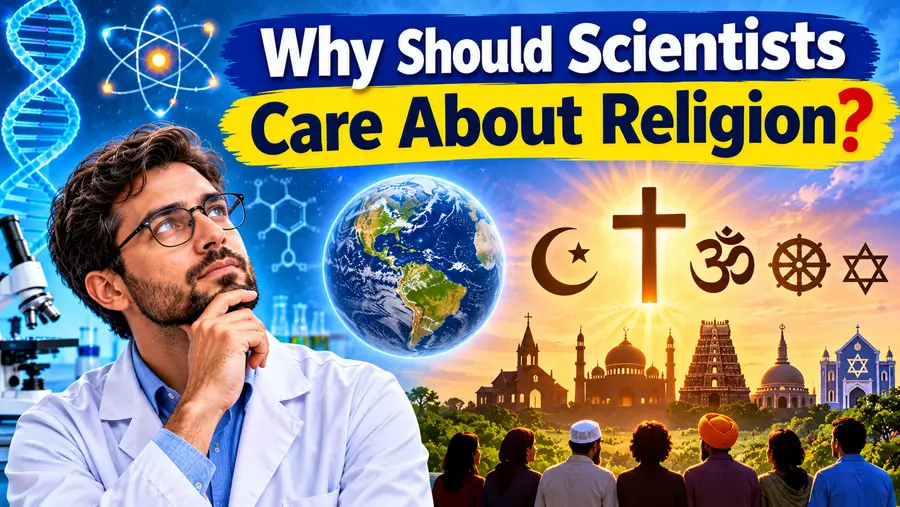
Why Should Scientists Care About Religion?
Scientists should care about religion because it influences billions of people and plays an important role in culture, education, public health, ethics, and social life.
A scientist does not have to believe in God or follow a religious tradition to understand its importance.
For example, a medical researcher developing a public-health programme may need to understand religious beliefs about vaccination, reproductive health, diet, or medical treatment. An environmental scientist working with a local community may need to understand its religious and cultural relationship with nature.
Similarly, a neuroscientist studying human consciousness may encounter philosophical and religious questions about the mind, identity, and personal experience.
Ignoring these perspectives does not make them disappear. It can simply make communication and cooperation more difficult.
There are several important reasons scientists should take religion seriously:
- Religion influences people’s understanding of life and human existence.
- Religious communities can help communicate scientific information.
- Religious beliefs shape public attitudes toward some scientific developments.
- Religion can contribute perspectives to discussions about scientific ethics.
- Understanding religious people can reduce unnecessary conflict.
- Dialogue can help both scientists and religious communities examine their assumptions.
Taking religion seriously does not mean accepting every religious claim. It means understanding a major part of human society and engaging with it thoughtfully.
First, What Is the Difference Between Science, Religion, Faith and Spirituality?
Before discussing the relationship between science and religion, it is important to understand that these terms do not mean the same thing.
They are related, but each represents a different way of approaching human experience.
What Is Science?
Science is a systematic way of investigating the natural world.
Scientists develop questions, collect observations, construct hypotheses, test explanations, analyze evidence, and communicate their findings for examination by other researchers.
Scientific knowledge is not completely free from error. Scientific conclusions can change when better evidence becomes available. However, methods such as experimentation, peer review, replication, and independent testing help make science a powerful system for building reliable knowledge.
For example, scientists have established strong evidence that:
- Matter consists of atoms and subatomic particles.
- Living organisms share evolutionary relationships.
- The universe is expanding.
- Infectious diseases can be caused by microorganisms.
- Human activities are increasing the concentration of greenhouse gases in the atmosphere.
These conclusions are supported by multiple lines of scientific evidence, not simply personal opinions.
What Is Religion?
Religion generally refers to an organized or shared system of beliefs, practices, values, traditions, and communities.
Religious traditions may include beliefs about God, gods, spiritual beings, revelation, sacred texts, life after death, morality, and the purpose of existence.
Religion also has a social dimension. It can bring people together through worship, festivals, charitable activities, education, community support, and shared traditions.
Different religions understand the world in different ways. Some are centered on belief in one God, others recognize multiple deities, and some traditions do not place belief in a creator God at the centre of their teachings.
Therefore, religion cannot be reduced to a single definition of God or one universal belief system.
What Is Faith?
Faith generally refers to trust or belief in something that a person may not be able to establish through scientific evidence alone.
For example, a person may have faith in God, revelation, an afterlife, or a spiritual reality.
Faith can also refer to trust in other people, institutions, or principles. However, religious faith involves commitments that go beyond what scientific experiments can directly establish.
What Is Spirituality?
Spirituality is an even broader concept.
For some people, it refers to a personal relationship with God or a divine presence. For others, it involves experiences of awe, wonder, compassion, inner peace, connection, or a search for deeper meaning.
A person can be spiritual without following an organized religion. Some atheists and agnostics also describe themselves as spiritual.
Research by sociologist Elaine Howard Ecklund and her colleagues has explored how scientists distinguish religion from spirituality and how some scientists understand spirituality without religious belief. Read the research in Sociology of Religion.
Understanding these distinctions makes it easier to discuss science and religion without treating every religious person, spiritual person, and believer as having the same worldview.
Read Here: Why Is It So Hard for Some Scientists to Believe in God?
Religion Influences How Millions of People Understand the World
Science does not operate outside society. Scientific discoveries affect people, and people’s existing beliefs can influence how they respond to those discoveries.
For many individuals, religion provides a framework for understanding questions such as:
- Why are we here?
- What gives human life meaning?
- What happens after death?
- What makes an action morally right or wrong?
- What responsibilities do humans have toward other living beings?
- How should people treat one another?
Science can investigate many aspects of these questions. Psychology can study how people experience meaning, biology can investigate the origins of life, and neuroscience can explore the brain processes associated with consciousness.
However, identifying the biological processes involved in an experience does not automatically answer every philosophical or moral question connected with it.
For example, neuroscience can investigate what happens in the brain when people experience compassion. But the scientific description alone does not settle how much compassion we owe to others or why we should treat vulnerable people with dignity.
Religion is one framework through which people explore such questions.
A scientist who understands these beliefs may communicate scientific discoveries more effectively and appreciate why different communities respond to them in different ways.
Scientists Need to Understand the Public They Serve
Scientific knowledge is most valuable when it helps society.
However, communicating science is not always easy. People interpret scientific information through their existing knowledge, cultural traditions, political views, personal experiences, and values.
Religion can influence all these factors.
Consider a public-health campaign.
A medical organization may recommend vaccination to prevent an infectious disease. The recommendation is based on scientific evidence about the safety and effectiveness of vaccines.
However, some communities may have concerns about particular ingredients, religious permissibility, medical procedures, or the role of government institutions.
Simply repeating scientific facts may not be enough to address every concern.
Scientists and public-health professionals need to listen, understand the source of the concerns, and explain the evidence clearly.
Religious leaders and community organizations can sometimes help with this process because people may trust them and seek their advice.
The same principle applies to topics such as:
- Reproductive health and family planning.
- Organ donation and transplantation.
- End-of-life medical decisions.
- Genetic testing and biotechnology.
- Mental health and psychological treatment.
- Environmental protection and climate change.
This does not mean religious authorities should determine scientific conclusions. Scientific evidence must remain the basis of scientific claims.
It means scientists should understand the people they are trying to reach.
Religious Communities Can Support Scientific Communication
Religious communities are not always opponents of science. Many participate in education, healthcare, charitable work, disaster relief, and environmental initiatives.
When scientists build respectful relationships with these communities, they can create opportunities for cooperation.
Imagine a region where a vaccination programme is facing public resistance.
Instead of assuming that the community is simply ignorant, scientists could work with trusted local organizations to understand people’s concerns. They could explain how vaccines are tested, discuss potential side effects honestly, and provide reliable information in familiar languages.
A similar approach can help with environmental issues.
Religious teachings in several traditions emphasize responsibility, compassion, stewardship, or respect for creation. These values can provide a useful starting point for conversations about pollution, biodiversity, conservation, and climate change.
However, cooperation should never involve hiding scientific evidence or compromising public health.
The objective is to make scientific knowledge understandable and accessible while respecting the people who need it.
Religion Can Contribute to Discussions About Scientific Ethics
Scientific discoveries do not automatically tell us how every discovery should be used.
This is particularly important as technology becomes increasingly powerful.
Consider some modern developments:
- Artificial intelligence can analyze personal data and influence important decisions.
- Genetic engineering raises questions about modifying human embryos.
- Neuroscience can improve our understanding of the brain but also create privacy concerns.
- Medical technology can extend human life while introducing difficult end-of-life decisions.
- Environmental engineering can change ecosystems in ways that may have long-term consequences.
Scientists can investigate what is technically possible, measure potential risks, and evaluate likely outcomes.
But deciding what society should permit, prohibit, prioritize, or protect also requires ethical reasoning and public discussion.
Religion can contribute to these discussions by offering moral principles and traditions concerning human dignity, responsibility, justice, compassion, and the value of life.
For example, different religious and philosophical traditions may raise important questions about whether a particular medical procedure respects human dignity or whether a technological intervention could unfairly disadvantage vulnerable populations.
However, religious arguments should not automatically determine public policy in a diverse society. Ethical decisions should involve open discussion, scientific evidence, human rights, relevant laws, and perspectives from people with different beliefs.
Does science need religion to have ethics?
No.
Science has developed its own professional standards and ethical frameworks. Researchers are expected to follow principles such as honesty, integrity, objectivity, fairness, transparency, responsible data management, and respect for research participants.
The U.S. National Academies’ 2026 edition of On Being a Scientist discusses the values that support responsible research, including honesty, openness, accountability, fairness, and mutual respect. Read the National Academies’ research ethics guide.
These principles do not require religious belief.
A nonreligious scientist can be deeply committed to human rights, compassion, and scientific integrity. A religious scientist may draw additional motivation from personal faith or religious teachings.
Religion can contribute to ethical conversations, but it is neither the only source of morality nor a substitute for professional research ethics.
Religion Can Help Scientists Understand Human Meaning and Identity
Science has greatly expanded our understanding of human beings.
Evolutionary biology explains how humans are related to other living organisms. Neuroscience investigates the brain, memory, and consciousness. Psychology examines emotion, motivation, and behaviour. Sociology explores relationships, institutions, and social structures.
Together, these fields explain many aspects of human life.
However, people also ask questions about meaning and identity that are not answered simply by describing biological or psychological processes.
For example:
- What makes a life meaningful?
- Why should people sacrifice their interests to help others?
- How should we respond to suffering?
- What responsibilities do we have toward future generations?
- Does human life have a purpose beyond survival?
Religion provides answers to these questions for many people.
Some believers understand human beings as creations of God. Others emphasize the soul, spiritual development, compassion, liberation, or moral responsibility.
Scientists do not need to accept these explanations to understand their importance.
In fact, studying how religious beliefs influence people’s experiences of suffering, hope, identity, and purpose can be valuable for psychology, anthropology, sociology, and medicine.
For example, researchers working in healthcare may need to understand how patients’ spiritual or religious beliefs influence their experiences of illness, treatment choices, and end-of-life preferences.
Understanding these dimensions can support more respectful and patient-centred care.
Religious Scientists Show That Science and Faith Are Not Always Mutually Exclusive
A common assumption is that scientists must be atheists or that religious belief prevents someone from practising modern science.
The reality is more complicated.
Some scientists are religious, others are atheists or agnostics, and many describe themselves as spiritual without following an organized religion.
Sociologist Elaine Howard Ecklund and her colleagues have conducted extensive research into scientists’ attitudes toward religion.
Their international research project surveyed more than 20,000 scientists across eight countries and regions: the United States, the United Kingdom, France, Italy, India, Turkey, Hong Kong, and Taiwan. The researchers also conducted more than 600 in-depth interviews.
The research found substantial differences between countries and showed that scientists’ religious identities and their views about the relationship between science and religion vary across cultural settings. Read Secularity and Science: What Scientists Around the World Really Think About Religion, Oxford University Press.
An earlier study by Ecklund and Jerry Park, published in 2009, examined 1,646 scientists at 21 elite U.S. research universities.
The researchers found that most participants did not perceive science and religion as being in constant conflict. Read the study in the Journal for the Scientific Study of Religion.
These studies challenge the assumption that all scientists share one attitude toward religion.
They do not prove that religious beliefs are scientifically correct or that science and every religious doctrine are compatible. They simply show that the relationship is more diverse than the popular conflict narrative suggests.
What about scientists who are spiritual but not religious?
Some scientists describe themselves as spiritual even though they do not believe in a personal God or belong to an organized religion.
For them, spirituality may involve awe, wonder, the search for meaning, or a sense of connection with the universe.
In research involving 275 scientists at major U.S. universities, Ecklund and Elizabeth Long explored how scientists understand spirituality and its relationship with science and religion.
The study highlighted that some scientists considered spirituality compatible with their scientific work, even when they did not identify with traditional religious beliefs. Read the study in Sociology of Religion.
This is another reason scientists should avoid treating all nonreligious people as having the same worldview.
Read Here: Why Religion Is Not Going Away and Science Will Not Destroy It
Scientists Should Understand the Limits of Science
Science is one of humanity’s most successful ways of investigating the natural world.
However, recognizing the power of science does not mean assuming that every meaningful question can be answered through scientific methods alone.
Consider the difference between these questions:
Scientific questions:
- How did the universe expand?
- How do stars form?
- How did biological evolution produce different species?
- What happens in the brain during conscious experience?
- How does a particular medicine affect the human body?
Ethical and philosophical questions:
- What makes a scientific discovery morally acceptable?
- How should the benefits of technology be distributed?
- What responsibilities do humans have toward other living beings?
- What makes a life worth living?
- What is the ultimate meaning of existence?
Science can provide important information that helps us think about many ethical and philosophical questions. It can also investigate beliefs, moral behaviour, and human values scientifically.
However, empirical evidence by itself does not always settle what society ought to value or how competing moral priorities should be balanced.
This distinction is important because scientific expertise does not automatically make someone an authority on every philosophical, religious, political, or moral question.
What Is Scientism?
The term scientism is sometimes used to describe an overly broad belief that science is the only valid way of gaining knowledge or that scientific methods can answer every meaningful question.
The term has different definitions, and it is often used in philosophical debates.
Philosopher Mikael Stenmark discussed the meaning of scientism in a 1997 article published in the journal Religious Studies. He examined the view that scientific knowledge has no meaningful limits and that there is no legitimate area of human understanding outside science. Read the Cambridge University Press article, What Is Scientism?
Criticizing scientism does not mean criticizing science.
A person can strongly support scientific research while recognizing the importance of philosophy, history, art, ethics, and religion.
For example, physics can explain the colours of a rainbow through the behaviour of light. But it cannot determine what emotional or artistic meaning a rainbow should have for an individual.
Similarly, neuroscience can investigate the brain processes associated with music, but scientific explanations do not make music less meaningful.
The same distinction can be applied to religion. Explaining the psychological and social functions of religious belief does not automatically settle every philosophical or theological question associated with it.
Religion and Science Can Cooperate on Global Challenges
Some of the biggest challenges facing humanity require cooperation between scientists, governments, businesses, educational institutions, and communities.
Examples include:
- Climate change.
- Infectious diseases.
- Poverty and malnutrition.
- Environmental degradation.
- Access to healthcare.
- Water scarcity.
- Technological risks.
- Global inequality.
Science provides essential evidence and practical tools for addressing these challenges.
Religion can sometimes contribute community networks, moral motivation, charitable institutions, and trusted communication channels.
Consider climate change.
Climate scientists study rising temperatures, changing rainfall patterns, extreme weather, and the effects of greenhouse gas emissions.
Religious leaders and organizations can help communicate the importance of environmental responsibility within their communities.
Some religious traditions emphasize humanity’s responsibility to protect nature, avoid waste, and care for vulnerable people.
These ideas can support environmental action, provided that discussions remain grounded in established climate science.
The same cooperation can be valuable during health emergencies, natural disasters, and humanitarian crises.
It is important to recognize that religious institutions may also disagree with scientific recommendations or promote inaccurate information.
Cooperation must therefore be based on honesty, evidence, and mutual respect rather than automatic agreement.
Scientists Can Help Religious Communities Engage With Modern Science
The relationship between science and religion should not be a one-sided conversation.
Scientists can learn about religion, but religious communities also benefit from understanding scientific discoveries and methods.
For example, modern biology has established evolution through evidence from genetics, fossils, comparative anatomy, and other fields.
Religious communities sometimes struggle with how to interpret evolutionary science alongside traditional beliefs about creation.
Scientists can contribute by explaining the evidence, answering questions, and helping distinguish scientific findings from philosophical or theological interpretations.
Similarly, astronomy and cosmology can help people understand the age and development of the universe.
Medical research can clarify questions about disease, reproduction, vaccination, and human genetics.
Environmental science can inform religious discussions about stewardship and responsibility toward the planet.
This does not mean scientists should tell religious communities what their theology must be. Religious interpretation belongs to religious and philosophical discussion.
But scientists can help ensure that discussions about the natural world take established scientific evidence seriously.
A healthy relationship requires both intellectual openness and a commitment to evidence.
Scientists Should Avoid Stereotyping Religious and Nonreligious People
Another important reason scientists should care about religion is that stereotypes make meaningful dialogue difficult.
Some people assume that religious individuals reject scientific evidence. Others assume that scientists are arrogant, hostile to religion, or unable to appreciate spiritual questions.
Neither assumption is fair.
There are religious scientists working in physics, biology, medicine, chemistry, engineering, and many other disciplines.
There are also nonreligious scientists who respect religious communities and recognize their contribution to society.
The international research led by Elaine Howard Ecklund illustrates how much scientists’ experiences and attitudes differ across countries.
For example, the social position of religion in India is different from its position in France or the United Kingdom. Consequently, scientists in these societies may experience and understand the relationship between science and religion differently.
A 2020 study based on interviews with Indian scientists also found that cultural context influences how scientists define religion and spirituality. Read Indian Scientists’ Definitions of Religion and Spirituality, published in the journal Religions.
Scientists should therefore avoid assuming that the experience of one country’s scientific community represents everyone.
Respectful dialogue begins by listening rather than making assumptions.
Does Taking Religion Seriously Mean Scientists Must Believe in God?
Absolutely not.
This is an important distinction.
A scientist can study religion without practising it, respect religious people without accepting their beliefs, and participate in discussions about religious ethics without becoming religious.
For example, an anthropologist may study religious rituals to understand cultural behaviour. A psychologist may investigate how religious beliefs influence decision-making. A medical researcher may study how spirituality affects patients’ experiences of illness.
None of these activities requires the researcher to believe in the religious claims being studied.
Similarly, an atheist scientist can work with religious organizations on a vaccination campaign or environmental project without compromising scientific integrity.
Taking religion seriously means understanding it as an important feature of human life.
It does not mean treating religious claims as scientific conclusions.
Read Here: Is There Definitive Proof of the Existence of God?
What Should a Healthy Relationship Between Science and Religion Look Like?
A healthy relationship requires clear boundaries, intellectual honesty, and mutual respect.
Neither science nor religion benefits from forcing the other to operate outside its proper role.
A constructive approach should follow several principles.
Respect Established Scientific Evidence
Religious interpretations should not be used to dismiss strong scientific findings without examining the evidence.
Claims about evolution, climate change, infectious diseases, and astronomy should be evaluated using scientific methods.
Encourage Open and Thoughtful Religious Interpretation
Religious traditions are interpreted in different ways. Communities should be able to discuss difficult questions, examine historical contexts, and consider how new knowledge affects their understanding of the world.
Separate Scientific Questions From Theological Claims
A statement about the physical development of the universe is not automatically the same kind of statement as a theological claim about why the universe exists.
Recognizing the difference can prevent unnecessary arguments.
Protect Freedom of Belief
Scientists should be free to be religious, atheist, agnostic, or spiritual without discrimination.
Likewise, religious communities should be able to discuss their beliefs while respecting scientific evidence and the rights of people with different worldviews.
Encourage Cooperation Without Forcing Agreement
Scientists and religious organizations can work together on healthcare, education, humanitarian assistance, and environmental protection even when they disagree about metaphysical questions.
The goal should be practical cooperation and mutual understanding, not compulsory agreement.
Why This Conversation Matters More Than Ever
Science is advancing rapidly. Artificial intelligence, genetic engineering, biotechnology, neuroscience, quantum technologies, and space exploration are creating possibilities that previous generations could hardly imagine.
These developments also raise difficult questions.
Should humans be allowed to genetically modify future generations? How should artificial intelligence be used in healthcare and government? What rights should people have over their personal biological data? How should society balance technological progress with human dignity and privacy?
These questions cannot be settled by technical capability alone.
Scientists can explain what technologies can do, what risks they create, and how they might affect society. But decisions about their responsible use also require ethical reasoning, public discussion, legal frameworks, and consideration of different cultural values.
Religion is one important voice in this wider conversation.
Scientists should understand it, engage with it, and respond to its arguments when relevant. At the same time, religious institutions should remain open to scientific evidence and avoid presenting theological interpretations as established scientific facts.
The future will benefit more from informed dialogue than from unnecessary hostility.
Read Here: Are We Born Believing in God? What Psychology and Science Reveal
Frequently Asked Questions (FAQs)
Why should scientists care about religion?
Scientists should care about religion because it influences billions of people and affects culture, education, public health, ethics, and social behaviour. Understanding religious beliefs can help scientists communicate their findings, work with communities, and participate in discussions about the responsible use of technology.
Are science and religion always in conflict?
No. Science and religion sometimes conflict, particularly when religious interpretations contradict established scientific findings. However, many scientists and religious individuals consider them compatible or believe they address different aspects of human life. Research by Elaine Howard Ecklund and colleagues shows that scientists’ views vary across countries and communities.
Can scientists be religious?
Yes. Scientists can be Muslim, Christian, Hindu, Buddhist, Jewish, atheist, agnostic, or spiritual. Religious identity does not automatically determine someone’s scientific ability. Scientific work is evaluated through evidence, research methods, and the quality of results rather than a researcher’s personal religious identity.
Does science need religion to explain the universe?
No. Science investigates the natural world through observation, testing, and evidence. It does not require religious beliefs to explain physical processes such as cosmic expansion, evolution, or the behaviour of matter. Religion may offer philosophical or theological interpretations of existence, but these are not substitutes for scientific explanations.
Can religion contribute to scientific ethics?
Yes, religion can contribute moral ideas about human dignity, compassion, responsibility, and justice. These perspectives can become part of discussions about biotechnology, medicine, artificial intelligence, and environmental protection. However, scientific ethics also has secular foundations, and religious views should be discussed alongside human rights, professional standards, evidence, and public interests.
What is scientism?
Scientism is a term used in philosophy to describe an excessively broad confidence in science, sometimes suggesting that scientific methods are the only legitimate way to understand reality or address every meaningful question. Supporting science does not require accepting scientism.
Can an atheist scientist respect religion?
Absolutely. An atheist scientist can study religion, appreciate its cultural importance, cooperate with religious communities, and respect religious freedom without believing in God. Respecting someone else’s beliefs does not require adopting those beliefs.
What is the difference between religion and spirituality?
Religion generally involves an organized system of beliefs, practices, traditions, and communities. Spirituality is broader and may involve personal experiences of meaning, wonder, connection, or the sacred. Some people are both religious and spiritual, while others identify as spiritual but not religious.
Why is science communication with religious communities important?
Religious communities are influential parts of many societies. Understanding their concerns and values can help scientists communicate accurately about healthcare, vaccination, climate change, environmental protection, and other public issues. Cooperation can improve trust and make scientific information more accessible.
Should religion change as science advances?
Religious traditions are interpreted and developed in different ways over time. Many believers and theologians explore how their teachings relate to new scientific discoveries. Where religious claims concern the natural world, they should engage honestly with established evidence.
However, the way religious communities interpret their spiritual and moral traditions remains a matter of wider theological and philosophical discussion.
Conclusion: Science and Religion Need More Understanding, Not More Hostility
Scientists should care about religion because science does not operate in isolation from human society.
Religion influences people’s identities, moral perspectives, communities, and understanding of existence. These influences matter when scientists communicate research, develop technologies, work with the public, and address global problems.
However, taking religion seriously does not mean accepting every religious claim. Scientific evidence must remain the foundation of scientific conclusions.
Religious beliefs should not be used to reject well-established findings, and scientific expertise should not be treated as automatic authority over every philosophical or moral question.
Religion is not a replacement for science, just as science does not automatically answer every question about meaning, values, and human purpose.
The most constructive relationship is one based on intellectual honesty, freedom of thought, mutual respect, and a willingness to learn.
Scientists do not need to become religious, and religious people do not need to become scientists. But both can benefit from understanding each other.
Ultimately, the goal should not be to make science and religion identical. It should be to encourage better knowledge, wiser decisions, and a more thoughtful society.