Unemployment in India is not just an economic issue—it is a deeply personal family challenge. When a breadwinner loses a job, the impact ripples through the household, reshaping relationships, roles, emotions, and future plans.
Families face financial strain, emotional stress, and social pressure, often all at once. In a society where work is closely tied to identity and respect, unemployment can quietly disrupt marital harmony, children’s education, and mental well-being.
In this article, we will explore how unemployment affects family dynamics in India, offering clear, research-backed insights into its social, emotional, and economic consequences—while highlighting resilience, coping strategies, and pathways toward stability and recovery.
How Does Unemployment Affect Family Dynamics in India?
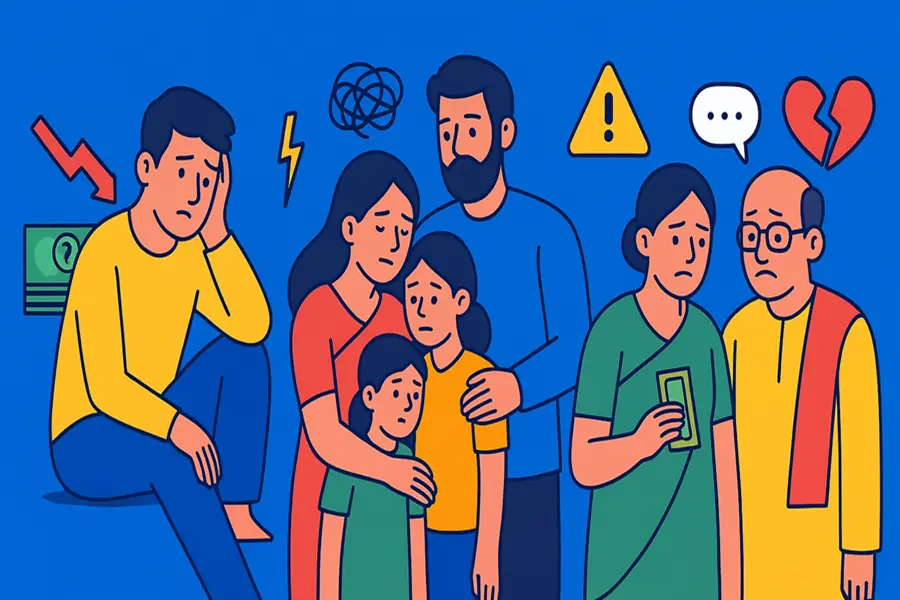
Unemployment affects Indian families by creating financial pressure, emotional stress, and social challenges.
Loss of income reduces the family’s ability to meet daily expenses, children’s education costs, healthcare needs, and savings, often leading to debt.
Emotionally, unemployed members may experience anxiety, low self-esteem, and depression, which can strain relationships at home. Traditional family roles may shift, causing conflicts between spouses and affecting decision-making power.
Children may feel insecure, face educational disruptions, or take on responsibilities early.
Socially, families often face stigma, reduced social interactions, and loss of status within the community.
Overall, unemployment deeply impacts family stability, mental well-being, and long-term aspirations.
Discover how unemployment affects family dynamics in India, including financial stress, emotional impact, role changes, children’s well-being, and social stigma—decoded with clear, research-based insights and practical understanding.
Understanding Unemployment in the Indian Context
Unemployment in India has a different meaning in urban and rural settings. In urban areas, it usually refers to educated or semi-skilled individuals who are actively seeking jobs but are unable to find suitable employment that matches their qualifications.
In rural areas, unemployment is often less visible and is closely linked to agriculture, where work is periodic and income is uncertain.
India faces seasonal unemployment, especially in agriculture, where workers remain idle during non-harvest months.
Educated unemployment occurs when graduates and skilled youth are unable to secure jobs due to limited opportunities or skill mismatch.
Disguised unemployment is common in rural families, where more people are engaged in farming or family businesses than actually needed, resulting in very low productivity.
In this context, the family acts as the primary support system in Indian society. Joint and extended families often absorb the financial burden by sharing income, food, and housing.
Emotional support from family members helps individuals cope with stress and uncertainty caused by joblessness. However, prolonged unemployment can strain family resources and relationships, highlighting the deep connection between employment, family stability, and social structure in India.
Financial Strain on Indian Households
Unemployment places significant financial strain on Indian households, where income from one or two earners often supports multiple dependents.
When a primary earning member loses employment, household income declines sharply while dependency increases, especially in families supporting children, elderly parents, or unemployed youth. This imbalance disrupts financial planning and day-to-day stability.
With regular income lost, families are forced to dip into savings meant for emergencies, education, or old age. Once savings are exhausted, many households turn to informal borrowing, personal loans, or credit, leading to rising household debt.
In lower-income and middle-class families, even short periods of unemployment can push families toward financial insecurity, making it difficult to manage monthly expenses such as food, electricity, transportation, and rent.
The impact is particularly severe on education, healthcare, and housing costs. School and college fees may be delayed, children may be shifted to lower-cost institutions, or education may be interrupted altogether.
Healthcare expenses are often postponed or avoided due to lack of funds, increasing long-term health risks.
Housing insecurity also grows, with families struggling to pay rent, home loans, or maintenance costs, sometimes forcing relocation or overcrowded living conditions.
Research consistently shows that prolonged unemployment increases the risk of poverty cycles, reduces social mobility, and weakens economic resilience within families.
Overall, financial strain caused by unemployment not only affects present living conditions but also limits future opportunities for Indian households.
Emotional and Psychological Impact on Family Members
Unemployment in India has deep emotional and psychological consequences that extend beyond the individual who loses a job.
Research in social psychology and labour studies shows that unemployed individuals often experience high levels of stress, anxiety, and loss of self-esteem, particularly in a society where employment is closely tied to identity, dignity, and social status.
The inability to fulfill the expected role of provider can lead to feelings of shame, helplessness, and reduced self-worth, especially among male earners in traditional households.
The emotional burden is also carried by spouses and elderly parents. Spouses may face constant worry about finances while managing household responsibilities and emotional support, leading to fatigue, frustration, and emotional distancing.
Elderly parents often experience anxiety about family stability and future security, particularly when retirement savings are limited or healthcare needs are rising.
Sustained or long-term unemployment significantly increases the risk of mental health problems such as depression, insomnia, irritability, and social withdrawal.
Studies indicate that prolonged joblessness can weaken coping mechanisms, increase family conflict, and reduce access to mental health care due to financial constraints.
In many Indian families, mental health concerns are still stigmatized, delaying professional help and worsening emotional distress.
Overall, unemployment creates a cycle of emotional strain within families, affecting communication, emotional bonding, and psychological well-being.
Addressing unemployment-related mental health challenges requires not only economic solutions but also family support, social awareness, and accessible mental health services.
Changing Family Roles and Power Dynamics
Unemployment significantly alters family roles and power dynamics in Indian households, where economic contribution is closely linked to authority and social position within the family.
Research in sociology and gender studies shows that when a primary earning member—often the male head of the household—loses employment, traditional breadwinner roles weaken, forcing families to redistribute financial and domestic responsibilities.
Spouses, including women who were previously homemakers, may enter the workforce or increase paid work to stabilize household income.
This shift directly affects decision-making authority within families. Financial contributors tend to hold greater influence over decisions related to spending, children’s education, healthcare, and long-term planning.
When income sources change, authority may shift as well, sometimes leading to tension, resentment, or power struggles.
In joint or extended families, unemployed members may lose influence altogether, increasing feelings of dependency and marginalization.
Gender-based role reversals often create cultural and emotional challenges. While women’s increased economic participation can empower them, it may also cause conflict in households that strongly value traditional gender norms.
Male unemployment is frequently associated with psychological distress, reduced self-esteem, and feelings of inadequacy, which can affect family harmony. At the same time, women managing both income generation and domestic work face increased workload and emotional strain.
Research suggests that families with flexible role adaptation and open communication manage these transitions better.
However, in rigid social settings, unemployment can intensify cultural conflict, challenge established hierarchies, and reshape long-standing family structures, influencing both short-term relationships and long-term family stability.
The Impact of Unemployment on Marital Relationships
Unemployment has a profound impact on marital relationships in Indian families, as financial stability and emotional security are closely interconnected.
Research in family psychology and economics consistently shows that job loss increases marital stress, often triggering frequent conflicts and communication breakdown.
Financial uncertainty heightens daily tensions, making small disagreements escalate into serious disputes, especially when couples lack effective coping mechanisms.
Financial insecurity is a major source of marital dissatisfaction. Reduced income affects routine household expenses, savings, and future planning, leading to anxiety and frustration between spouses.
Partners may blame each other for the financial situation, resulting in resentment and emotional withdrawal.
In many Indian households, cultural expectations place pressure on one spouse—commonly the male partner—to fulfill the provider role, and failure to meet this expectation can weaken marital confidence and respect.
Long-term or repeated unemployment increases the risk of emotional distancing between spouses.
Studies indicate that prolonged stress can reduce intimacy, trust, and emotional support within marriage.
While formal separation or divorce rates remain comparatively lower in India due to social and familial constraints, emotional separation is common, where couples continue living together but experience reduced emotional connection.
Additionally, the stress surrounding unemployment can contribute to mental health issues, such as depression or irritability, further straining marital bonds.
Research suggests that couples who practice open communication, mutual support, and shared decision-making are better able to manage unemployment-related stress.
Without such support, unemployment can erode marital stability and weaken long-term relationship satisfaction.
The Effects of Unemployment on Children and Youth
Unemployment within Indian families has a direct and lasting impact on children and youth, affecting their education, emotional well-being, and future aspirations.
Research in developmental psychology and education studies indicates that loss of household income often leads to educational disruption.
Families facing financial stress may struggle to pay school fees, tuition, books, or digital learning costs, forcing children to shift to lower-quality institutions or, in severe cases, discontinue education altogether.
Emotional insecurity is another critical outcome. Children are highly sensitive to stress within the household, and unemployment often exposes them to parental anxiety, conflicts, and uncertainty.
Studies show that prolonged financial instability can lead to behavioural changes, including withdrawal, low self-confidence, academic decline, or increased aggression.
Adolescents may also experience fear about their own future employability, resulting in reduced motivation or heightened stress.
In many low-income households, unemployment creates pressure on children to contribute economically.
Older children may take up informal or part-time work to support the family, particularly in urban slums or rural areas. This often limits educational opportunities and narrows career ambitions.
Even when children remain in school, financial constraints may influence them to choose career paths based on immediate income rather than long-term potential.
Research suggests that children from unemployed households face higher risks of intergenerational poverty.
Long-term exposure to economic insecurity can shape aspirations, mental health, and social mobility, underscoring the need for targeted educational and social support systems.
Social Pressure and Stigma in Indian Society
In Indian society, employment is strongly linked to social identity, respect, and family reputation.
Research in sociology and social psychology shows that unemployment often exposes families to social pressure and stigma, particularly in close-knit communities.
Individuals and families are frequently compared to peers, relatives, or neighbors, leading to social comparison and community judgment.
Questions about job status, income, or career progress can become sources of embarrassment and emotional distress.
Loss of social status and respect is a common outcome of unemployment, especially when the unemployed member previously held a stable or respected position.
In many communities, financial contribution influences social standing, participation in social events, and decision-making power.
Families experiencing unemployment may feel marginalized, excluded from celebrations, or hesitant to engage in community gatherings due to perceived judgment.
The effects often extend to family reputation and social participation. In conservative or traditional settings, unemployment can affect marriage prospects, social alliances, and long-term relationships within the community.
Families may voluntarily withdraw from social interactions to avoid gossip or criticism, leading to isolation and reduced emotional support.
Research indicates that such social withdrawal increases stress and weakens coping capacity during economic hardship.
This stigma is particularly intense in urban middle-class and rural settings, where social visibility is high and privacy is limited.
Addressing unemployment-related stigma requires changing social attitudes, promoting empathy, and strengthening community-based support systems that focus on dignity, inclusion, and shared resilience.
Coping Strategies Adopted by Indian Families
When faced with unemployment, Indian families rely on resilience, social bonds, and adaptability to survive economic uncertainty.
Research shows that collective support systems, financial adjustments, and continuous skill-building help families manage stress while maintaining stability and hope during difficult periods.
Here are 8 practical coping strategies used by Indian families:
1. Relying on Extended Family Support
Joint families and close relatives often provide financial help, shared housing, or food support during unemployment. This collective approach reduces immediate survival pressure, shares economic risk, and provides emotional reassurance, helping families maintain dignity and stability during temporary job loss.
2. Community and Social Network Assistance
Local communities, religious groups, neighbors, and informal support networks play an important role. These networks may offer temporary work, small loans, or moral support. Community solidarity helps families feel less isolated while strengthening traditional social safety systems.
3. Restructuring Household Budgets
Families carefully reassess their spending priorities by cutting non-essential expenses like entertainment, travel, or luxury goods. Budget restructuring focuses on food, education, utilities, and healthcare, allowing households to stretch limited resources and maintain financial discipline during unemployment periods.
4. Lifestyle Adjustments and Cost Reduction
To cope with reduced income, families adopt simpler lifestyles. This may include shifting to affordable food choices, sharing resources, reducing energy usage, or relocating to lower-cost housing. Such adjustments help families manage prolonged financial pressure without collapsing household stability.
5. Taking Temporary or Informal Jobs
Unemployed members often accept short-term, part-time, or informal work to generate income. While these jobs may lack stability or benefits, they provide essential cash flow, preserve work routine, and reduce psychological stress associated with long-term joblessness.
6. Exploring Self-Employment Opportunities
Many Indian families turn to small-scale self-employment such as street vending, home-based businesses, tutoring, or online freelancing. Research shows that informal entrepreneurship helps families stay resilient by creating alternative income sources when formal employment opportunities are limited.
7. Skill Development and Re-Skilling Efforts
Unemployment is increasingly used as a period for learning new skills. Families encourage skill training, digital literacy, or vocational courses to improve long-term employability. Investing in skills increases confidence and enhances future job prospects in a competitive job market.
8. Emotional Coping and Mutual Family Support
Strong emotional bonds help families cope with uncertainty. Open communication, shared decision-making, and emotional reassurance reduce anxiety and conflict at home. Research highlights that families with healthy emotional support structures recover faster from unemployment-related stress.
Role of Government Policies and Welfare Schemes
Government policies and welfare schemes play a crucial role in reducing the impact of unemployment on Indian families.
Employment-focused programs such as MGNREGA provide wage-based work in rural areas, helping households meet basic needs during periods of job loss.
Skill development initiatives aim to improve employability by offering vocational training, digital skills, and industry-relevant competencies to unemployed youth and adults.
In addition to employment generation, several social security and financial relief schemes support vulnerable families.
These include subsidized food distribution, health insurance programs, direct cash transfers, and pension schemes for the elderly. Such measures help families maintain minimum living standards, access healthcare, and avoid extreme poverty during economic hardship.
Despite their importance, gaps in policy implementation remain a major concern. Limited awareness, delayed payments, administrative challenges, and regional inequalities reduce the effectiveness of these schemes.
Urban unemployment often receives less coverage compared to rural employment programs, leaving many families without adequate support.
Strengthening outreach, improving transparency, and expanding coverage are essential to ensure government policies effectively protect families facing unemployment.
Long-Term Impact of Unemployment on Family Stability
Long-term unemployment has enduring consequences for family stability in India, extending far beyond short-term financial distress.
Research in sociology and developmental economics shows that prolonged stress caused by sustained income loss leads to emotional exhaustion and relationship fatigue within families.
Continuous uncertainty weakens coping capacity, increases conflicts, and reduces emotional bonding among family members, making households more vulnerable to breakdown.
One of the most serious outcomes is its intergenerational impact on aspirations and confidence.
Children raised in households facing long-term unemployment often grow up with reduced educational opportunities, limited exposure to career possibilities, and lower self-confidence.
Studies indicate that repeated exposure to financial hardship can shape how young people view risk, ambition, and success, sometimes leading them to limit aspirations or accept underemployment as inevitable.
Long-term unemployment also raises the risk of chronic poverty and social exclusion. Families may exhaust savings, accumulate debt, and lose access to quality healthcare and education.
Over time, social isolation increases as families withdraw from community life due to stigma or financial constraints.
Research suggests that these conditions trap households in cycles of disadvantage, making economic recovery increasingly difficult.
Addressing long-term unemployment therefore requires sustained policy support, access to education and skills, and family-focused social protection measures.
Read Here: Urban Unemployment in India: Challenges and Solutions
Conclusion: Decoding the Family Impact of Unemployment
Unemployment deeply affects Indian families across economic, emotional, and social dimensions.
Loss of income creates financial strain, disrupts education and healthcare access, and increases dependency within households. At the same time, emotional stress, anxiety, and reduced self-esteem weaken relationships and family stability.
Social stigma and loss of status further intensify the burden, often pushing families toward isolation.
Addressing these challenges requires empathy at the family and community level, where emotional support and understanding can reduce conflict and psychological harm.
Strong and inclusive government policies—focused on employment generation, skill development, and social security—are essential to protect vulnerable households.
Equally important is family resilience, built through adaptability, shared responsibility, and long-term planning.
Despite its serious impact, unemployment does not have to define a family’s future. With proactive solutions such as continuous learning, flexible job opportunities, access to welfare schemes, and supportive social environments, families can recover and rebuild stability.
A coordinated approach combining compassion, policy action, and personal resilience offers hope for stronger and more secure family life.