Why is settler colonialism intersecting with migration studies in today’s academic and policy debates? The answer lies in how land, borders, displacement, and citizenship are historically connected.
Settler colonialism is not just a past event—it is an ongoing structure shaping immigration systems, border control, Indigenous sovereignty, and refugee resettlement.
Migration studies increasingly examine how global mobility operates within settler states built on Indigenous dispossession. By linking these fields, scholars uncover deeper insights into forced migration, belonging, decolonization and climate displacement—making this intersection essential for understanding modern migration politics.
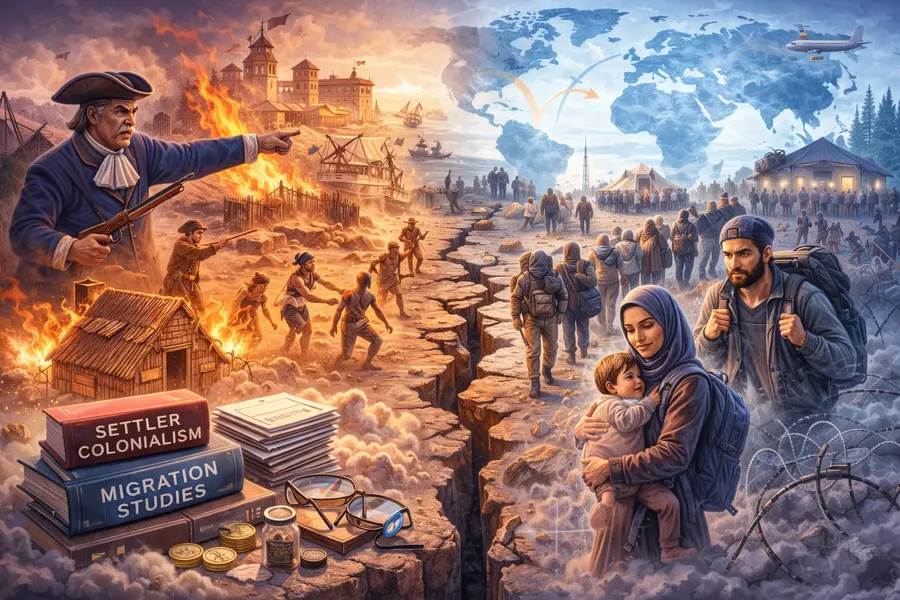
Why Is Settler Colonialism Intersecting with Migration Studies in Today’s Academic and Policy Debates?
In recent years, scholars across history, sociology, political science, and human geography have started asking a powerful question: Why are settler colonialism and migration studies being discussed together?
At first glance, these fields may seem separate. One focuses on land occupation and Indigenous displacement; the other examines why and how people move across borders. But look closer, and the overlap becomes impossible to ignore.
Settler colonialism is not just a historical event—it is an ongoing structure. Migration, likewise, is not just movement—it is shaped by laws, borders, and power systems. When migrants settle in lands shaped by settler colonial histories, they enter complex political and ethical landscapes. This intersection forces scholars to rethink belonging, citizenship, displacement, and identity.
Understanding this connection is essential for anyone studying global mobility, Indigenous rights, or border politics.
In this article, we’ll unpack why these two fields are converging, what it means for research, and why it matters in today’s world.
Understanding Settler Colonialism as an Ongoing Structure
Settler colonialism is often misunderstood as something that ended centuries ago. However, scholars like Patrick Wolfe argue that it is a structure, not an event. It operates through the ongoing displacement of Indigenous peoples and the establishment of permanent settler societies.
Unlike classical colonialism, which extracts resources and eventually withdraws, settler colonialism aims to replace Indigenous populations and claim land as a new homeland.
Countries such as Canada, Australia, and United States are frequently studied in this context. Their national foundations are deeply tied to Indigenous dispossession and migration policies that encouraged European settlement.
Migration studies now recognizes that contemporary migration flows occur within these settler frameworks.
When new migrants arrive, they enter societies already built upon Indigenous land claims and colonial histories. This realization has reshaped academic debates, prompting scholars to examine how migration policies may reinforce or challenge settler colonial structures.
Migration as a Tool of Settler Expansion
Historically, migration was not accidental—it was policy. Governments actively recruited settlers to solidify territorial control.
Land grants, economic incentives, and racialized immigration laws were used to populate frontier regions and marginalize Indigenous communities.
In the 19th and early 20th centuries, immigration policies in countries like Canada and Australia were explicitly designed to attract European settlers while excluding Indigenous peoples and non-European migrants. These policies shaped demographic realities that persist today.
Migration studies scholars are now revisiting historical archives to understand how migration functioned as a colonial instrument. This shift challenges the traditional narrative of migration as purely economic mobility. Instead, it frames certain migration waves as part of territorial consolidation projects.
By integrating settler colonial analysis, migration research becomes more historically grounded. It moves beyond individual choice and explores state power, land politics, and racial hierarchies embedded in migration systems.
Read Here: The Role of Diaspora in Shaping National Identity
Indigenous Displacement and Forced Migration
Migration studies traditionally focuses on voluntary movement or refugee displacement. But Indigenous displacement complicates these categories. Settler colonialism often involved forced removals, broken treaties, and cultural erasure.
For example, the history of forced relocation policies in the United States illustrates how Indigenous communities were uprooted to make space for settlers. These movements were not international border crossings but internal expulsions, challenging how migration is defined.
By engaging with settler colonial frameworks, migration scholars expand their understanding of forced migration. Indigenous displacement becomes central rather than peripheral to mobility studies.
This intersection also raises ethical questions: Who is labeled a migrant? Who is considered native? And how do legal categories obscure historical injustice? These debates push migration studies toward a more critical and inclusive approach.
Borders, Sovereignty and Indigenous Land Rights
Modern borders often cut across Indigenous territories. Settler colonial states established international boundaries without Indigenous consent. As migration scholars examine border regimes, they increasingly confront this history.
Take the border between United States and Canada. Indigenous nations such as the Haudenosaunee have ancestral territories spanning both sides. Their mobility rights complicate state-defined border control systems.
Migration enforcement, visa regimes, and citizenship laws operate within settler sovereignty claims. This creates tension between Indigenous land rights and national immigration systems.
By linking settler colonialism to migration studies, researchers reveal how borders are not neutral lines but colonial constructs. This understanding enriches debates about migration governance, sovereignty, and human rights in contemporary policymaking.
The Politics of Belonging and Citizenship
Migration studies often explores who belongs and who does not. Settler colonial theory adds another layer: How was belonging established in the first place?
Citizenship in settler states emerged through exclusion—both of Indigenous peoples and racialized migrants. For example, historical policies in Australia restricted non-white immigration for decades. These racial frameworks shaped national identity.
Today, new migrants may seek inclusion within systems built on Indigenous dispossession. This creates complex solidarities and tensions. Some scholars argue migrants can become “settlers” within colonial contexts, even if they themselves face discrimination.
This perspective reframes integration debates. It moves beyond assimilation models and encourages reflection on shared responsibilities toward Indigenous justice. Citizenship becomes not just a legal status but an ethical relationship to land and history.
Refugees in Settler States
Refugees are often framed as victims of conflict seeking safety. Yet many resettle in countries shaped by settler colonial histories, such as Canada and United States.
This raises important questions: Can refugee protection coexist with unresolved Indigenous land claims? How do resettlement policies intersect with territorial sovereignty?
Migration scholars are now examining how humanitarian narratives sometimes obscure colonial foundations. Welcoming refugees does not erase historical injustice; it occurs within existing power structures.
By integrating settler colonial analysis, researchers can develop more ethically grounded resettlement models. These approaches acknowledge Indigenous sovereignty while supporting displaced communities, fostering dialogue rather than competition over belonging.
Read Here: The Sociology of Refugee Resettlement and Integration
Decolonizing Migration Research Methodologies
Another reason for this intersection is methodological. Scholars are increasingly calling for decolonized research approaches. This means centering Indigenous knowledge systems and challenging Eurocentric frameworks.
Migration studies historically relied on state data and border metrics. Settler colonial theory critiques these tools, arguing they reproduce colonial categories.
By collaborating with Indigenous scholars and communities, researchers can rethink mobility, land, and belonging from non-state perspectives. This shift enhances academic credibility and aligns with E-E-A-T principles—demonstrating expertise, lived experience, and ethical accountability.
Decolonizing methodologies also improve policy relevance. They encourage more inclusive data collection and more responsible storytelling in migration debates.
Climate Migration and Colonial Legacies
Climate change is driving new migration patterns. But climate vulnerability is unevenly distributed, often along colonial lines. Indigenous communities frequently face disproportionate environmental harm due to extractive practices rooted in settler expansion.
As climate migration grows, scholars are asking whether relocation policies replicate colonial displacement. Will climate adaptation projects override Indigenous land rights?
By connecting settler colonialism with migration studies, researchers can anticipate these risks. Climate mobility must consider historical land claims, environmental justice, and sovereignty.
This interdisciplinary lens ensures that solutions to climate displacement do not repeat the injustices of the past but instead promote equitable and community-led approaches.
Read Also: Impact of Immigration Policies on Migrant Communities
Why This Intersection Matters Today
The intersection of settler colonialism and migration studies is not just academic—it shapes real-world debates. Immigration policy, refugee resettlement, border enforcement, and Indigenous reconciliation efforts are deeply interconnected.
As global migration intensifies, settler states must confront their histories. Scholars, policymakers, and communities are recognizing that mobility cannot be separated from land politics.
This convergence strengthens both fields. Migration studies gains historical depth and ethical nuance. Settler colonial theory gains contemporary relevance in global mobility debates.
Ultimately, this intersection invites a more honest conversation about who moves, who belongs, and who bears responsibility for justice. It challenges us to rethink migration not just as movement across space, but as movement within layered histories of power and dispossession.
Understanding this connection is essential for building more equitable societies in a world defined by both migration and memory.