In today’s hyperconnected world, social media isn’t just a place to share memes or catch up with friends — it’s a powerful force shaping political opinions.
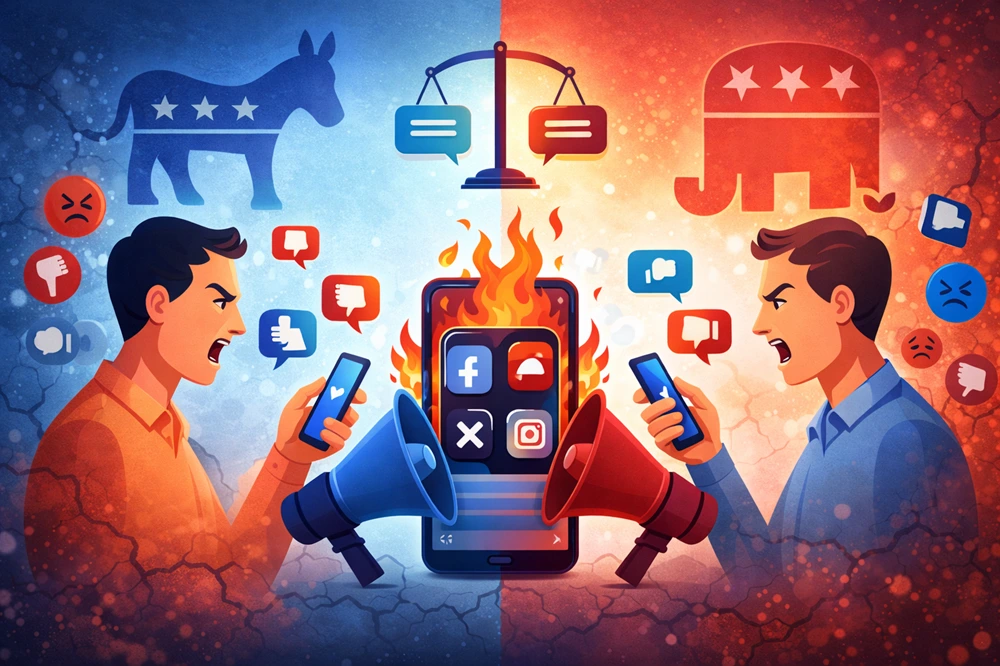
Platforms like Facebook, X (Twitter), and Instagram often act as echo chambers, where algorithms feed users content that reinforces their existing beliefs. This constant cycle of tailored posts and viral debates can deepen divides, turning healthy disagreements into entrenched polarization.
Add in the rapid spread of misinformation and emotionally charged narratives, and the result is a digital environment where opposing sides grow further apart.
Understanding how social media contributes to political polarization is essential for anyone concerned about democracy, public discourse and the future of civic engagement.
How Does Social Media Contribute to Political Polarization? Causes & Effects
Social media has transformed how people consume news, share opinions, and engage in political discussions.
Platforms like Facebook, X (formerly Twitter), YouTube, and Instagram have become powerful digital spaces where political ideas spread instantly. While these platforms help people stay informed and connected, they also play a significant role in increasing political polarization.
Political polarization occurs when societies become divided into strongly opposing ideological groups with little room for compromise.
Social media can intensify this divide by amplifying extreme viewpoints, reinforcing personal beliefs, and limiting exposure to diverse perspectives.
Algorithms designed to maximize engagement often prioritize emotionally charged content, which can deepen disagreements rather than encourage balanced dialogue.
Understanding how social media contributes to political polarization is essential in today’s digital age.
Let’s examine the mechanisms behind online echo chambers, misinformation, algorithmic bias, and emotional engagement and better understand why political divisions appear sharper than ever before.
Algorithm-Driven Content Personalization
One of the biggest ways social media fuels political polarization is through algorithm-driven content personalization.
Social media platforms use complex algorithms to analyze user behavior—likes, shares, comments, watch time, and search history. Based on this data, platforms recommend content that aligns with a user’s interests and beliefs.
While personalization improves user experience, it also creates an environment where individuals repeatedly see content that supports their existing political views. Over time, this selective exposure can strengthen ideological beliefs and reduce openness to opposing viewpoints.
For example, someone who frequently engages with conservative political content will likely see more of it in their feed, while liberal content may rarely appear. This reinforcement effect can make users feel that their perspective is widely accepted, even when society holds diverse opinions.
As a result, people may become more confident in their views and less willing to engage constructively with opposing perspectives.
Read Here: The Role of Algorithms in Social Media Polarization
The Rise of Echo Chambers
Echo chambers are digital environments where individuals are primarily exposed to opinions and information that mirror their own beliefs.
Social media platforms often unintentionally create these echo chambers through algorithms and user behavior.
People tend to follow accounts, join groups, and interact with communities that share similar political ideologies. Over time, this leads to networks of like-minded individuals reinforcing the same narratives.
When users constantly hear similar opinions repeated by others, those views can appear more credible and widely accepted.
Echo chambers can also make opposing viewpoints seem unfamiliar, extreme, or even threatening.
Without exposure to balanced discussions, individuals may develop stronger biases and stereotypes about people who disagree with them politically.
This environment discourages meaningful dialogue and reduces opportunities for constructive debate. Instead of encouraging understanding, echo chambers amplify division and make political compromise increasingly difficult.
The Spread of Misinformation and Disinformation
Misinformation and disinformation spread rapidly on social media, often contributing to political polarization.
Misinformation refers to false or misleading information shared without harmful intent, while disinformation is deliberately created to deceive people.
Social media platforms allow information to travel faster than traditional news channels.
A sensational political claim can reach millions of users within hours through shares, retweets, and reposts. Because emotionally charged content tends to attract more engagement, misleading political narratives often gain traction quickly.
When users repeatedly encounter misleading information that supports their political beliefs, they may accept it as truth without verifying the source. This can strengthen ideological divides and increase distrust between political groups.
Additionally, coordinated disinformation campaigns—sometimes organized by political actors or foreign groups—can deliberately exploit social media to deepen divisions within societies and manipulate public opinion.
Emotional Content and Outrage Culture
Social media platforms reward content that generates strong emotional reactions. Posts that trigger anger, fear, or outrage often receive more likes, shares, and comments than neutral or balanced information.
Political content designed to provoke emotional responses can spread quickly across platforms. Politicians, activists, and influencers sometimes use emotionally charged language to mobilize supporters or criticize opponents.
When users repeatedly engage with content that fuels anger toward opposing political groups, it can intensify polarization.
Emotional reactions can reduce critical thinking and encourage quick judgments about complex political issues.
Over time, outrage-driven discussions can replace thoughtful debate. Instead of focusing on policy solutions or constructive dialogue, political conversations become dominated by accusations, insults, and partisan conflict. This emotional amplification contributes significantly to the widening ideological divide seen on social media today.
Selective Exposure to Political Information
Selective exposure is the tendency for individuals to seek information that confirms their existing beliefs while avoiding content that challenges them. Social media makes this process easier than ever before.
Users have complete control over who they follow, what content they engage with, and which discussions they participate in. This means they can easily curate their information environment to align with their personal views.
When people consistently consume political content that supports their beliefs, they may become more convinced that their viewpoint is correct. At the same time, they may perceive opposing perspectives as misinformed or biased.
This pattern reinforces ideological divisions and limits opportunities for exposure to balanced viewpoints.
In a healthy democratic society, encountering diverse perspectives can encourage critical thinking and compromise. However, selective exposure on social media often leads to deeper ideological separation.
Political Identity and Online Tribalism
Social media has transformed politics into a strong form of personal identity. Many users publicly display their political beliefs through profile bios, hashtags, posts, and shared content.
When political identity becomes central to someone’s online presence, disagreements with opposing viewpoints may feel personal rather than ideological. Social media communities often reinforce this sense of belonging to a political “tribe.”
Members of these groups support each other’s beliefs while criticizing or mocking opposing political groups. This tribal dynamic can increase hostility between political camps and make constructive discussions more difficult.
Online tribalism also encourages loyalty to group narratives, even when evidence contradicts them. People may defend their political group to maintain social approval within their online community.
As a result, political debates can become less about understanding complex issues and more about defending group identity.
Virality of Extreme Political Views
Social media algorithms tend to prioritize content that generates strong engagement. Unfortunately, extreme political opinions often receive more attention than moderate viewpoints.
Content that expresses highly polarized opinions—whether strongly conservative or strongly progressive—can attract large numbers of reactions, comments, and shares. This engagement signals to algorithms that the content is popular, leading to wider distribution.
As a result, users may encounter a disproportionate amount of extreme political content compared to moderate perspectives. This can create the impression that society is more politically divided than it actually is.
Exposure to extreme viewpoints can also influence individuals’ attitudes over time. When extreme narratives dominate political discussions, moderate voices may become less visible, making constructive political dialogue increasingly rare.
Influence of Political Influencers and Partisan Media
Political influencers, commentators, and partisan media outlets play a significant role in shaping political discourse on social media. Many of these figures build large audiences by presenting strongly opinionated political content.
Influencers often frame political issues in ways that resonate with their followers’ beliefs. Their posts can shape how audiences interpret events, policies, and political opponents. Because followers trust these figures, their messages can have a powerful impact on political attitudes.
Partisan media content is also widely shared on social media platforms. Articles, video clips, and commentary from politically aligned sources can reinforce existing beliefs within specific communities.
While political commentary is a normal part of democratic discussion, highly partisan narratives can deepen divisions.
When audiences rely primarily on politically aligned sources, they may receive a limited perspective on complex political issues.
Reduced Face-to-Face Political Dialogue
Before the rise of social media, political discussions often occurred in face-to-face settings—community meetings, workplaces, universities, and family gatherings. These interactions allowed people to hear different viewpoints in a more personal and respectful context.
Online discussions, however, often lack the social cues present in real-life conversations. Without tone of voice, facial expressions, or personal relationships, disagreements can escalate quickly into hostility.
Social media also allows users to communicate anonymously or with limited accountability. This can encourage more aggressive or dismissive responses during political debates.
As more political conversations move online, opportunities for respectful dialogue may decrease.
The lack of personal connection between participants can make it easier to dehumanize opposing viewpoints, further contributing to political polarization.
The Role of Platform Design and Engagement Metrics
The design of social media platforms plays a crucial role in shaping political conversations. Features such as likes, shares, trending topics, and comment sections encourage users to engage with content quickly and frequently.
These engagement metrics reward posts that capture attention, spark debate, or generate controversy.
Political content that provokes strong reactions often performs better in this system than balanced discussions or nuanced analysis.
Additionally, trending algorithms may highlight controversial political topics, exposing them to larger audiences. While this can increase awareness of important issues, it can also amplify conflict and polarization.
Platform designers often prioritize user engagement and time spent on the platform. However, this focus can unintentionally encourage divisive political content. As social media continues to evolve, researchers and policymakers are exploring ways to reduce polarization while maintaining open online discussion.
Read Also: How Social Media Shapes Political Participation Today
Conclusion:
Social media has become one of the most influential forces shaping modern political discourse. While it offers opportunities for information sharing and civic participation, its structure and algorithms can unintentionally intensify ideological divisions.
Understanding these dynamics is the first step toward promoting healthier online conversations and reducing political polarization in the digital age.