The Science and Religion Debate: Can Faith and Modern Science Find Common Ground?
Can science and religion exist together in the modern world? Should religious beliefs change when scientific discoveries challenge traditional interpretations? And can scientists and religious thinkers discuss difficult subjects without treating each other as enemies?
These questions have become increasingly important as science transforms our understanding of the universe, life, human behaviour, and technology.
From the discovery of evolution and the expansion of the universe to genetic engineering, stem-cell research, artificial intelligence, and neuroscience, modern science has opened up questions that previous generations could hardly imagine. Some of these questions were once discussed mainly by philosophers and religious scholars. Today, scientists are also deeply involved in exploring them.
One important effort to encourage this conversation was the Belief in Dialogue: Science, Culture and Modernity conference, held at the American University of Sharjah in the United Arab Emirates from June 21 to 23, 2011.
The conference brought together scientists, philosophers, historians, religious thinkers, and other experts to examine how science, religion, culture, and modern society interact. It was organized by the British Council in partnership with the American University of Sharjah and in association with the International Society for Science and Religion.
The event represented an important attempt to move beyond the traditional idea of science versus religion. Instead of simply asking which side was right, participants explored how people with different beliefs could discuss challenging questions constructively.
But why is this kind of debate important? Can science and religion really find common ground? And what can modern societies learn from open discussions between scientists and religious thinkers?
Let’s explore the issues.
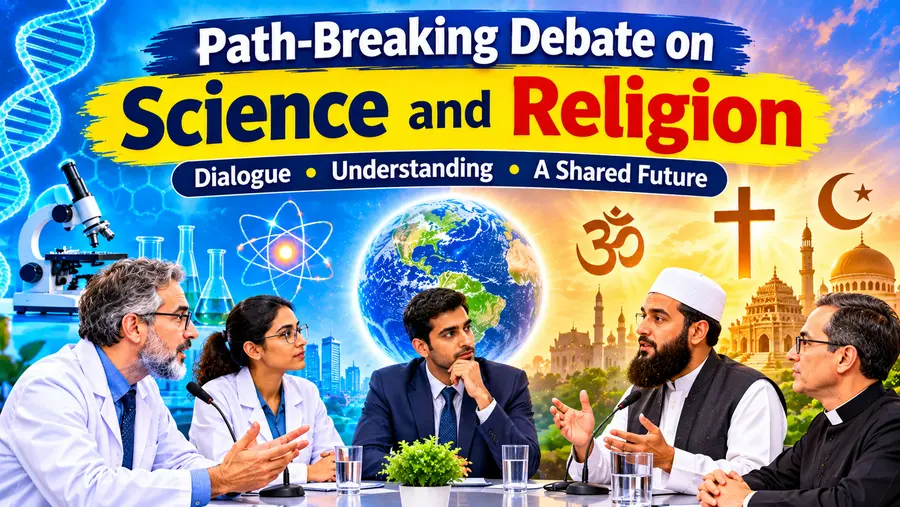
What Was the Path-Breaking Debate on Science and Religion?
The phrase “path-breaking debate on science and religion” refers to efforts to create a constructive conversation between people who approach the world through different scientific, philosophical, and religious perspectives.
One notable example was the 2011 Belief in Dialogue conference at the American University of Sharjah.
The three-day event brought together more than 40 thinkers from 10 countries. Speakers and participants included physicists, medical professionals, historians of science, philosophers, Muslim intellectuals, and researchers interested in the relationship between scientific knowledge and religious belief.
Among the participants were physicist Paul Davies, astronomer and science educator Nidhal Guessoum, historian of science Patricia Fara, and other prominent scholars.
The conference was organized around three broad themes:
- Science and Religion: Two Cultures? This theme explored whether science and religion represent fundamentally different ways of understanding the world.
- Cultures of Belief in Modern Societies: Discussions examined how religious and nonreligious worldviews influence modern communities.
- Ethical Values and Human Responsibility: Participants considered the ethical challenges arising from scientific progress, including environmental sustainability and new technologies such as stem-cell research.
The organizers wanted participants to move beyond confrontational arguments and explore difficult issues through informed discussion.
The event also included a BBC World Service debate, giving the wider public an opportunity to engage with the conversation.
You can read the American University of Sharjah’s original conference announcement and the conference programme and themes.
Why Is a Debate Between Science and Religion Necessary?
Science and religion influence human life in different ways.
Science helps us understand the natural world through observation, experimentation, mathematical reasoning, and evidence. Religion, depending on the tradition, addresses questions about meaning, morality, spiritual experience, identity, and humanity’s relationship with the sacred.
However, their areas of discussion sometimes overlap.
For example, scientific discoveries about the origin of the universe raise philosophical questions about existence. Evolutionary biology influences discussions about human origins. Neuroscience raises questions about consciousness and personal identity. Medical technology creates ethical questions about the beginning and end of human life.
These subjects can be difficult to discuss because they touch on deeply held beliefs.
A constructive debate allows people to examine such questions without assuming that disagreement must lead to hostility.
There are several reasons why this dialogue matters.
Read Here: Why Should Scientists Care About Religion?
Science Is Constantly Changing Our Understanding of the Universe
Scientific discoveries have transformed almost every area of human knowledge.
Astronomers have discovered that the universe is expanding. Physicists have developed theories about the behaviour of matter and energy. Biologists have established the evolutionary relationships between living organisms. Neuroscientists are investigating the relationship between the brain and consciousness.
These discoveries have changed how humanity understands its place in the universe.
Questions that were once addressed mainly through philosophy and religion are now also investigated through scientific research.
For example:
- How did the universe begin?
- How did life develop on Earth?
- What makes human consciousness possible?
- Could life exist elsewhere in the universe?
- How did human beings evolve?
- What happens to the brain and body when a person dies?
Science can investigate many aspects of these questions. However, people may also consider their philosophical or theological implications.
A scientific discovery does not automatically settle every philosophical question connected with it.
Religious Communities Need Scientific Literacy
Scientific literacy is not simply about knowing scientific facts. It also involves understanding how science works, how evidence is evaluated, and why scientific conclusions sometimes change.
This is particularly important in religious communities, where some scientific discoveries may challenge traditional interpretations.
For example, evolutionary biology has generated considerable debate in different religious traditions. Some people reject evolution because they believe it conflicts with their interpretation of sacred texts. Others accept evolutionary science while interpreting their religious teachings in ways they consider compatible with it.
Similarly, modern astronomy, genetics, and medical science have changed how people discuss the natural world and human life.
Religious communities benefit from understanding established scientific findings rather than relying on inaccurate information or popular misconceptions.
At the same time, scientists and educators should communicate discoveries in ways that recognize cultural differences and encourage questions.
Scientific literacy is a global educational challenge, not a problem confined to any particular religion or region.
Scientists Need to Understand Religious Beliefs
The relationship should not be one-sided.
Scientists also need to understand how religious beliefs influence human behaviour, social attitudes, and public responses to technology.
For example, a medical researcher may develop a treatment that raises questions about reproductive ethics. A public-health professional may need to communicate vaccination information to communities with particular religious concerns.
Understanding these perspectives can make scientific communication more effective.
It can also help researchers build trust with communities, especially when scientific developments affect sensitive areas of human life.
Read Here: Why Religion Still Matters in the Age of Science
5 Major Issues That Make the Science and Religion Debate Important
The relationship between science and religion involves several difficult questions. The following issues demonstrate why open discussion is valuable.
The Origin of the Universe: What Does Science Explain?
One of the oldest questions in philosophy and religion concerns the origin of the universe.
Religious traditions often describe the universe as the creation of a divine being. Modern cosmology, meanwhile, investigates the universe’s history, expansion, composition, and early development.
The leading scientific framework is the Big Bang model.
According to modern cosmology, the observable universe evolved from an extremely hot and dense early state approximately 13.8 billion years ago. Evidence includes the expansion of the universe, the cosmic microwave background radiation, and the observed abundance of light elements.
However, the Big Bang model should not be simplified into the statement that science has completely explained why the universe exists.
Scientists continue to investigate questions about the earliest physical conditions, the limits of current cosmological models, and whether it makes sense to ask what happened before the earliest stages we can describe.
Religious and philosophical thinkers may interpret the existence of the universe in terms of creation, purpose, or a divine cause.
The important question is how to distinguish scientific explanations of cosmic history from philosophical or theological interpretations of why anything exists at all.
A meaningful discussion should examine the evidence without treating an unanswered scientific question as automatic proof of a religious claim.
Evolution: How Did Life and Human Beings Develop?
Evolution is among the most debated subjects at the intersection of science and religion.
Modern evolutionary biology explains how populations of living organisms change over generations through processes such as mutation, natural selection, genetic drift, and gene flow.
There is extensive scientific evidence for evolution from genetics, fossils, comparative anatomy, biogeography, and direct observations of biological change.
However, some religious interpretations of creation have been understood as conflicting with common scientific accounts of life’s development.
This has led to debates within Christianity, Islam, and other religious communities.
Not all religious believers reject evolution. Some accept the scientific evidence and understand evolutionary processes as compatible with their theological beliefs. Others question particular aspects of evolutionary theory or reject it on religious grounds.
The discussion becomes more productive when people distinguish established biological evidence from theological questions about creation, purpose, and human significance.
Scientists should explain evolutionary evidence clearly. Religious thinkers should engage with the actual scientific theory rather than simplified or inaccurate descriptions of it.
Stem-Cell Research: Scientific Progress and Moral Responsibility
Stem-cell research is an important example of how scientific discoveries can raise ethical questions.
Stem cells are cells that can develop into different specialized cell types. Researchers study them to understand human development, investigate diseases, and explore potential treatments.
Some types of stem cells have the ability to develop into many different cell types, making them valuable for medical research.
However, certain research involving human embryonic stem cells has raised ethical disagreements because obtaining these cells has traditionally involved the destruction of early-stage embryos.
Religious and philosophical perspectives differ on when human life acquires moral status and what responsibilities researchers have toward embryos.
Modern stem-cell science also includes adult stem cells and induced pluripotent stem cells, which are created by reprogramming mature cells. These approaches can provide important research opportunities without using embryos.
The debate demonstrates why scientific possibilities and moral questions need to be considered together.
Scientists can explain what a particular research method involves and what medical benefits it might offer. Ethicists, religious thinkers, patients, and policymakers can contribute to wider discussions about its responsible use.
DNA Testing and Genetic Engineering: How Far Should Science Go?
Advances in genetics have transformed medicine, biology, and our understanding of human identity.
DNA testing can help identify genetic variations, estimate certain disease risks, establish biological relationships, and support forensic investigations.
Genetic research has also led to technologies that allow scientists to modify DNA with increasing precision.
One important example is CRISPR-based gene editing.
These technologies raise several ethical and social questions.
Should parents have access to genetic information about an unborn child? How should society protect genetic privacy? Should gene editing be used to prevent serious inherited diseases? Should scientists be allowed to make genetic changes that could be passed to future generations?
Religious perspectives can contribute to these conversations by raising questions about human dignity, responsibility, and the boundaries of human intervention in nature.
However, decisions should also consider medical evidence, safety, informed consent, equality, human rights, and the potential long-term effects of genetic technologies.
The objective should be responsible scientific progress rather than rejecting research simply because it raises difficult questions.
In-Vitro Fertilisation: Science, Reproduction and Religious Values
In-vitro fertilisation, commonly known as IVF, is a medical technique that can help some people experiencing infertility have children.
In IVF, eggs are collected and fertilized with sperm in a laboratory. An embryo may then be transferred into the uterus.
The technology has helped many individuals and couples become parents.
However, IVF raises several ethical and religious questions.
These may involve embryo storage, the use of donor eggs or sperm, embryo selection, surrogacy, and the moral status of embryos.
Different religious traditions and scholars have developed different positions on these issues.
For example, discussions within Islamic jurisprudence have considered questions about marriage, lineage, donor gametes, and reproductive responsibility. Christian, Jewish, Hindu, and other religious perspectives also vary.
A productive debate requires accurate medical information as well as careful consideration of religious and ethical principles.
The purpose should be to understand the actual medical procedures and the different moral arguments, not to assume that every religious community has one universal position.
Can Science and Religion Exist Together?
Yes, science and religion can coexist for many people, but the relationship depends on how scientific findings and religious claims are interpreted.
Science and religion are not identical systems of knowledge.
Science uses methods such as observation, measurement, experimentation, mathematical analysis, and independent verification to investigate the natural world.
Religious traditions draw on sources such as sacred texts, philosophical arguments, spiritual experiences, theological interpretation, and community practices.
These approaches may address different kinds of questions, but they can also make claims about the same subject.
For example, a religious interpretation might make a claim about the physical development of living organisms. If that claim conflicts with strong scientific evidence, it should be examined carefully.
Likewise, scientific findings do not automatically answer every question about purpose, moral responsibility, or spiritual meaning.
Some scientists and religious thinkers believe that science and faith can form complementary parts of a broader worldview. Others argue that certain religious beliefs conflict with scientific naturalism or specific scientific conclusions.
There is no single position shared by all scientists or all religious people.
The goal of constructive dialogue is not to pretend that disagreements do not exist. It is to examine them honestly and identify where meaningful cooperation is possible.
Why Should Religious Thinkers Take Modern Science Seriously?
Scientific discoveries are based on accumulated evidence from observation and investigation.
Religious thinkers who want to engage seriously with modern society should understand these findings before discussing their theological implications.
For example, biological evolution is supported by multiple independent lines of evidence. The expansion of the universe is supported by observations in modern astronomy. Germ theory and microbiology have transformed our understanding of infectious diseases.
Rejecting such findings without examining the evidence can create unnecessary conflict between religious interpretations and established knowledge.
However, taking science seriously does not mean abandoning religious faith.
Many believers explore ways to interpret their religious traditions in light of new knowledge. This may involve distinguishing between theological principles, historical interpretations, symbolic language, and claims about the physical world.
The important point is intellectual honesty.
Religious interpretations should not be presented as scientific discoveries unless they meet the standards of scientific investigation.
Similarly, scientists should avoid treating every religious belief as irrational or assuming that all believers reject modern knowledge.
Read Here: Why Is It So Hard for Some Scientists to Believe in God?
Why Should Scientists Take Religion and Philosophy Seriously?
Scientists also benefit from understanding religion and philosophy.
Scientific discoveries raise questions about how knowledge should be used and what responsibilities researchers have toward society.
For example, artificial intelligence can create powerful tools for education, medicine, and research. It can also raise concerns about privacy, bias, employment, misinformation, and human control.
Genetic engineering may help prevent serious diseases, but it also raises questions about fairness, consent, and the future of human reproduction.
Scientific research can identify possible outcomes and measure risks. But deciding which outcomes society should prioritize also requires ethical and philosophical reasoning.
Religious traditions can contribute moral perspectives to these discussions, particularly through ideas about compassion, justice, responsibility, and human dignity.
This does not mean that science needs religion to function or that moral values must come from religious belief.
Secular philosophy, human-rights frameworks, democratic institutions, and professional ethics also provide important foundations for responsible decision-making.
The real benefit comes from bringing different perspectives into a respectful and evidence-informed discussion.
What Makes a Science and Religion Debate Constructive?
A productive debate needs more than passionate opinions. It requires clear definitions, accurate information, open discussion, and mutual respect.
Here are some important principles.
Respect Scientific Evidence
Scientific claims should be evaluated through reliable evidence and established research methods.
If strong evidence supports a scientific conclusion, disagreement should involve serious examination of that evidence rather than simply rejecting it.
Avoid Misrepresenting Religious Beliefs
Religious traditions are diverse. Different communities and scholars often interpret the same sacred text or theological question differently.
A constructive discussion should represent these differences fairly.
Distinguish Facts From Interpretations
A scientific observation, a philosophical argument, and a theological interpretation are not interchangeable.
For example, the scientific evidence that the universe is expanding is different from the philosophical argument that the universe requires a cause.
Clear distinctions help prevent confusion.
Encourage Questions
Education should not discourage people from asking difficult questions.
Students should be able to discuss evolution, cosmology, neuroscience, genetics, religion, and philosophy without being made to feel that asking a question is disrespectful.
Accept That Disagreement May Remain
Not every debate will produce agreement.
Some disagreements are genuine differences in philosophical or theological assumptions. The objective is to improve understanding, not force everyone to adopt the same worldview.
The Importance of Science Education in Religious Societies
Scientific literacy is particularly important in societies where religious beliefs play a major role in public life.
However, this does not mean that scientific literacy is a problem unique to Muslim-majority countries or any other religious community. Misunderstandings about science can occur in societies with very different religious and cultural backgrounds.
A strong science education system should encourage:
- Evidence-based thinking.
- Critical examination of scientific claims.
- Practical experimentation and observation.
- Understanding of scientific uncertainty.
- Open discussion of ethical questions.
- Respect for different cultural and philosophical perspectives.
Students should learn not only scientific facts but also how scientific knowledge is produced and evaluated.
For example, when teaching evolution, educators should explain the evidence from fossils, genetics, and natural selection. Students should also understand the difference between scientific explanations of biological change and broader philosophical or theological questions about purpose.
Similarly, teaching cosmology should involve scientific evidence about the expanding universe, not unsupported claims that science has already answered every question about existence.
Education becomes more valuable when students learn how to think rather than simply what to memorize.
What Can the Muslim World Learn From the Science and Religion Dialogue?
The 2011 Belief in Dialogue conference was particularly significant because it took place in the United Arab Emirates and brought international scientists, Muslim intellectuals, historians, and philosophers together.
It created an opportunity to discuss modern science in a setting where religious, cultural, and philosophical questions were also taken seriously.
For Muslim societies, the wider discussion raises important issues about scientific education, research investment, academic freedom, technology, and the interpretation of religious traditions.
The history of the Islamic Golden Age provides examples of scholars working across cultures and intellectual traditions. Scientists such as Al-Khwarizmi, Ibn al-Haytham, Al-Biruni, and Al-Jazari made important contributions to mathematics, optics, astronomy, and engineering.
Their achievements demonstrate the importance of scientific curiosity, experimentation, and learning from other civilizations.
Modern Muslim societies can benefit from strengthening universities, supporting research institutions, encouraging young scientists, improving scientific literacy, and creating opportunities for open intellectual discussion.
However, these priorities are not limited to Muslim societies. Every country benefits when education encourages curiosity, evidence-based thinking, and responsible scientific research.
The Future of Science and Religion: Cooperation or Conflict?
The relationship between science and religion will remain an important subject as new discoveries challenge existing assumptions.
Artificial intelligence, biotechnology, neuroscience, space exploration, and quantum technologies will raise questions about human identity, responsibility, consciousness, and the future of civilization.
Scientists will continue to investigate what is possible. Philosophers, religious thinkers, policymakers, and communities will continue to discuss how new discoveries should be interpreted and used.
There will undoubtedly be disagreements.
Some religious interpretations may conflict with scientific findings. Some scientific claims may be used to make philosophical arguments that go beyond the available evidence. Some discussions may become political or ideological.
But conflict is not the only possible outcome.
Constructive dialogue can help people identify genuine areas of disagreement, correct misunderstandings, and cooperate on shared challenges.
The future does not require science and religion to become the same thing. It requires people to understand their different methods, responsibilities, and limitations.
Frequently Asked Questions (FAQs)
What is the science and religion debate?
The science and religion debate examines how scientific knowledge and religious beliefs relate to one another. It includes discussions about the origin of the universe, evolution, consciousness, medical ethics, human life, and the role of faith in modern society.
What was the Belief in Dialogue: Science, Culture and Modernity conference?
It was an international conference held at the American University of Sharjah in the UAE from June 21 to 23, 2011. Organized by the British Council in partnership with the university and in association with the International Society for Science and Religion, it brought together scientists, philosophers, historians, and religious thinkers to discuss science, faith, culture, and ethics.
Can science and religion coexist?
Yes, many people consider science and religion compatible, although disagreements arise when particular religious interpretations conflict with established scientific findings. Their relationship depends partly on how scientific evidence and religious claims are understood.
Why is dialogue between scientists and religious scholars important?
Dialogue helps scientists understand religious communities and helps religious thinkers engage with modern scientific knowledge. It can also support discussions about medical ethics, biotechnology, evolution, environmental responsibility, and artificial intelligence.
Does science disprove religion?
Science does not establish a general conclusion that every religious belief is false. It can test claims about the natural world when they produce testable predictions or involve observable phenomena. Broader theological and philosophical claims require additional forms of reasoning and debate.
Why is evolution controversial in some religious communities?
Some religious interpretations describe the creation of life and humans in ways that appear to conflict with evolutionary biology. Other believers accept evolutionary science and interpret their religious teachings differently. The positions vary across religions, communities, and individual thinkers.
What is the relationship between science and religion in Islam?
Muslim thinkers hold different views about the relationship between Islam and modern science. Some emphasize compatibility between Islamic theology and scientific discoveries, while others disagree about particular subjects such as evolution, cosmology, and the interpretation of sacred texts. Open scholarship and scientific education are important for informed discussion.
What ethical questions does modern science raise?
Modern science raises ethical questions about genetic engineering, stem-cell research, IVF, artificial intelligence, neuroscience, medical treatment, environmental protection, and the use of personal data. These questions require scientific evidence as well as ethical, legal, philosophical, and social reasoning.
Can religious beliefs influence scientific research?
Personal beliefs can influence the questions researchers find interesting, their motivations, and how they interpret the wider significance of their work. However, scientific findings must be evaluated through evidence, appropriate methods, critical review, and independent examination rather than a researcher’s religious identity.
What is the main purpose of a science and religion debate?
The main purpose is to understand how scientific discoveries, religious beliefs, philosophical ideas, and cultural values interact. A constructive debate encourages critical thinking, intellectual honesty, mutual respect, and informed discussion rather than hostility.
Read Here: Is There Definitive Proof of the Existence of God?
Conclusion: A Path Toward Better Understanding Between Science and Religion
The debate between science and religion is not simply a contest between two opposing sides. It is a much wider conversation about knowledge, human existence, morality, culture, and the future of society.
The Belief in Dialogue conference held in Sharjah in 2011 demonstrated the value of bringing scientists, philosophers, religious thinkers, and students together to discuss challenging subjects.
Scientific discoveries about the universe, evolution, genetics, neuroscience, and medicine deserve serious attention. Religious and philosophical traditions also influence how many people understand meaning, identity, and responsibility.
Neither side benefits from ignoring the other.
Science should remain grounded in evidence and rigorous investigation. Religious discussions should engage honestly with established scientific knowledge. Both should encourage intellectual freedom, thoughtful questions, and respect for people with different beliefs.
The most meaningful progress may come not from ending every disagreement between science and religion, but from learning how to discuss those disagreements intelligently and peacefully.