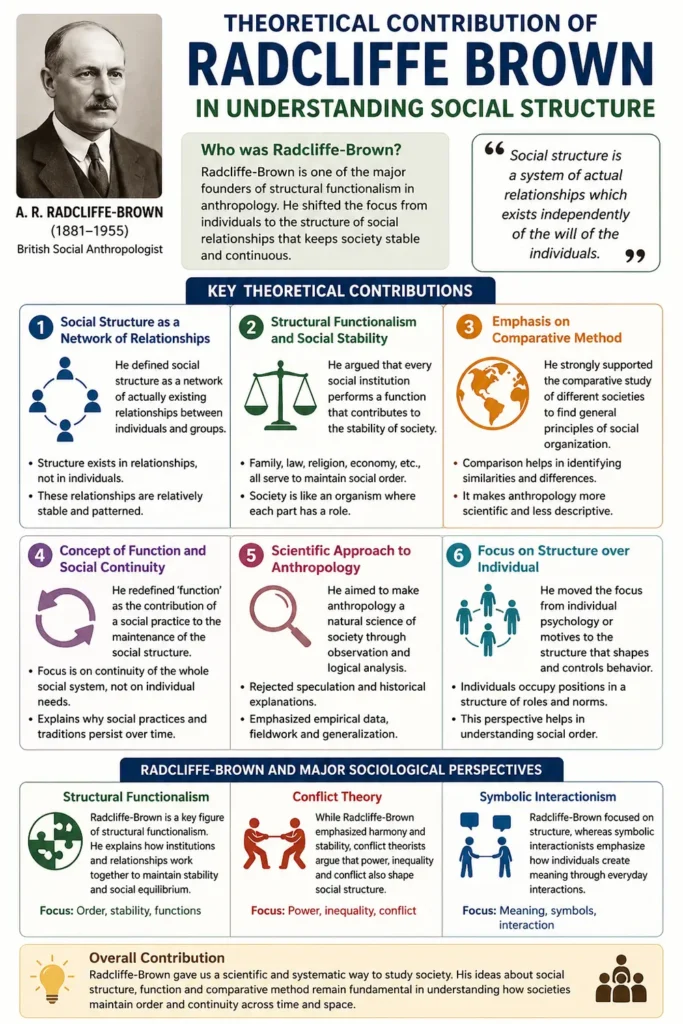
A. R. Radcliffe-Brown explained social structure as a system of stable relationships that maintain social order. His main contribution lies in developing Structural Functionalism, which shows how institutions function to support society’s stability. He also promoted the comparative and scientific study of societies. His work helps explain how social systems remain continuous, though it is often contrasted with Conflict Theory and Symbolic Interactionism.
Let’s explain A. R. Radcliffe-Brown’s theoretical contribution to social structure, including Structural Functionalism and key sociological perspectives in simple terms.

Theoretical Contribution of Radcliffe Brown in Understanding Social Structure
A. R. Radcliffe-Brown made a major contribution to understanding social structure in sociology and anthropology. He shifted attention from individual actions to the patterned relationships that form society.
For him, society is a system where institutions, roles, and norms are interconnected and work together to maintain order. His ideas laid the foundation for the Structural Functionalism perspective, which explains how different parts of society contribute to stability.
At the same time, his work can be compared with other sociological perspectives like Conflict Theory and Symbolic Interactionism to provide a broader understanding of society. His approach made anthropology more scientific by focusing on observation, comparison, and generalization.
Overall, his theoretical contributions help us see society as an organized and structured system rather than a random collection of individuals. This helps shape how scholars analyze kinship, politics, and social institutions in both traditional and modern societies.
Read Here: Understanding the Concept of Social Structure
Social Structure as a Network of Relationships
Radcliffe-Brown defined social structure as a network of real and ongoing relationships between individuals and groups. These relationships include kinship ties, political authority, and social obligations. He argued that these patterns are stable and give society its shape.
From the perspective of Structural Functionalism, these relationships are important because they help maintain order and balance.
However, Conflict Theory would question whether all relationships are equal, pointing out that power and inequality also shape social structures.
Meanwhile, Symbolic Interactionism focuses on how individuals create and interpret these relationships in daily life.
Radcliffe-Brown’s view highlights the importance of connections over individuals. This idea allows sociologists to study how people are linked within a system. It also helps in comparing societies and identifying patterns that maintain continuity and social cohesion over time.
Read Here: Examples of Social Structure in Everyday Life
Structural Functionalism and Social Stability
Radcliffe-Brown’s work is closely linked with Structural Functionalism. He argued that every institution in society performs a function that supports stability. For example, family, religion, and law help maintain order and unity.
This perspective views society as a system where all parts work together like organs in a body.
However, Conflict Theory offers a different view by arguing that institutions may also create inequality and serve powerful groups.
In contrast, Symbolic Interactionism focuses on how individuals experience and interpret these institutions in everyday life.
Radcliffe-Brown mainly emphasized stability and ignored conflict and change. Even so, his approach provides a strong foundation for understanding how societies maintain order.
His contribution remains important for analyzing how institutions function and how social systems remain stable over time.
Emphasis on Comparative Method
Radcliffe-Brown strongly supported the comparative method, which involves studying different societies to find general patterns. He believed that comparing cultures helps identify universal principles of social organization.
This idea fits well with Structural Functionalism, which looks for common functions across societies.
However, Conflict Theory may argue that comparisons should also focus on inequality and power differences.
On the other hand, Symbolic Interactionism would emphasize understanding meanings within specific cultural contexts rather than broad comparisons.
Radcliffe-Brown’s method made anthropology more scientific and less descriptive. It allowed scholars to move beyond isolated case studies.
By comparing societies, researchers can discover patterns that explain how social structures operate. His contribution continues to influence modern research methods in sociology and anthropology.
Concept of Function and Social Continuity
Radcliffe-Brown explained function as the role a social practice plays in maintaining the continuity of the social system.
Customs, rituals, and institutions exist because they help sustain social order. This idea is central to Structural Functionalism, which focuses on stability and balance.
However, Conflict Theory challenges this view by arguing that some practices may benefit certain groups while disadvantaging others. At the same time, Symbolic Interactionism examines how individuals attach meaning to these practices.
Radcliffe-Brown focused more on the system than on individuals. His concept helps explain why traditions continue over time. It also shows how societies maintain stability even during change.
His idea of function remains important for understanding how social practices contribute to the survival of social structures.
Scientific Approach to Anthropology
Radcliffe-Brown aimed to make anthropology a scientific discipline. He believed that social life should be studied through observation, evidence, and logical reasoning. This approach aligns with Structural Functionalism, which also seeks systematic explanations of society.
However, Conflict Theory would argue that scientific analysis must also consider power and inequality. Meanwhile, Symbolic Interactionism focuses on subjective meanings and everyday interactions, which are harder to measure scientifically.
Radcliffe-Brown rejected speculative explanations and focused on observable social structures. His emphasis on empirical research made anthropology more reliable and objective.
This contribution helped establish anthropology as a respected academic field. His scientific approach continues to influence modern sociological research and encourages the use of evidence-based methods to study society.
Read Here: Understanding Social Structure as Construct: Claude Lévi-Strauss’ Theory
Conclusion
A. R. Radcliffe-Brown made a lasting contribution to understanding social structure by presenting society as an organized system of relationships.
His focus on patterns, functions, and stability shaped the foundation of Structural Functionalism and gave sociology a more scientific direction.
At the same time, comparing his ideas with Conflict Theory and Symbolic Interactionism helps us see both the strengths and limits of his approach.
While he explained how societies maintain order, he paid less attention to conflict and individual meaning. Even so, his work remains essential for understanding how institutions and relationships hold society together.
Overall, his theoretical insights continue to guide sociological analysis and provide a strong base for studying social systems in both traditional and modern contexts.
Read Here: The Social Construction of Reality: Berger and Luckmann Theory