RAG vs Fine-Tuning: Key Differences, Use Cases and Benefits
Imagine you are building an AI chatbot for your business. You want it to answer questions using your company’s documents, follow your preferred communication style, and provide reliable information to customers.
You have two popular options: Retrieval-Augmented Generation (RAG) and fine-tuning.
Both approaches can make a large language model (LLM) more useful for a specific application. However, they solve different problems. RAG connects an AI model to relevant external information when a question is asked. Fine-tuning trains a model further using carefully prepared examples so it can perform a task or follow a desired behavior more consistently.
So, which one should you choose?
RAG is generally the better starting point when your AI application needs private, current, or frequently changing information. Fine-tuning is more suitable when you need consistent task performance, a particular writing style, specialized output formats, or specific behavior. Some applications benefit from combining both.
In this guide, we’ll explain how RAG and fine-tuning work, compare their costs and limitations, explore real-world examples, and help you choose the right approach for your AI application.
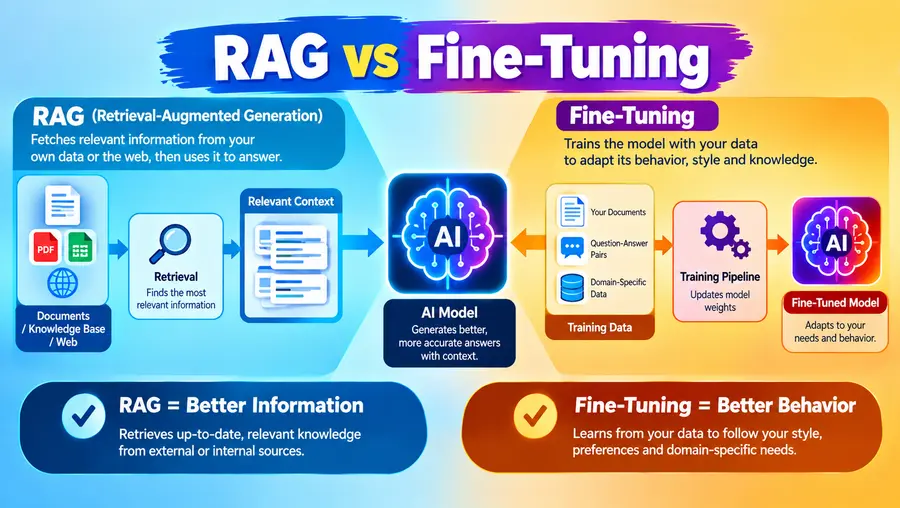
Quick Answer: RAG vs Fine-Tuning
RAG and fine-tuning customize AI applications in different ways.
- RAG: Retrieves relevant information from external sources and provides it to the AI model when answering a question. It is useful for company knowledge bases, documentation assistants, customer support chatbots, and applications that need frequently updated information.
- Fine-tuning: Uses additional training examples to adjust a model’s behavior for a particular task. It is useful for consistent writing styles, specialized classifications, structured outputs, and repeatable task workflows.
- RAG + fine-tuning: Combines external knowledge retrieval with task-specific model behavior. It is useful when an AI application needs both current information and consistent responses.
The best choice depends on the problem you are trying to solve, your data, your budget, and the performance requirements of your application.
What Is RAG in AI?
Retrieval-Augmented Generation, or RAG, is a technique that connects a large language model to an external information source. Instead of relying only on the information learned during training, the model retrieves relevant content and uses it to generate an answer.
That content may come from company documents, product databases, research papers, internal websites, technical manuals, or other searchable information sources.
According to Microsoft’s documentation on retrieval-augmented generation, RAG combines information retrieval with an LLM to produce responses grounded in relevant data.
How does RAG work?
A typical RAG application follows three main steps.
1. Retrieve relevant information
When a user asks a question, the application searches an external knowledge base or index for relevant content.
For example, if a customer asks, “What is your refund policy?”, the system searches the company’s current refund documentation.
2. Augment the prompt
The application combines the user’s question with the relevant information found during retrieval.
This gives the model context it may not have learned during its original training.
3. Generate the answer
The LLM uses the question and retrieved information to produce a response. Depending on how the application is designed, the answer may include links or citations to the original sources.
The result is an AI application that can use information from a knowledge base without retraining its model every time a document changes.
A simple RAG example
Imagine that you manage an online store with hundreds of products.
Your product prices, return policies, and delivery options change regularly. You connect your documentation and product information to a RAG system.
When a customer asks about the return period, the application retrieves the relevant policy and asks the LLM to explain it.
When the policy changes, you update the source document and refresh the relevant index. The application can then retrieve the new policy without fine-tuning the model again.
This makes RAG particularly useful for customer support, internal knowledge assistants, and applications that depend on frequently changing information.
What technologies does RAG use?
A RAG pipeline may include:
- A document-processing system to extract and organize information.
- Chunking to divide large documents into searchable sections.
- Embeddings that represent text as numerical vectors for semantic search.
- A search index or database to store and retrieve relevant content.
- Keyword, vector, semantic, or hybrid search to find useful information.
- An LLM that generates the final answer.
Not every RAG system uses the same architecture. Some use vector databases, while others rely on search services or hybrid retrieval systems. The appropriate design depends on the data and the application.
For example, exact product codes may work well with keyword search, while natural-language questions may benefit from semantic search. Combining both can improve retrieval in some situations. Microsoft explains these options in its RAG and search documentation.
What Is Fine-Tuning in AI?
Fine-tuning is a process in which a pretrained model receives additional training on a curated dataset to improve its performance on a particular task or encourage more consistent behavior.
Instead of retrieving new information for every question, fine-tuning adjusts the model’s learned parameters based on training examples.
These examples might demonstrate how to classify support tickets, respond in a particular tone, follow a structured format, or perform a specialized language task.
How does fine-tuning work?
A typical fine-tuning workflow includes four steps.
1. Prepare training examples
You collect high-quality examples of the task you want the model to perform. Each example should reflect the inputs and outputs expected in real use.
2. Choose a base model
You select a model that already has the general language capabilities needed for your application.
3. Train the model
You use a supported fine-tuning method to adjust the model using your examples. Depending on the model and training method, this may require substantial computing resources or a more efficient technique such as Low-Rank Adaptation (LoRA).
4. Evaluate the fine-tuned model
You test the result on examples that were not used for training. This helps determine whether the model has genuinely improved rather than simply memorized its training examples.
The model can then be deployed and monitored as part of your AI application.
A simple fine-tuning example
Suppose you run a customer support team. Your agents receive thousands of messages and must classify them into categories such as billing, technical support, delivery, and account access.
A general-purpose LLM may perform this task reasonably well, but its output format or category choices might be inconsistent.
You prepare examples that show the model how to classify messages and return a standardized output, such as:
{“category”: “billing”, “priority”: “medium”}
Fine-tuning may help the model produce this structure more consistently across similar requests.
You can also fine-tune a model to follow your organization’s writing style, apply specialized terminology, or perform a narrow task more efficiently.
However, fine-tuning does not guarantee correct answers. The results depend on the quality of the training data, the chosen model, the training method, and the task itself.
For further guidance, see OpenAI’s documentation on optimizing LLM accuracy, which explains how prompting, retrieval, and fine-tuning can address different performance problems.
RAG vs Fine-Tuning: What Is the Difference?
The biggest difference is how each approach adapts an AI system.
RAG changes the information available to the model when it generates an answer. Fine-tuning changes the model through additional training.
Here is a side-by-side comparison.
| Feature | RAG | Fine-tuning |
| Main purpose | Provide relevant external information | Improve task-specific behavior or performance |
| How it works | Retrieves information at inference time | Trains the model on additional examples |
| Frequently changing information | Well suited when retrieval sources are kept updated | Usually less convenient for frequent factual updates |
| Private company documents | Can retrieve relevant passages as needed | May influence model behavior, but is not a reliable document-retrieval system |
| Writing style | Can be guided through prompts and examples | Can improve style consistency |
| Structured outputs | Can be guided by instructions and output constraints | Can help the model follow recurring formats |
| Source citations | Can provide source passages for citations when implemented | Does not inherently retrieve or cite the source of a fact |
| Initial work | Data preparation, indexing, retrieval, and testing | Training-data preparation, training, and evaluation |
| Runtime requirements | Includes retrieval and context assembly, plus model generation | Requires model inference; no external retrieval is necessary unless separately added |
| Main maintenance task | Maintain the data, index, and retrieval quality | Maintain training data, model versions, and evaluation |
| Common examples | Knowledge assistants, document Q&A, current policy lookup | Classification, consistent formatting, domain-specific task behavior |
Neither approach is automatically more accurate, cheaper, faster, or easier in every situation. Performance depends on the implementation and the task being evaluated.
RAG vs Fine-Tuning: Which Is Better for Different Use Cases?
The best way to choose is to start with the actual problem your AI application must solve.
When should you choose RAG?
RAG is often the better choice when your model needs access to information that is private, updated regularly, or too extensive to include directly in every prompt.
Consider RAG when you need to build:
1. A company knowledge-base chatbot
Employees could ask questions about internal policies, project documents, HR guidelines, and operating procedures. RAG can retrieve relevant passages from approved sources before generating a response.
2. A customer support assistant
A support chatbot may need current product manuals, pricing information, delivery rules, warranty terms, and return policies. Retrieving these documents helps the application answer questions using the latest available information.
3. A research assistant
Researchers may want an AI tool to search articles, reports, or a document collection and summarize the most relevant findings. RAG can help connect generated answers to the documents used.
4. An internal business assistant
An organization may store information across technical documentation, spreadsheets, knowledge bases, and internal portals. RAG can provide a natural-language interface to that information, subject to access controls.
5. A technical documentation assistant
Developers often need answers about changing APIs, software versions, configuration options, and troubleshooting steps. RAG can retrieve the relevant version of the documentation instead of relying entirely on the model’s training knowledge.
When should you choose fine-tuning?
Fine-tuning is more appropriate when your application needs consistent behavior that prompts alone do not deliver reliably.
Consider it for:
1. Consistent writing style
A business may need generated emails, product descriptions, or support responses to follow a particular voice. Carefully designed fine-tuning examples can improve consistency.
2. Classification tasks
You may want the model to categorize thousands of customer messages, legal document types, support requests, or product descriptions according to your own classification scheme.
3. Structured output
If an application repeatedly requires a specific output pattern, fine-tuning may help the model learn that behavior. However, where strict validity is essential, also consider structured-output features, schemas, and validation.
4. Specialized language tasks
A model may need to work with a specific technical vocabulary, recurring linguistic patterns, or a narrowly defined workflow. Fine-tuning can help it perform that task more consistently when the training examples represent the real use case.
5. Improving efficiency
Fine-tuning can sometimes help a smaller or less expensive model perform a specialized task well enough for deployment. This may reduce inference costs, although the savings must be measured against training and maintenance expenses.
A useful rule is to choose fine-tuning when you can clearly describe the behavior you want and create high-quality examples that demonstrate it.
RAG vs Fine-Tuning: Which Is Better for Accuracy?
Neither approach automatically guarantees accurate answers. They address different sources of errors.
RAG can improve factual grounding by giving the model relevant evidence. Fine-tuning can improve how consistently the model performs a task. But both approaches require testing.
How RAG can improve accuracy
Suppose a chatbot must answer questions about a company’s latest delivery policy. Without access to that policy, a general-purpose model might produce an outdated or invented answer.
RAG can retrieve the relevant section of the policy and provide it as context.
However, the result depends on retrieval quality. If the system retrieves an outdated document, misses the relevant passage, or supplies too much irrelevant information, the generated answer may still be wrong.
RAG reduces some risks of unsupported answers, but it does not eliminate hallucinations.
How fine-tuning can improve accuracy
Suppose a model must classify invoices using a set of company-specific rules. Fine-tuning on representative, correctly labeled examples may help it apply the desired categories more consistently.
But a fine-tuned model can still make mistakes, particularly when the input is unfamiliar or the training examples are incomplete or inconsistent.
It may also fail to reproduce exact facts on demand. Training a model on documents does not make it equivalent to a searchable database.
What if the model gets the wrong answer despite using RAG?
First, identify where the failure occurs.
- Did the system retrieve the correct source?
- Was the retrieved passage complete and up to date?
- Did the prompt tell the model how to use the evidence?
- Did the model ignore or misunderstand the evidence?
- Was the answer checked against the original source?
If the right evidence was never retrieved, improve the search process, document chunking, indexing, or ranking. If the evidence was correct but the model consistently mishandled it, better prompting or fine-tuning may help.
This troubleshooting approach is consistent with OpenAI’s guidance on LLM accuracy.
RAG vs Fine-Tuning: Which Is Cheaper?
There is no universal cost winner. The cheaper option depends on your workload, data, infrastructure, chosen model, and accuracy requirements.
RAG costs
A RAG application may require spending on:
- Document processing and indexing.
- Embedding generation, where used.
- Search infrastructure or database hosting.
- Retrieval, reranking, and additional application logic.
- The extra tokens needed to include retrieved context in the model’s prompt.
- Monitoring, source updates, and retrieval evaluation.
RAG may avoid the expense of retraining the model whenever information changes, but maintaining a reliable retrieval pipeline still requires effort.
Fine-tuning costs
Fine-tuning costs may include:
- Collecting, cleaning, labeling, and reviewing training examples.
- Computing resources or provider training fees.
- Experimentation and evaluation.
- Model versioning, deployment, and ongoing monitoring.
- Retraining or updating the model when requirements change.
Fine-tuning may allow a model to follow instructions with shorter prompts or enable a smaller model to handle a task. These benefits can sometimes reduce ongoing inference costs.
However, training a model does not automatically make the overall application cheaper.
Which one should a small business choose?
If your main requirement is answering questions from documents that change regularly, RAG is often a practical starting point.
If your task is stable, repetitive, and easy to describe through examples, fine-tuning may become attractive after you have established a baseline and measured the limitations of the original model.
For an accurate cost comparison, estimate the total cost over a realistic period. Include development, infrastructure, training, inference, maintenance, and the cost of incorrect answers.
Can You Use RAG and Fine-Tuning Together?
Yes. In many applications, RAG and fine-tuning complement each other rather than compete.
RAG can give the model current, relevant information, while fine-tuning can help it follow a specialized workflow or response style.
Imagine a bank building an internal assistant for employees.
The application needs to retrieve the latest internal procedures and regulatory documents. It must also produce concise answers in a consistent format and follow specific rules for escalating uncertain questions.
A combined design might work like this:
- RAG retrieves the approved procedure or policy relevant to the question.
- The application passes that evidence to a fine-tuned model.
- The model follows the desired response format and workflow.
- The application provides source references and applies any required checks.
- Uncertain or high-risk cases are escalated for human review.
Fine-tuning could help the model perform the specialized task consistently, while RAG keeps its responses connected to the relevant documents.
The combination does add complexity. You need to evaluate both the retrieval system and the model’s behavior. For some simple applications, prompting and RAG alone may already be sufficient.
AWS discusses this combined approach in its RAG versus fine-tuning guidance.
RAG vs Fine-Tuning: Which Is Better for Your AI Application?
Use the following decision guide to choose a sensible starting point.
| Your main requirement | Recommended starting point | Why |
| Answer questions from private company files | RAG | Retrieves relevant information from your documents |
| Use frequently changing prices, policies, or product data | RAG | Updated sources can be retrieved without retraining the model |
| Provide answers with source citations | RAG | Retrieved passages can be linked to supporting evidence |
| Produce content in a consistent brand voice | Prompting, then fine-tuning if needed | Fine-tuning may improve repeatable style behavior |
| Classify many examples into custom categories | Prompting, then fine-tuning if needed | Training examples can teach the task-specific pattern |
| Return a strict data format | Structured outputs first; consider fine-tuning if needed | Schemas and validation enforce format, while fine-tuning may improve task consistency |
| Use current documents and a specialized response style | RAG + fine-tuning | Combines external evidence with specialized behavior |
| Improve performance but the source of errors is unclear | Evaluation first | Determines whether the problem is retrieval, instructions, model behavior, or data quality |
A practical decision framework
Before making a decision, ask yourself these questions:
Question 1: Does the AI need information that changes frequently?
If yes, start by evaluating RAG. Keeping information in an external source is usually more convenient than repeatedly training a model to absorb every change.
Question 2: Does the AI already have the right information but respond inconsistently?
If yes, improve instructions and examples first. If the problem persists and you have representative training data, test fine-tuning.
Question 3: Do you need both accurate document-based answers and consistent task behavior?
A combined architecture may be appropriate. Test the simpler approach first and add complexity only when evaluation demonstrates a benefit.
Question 4: Can you measure whether the new approach actually helps?
Create a test set of realistic questions and expected outcomes before making a major investment. Compare accuracy, groundedness, latency, cost, and the frequency of unacceptable errors.
The correct choice is the one that solves your actual problem, not the one that sounds more advanced.
What Should You Try Before RAG or Fine-Tuning?
You may not need either technique immediately.
Before building a RAG pipeline or training a model, establish a baseline with a capable pretrained model and clear prompt instructions.
Then inspect the failures.
If the model lacks relevant information, provide the missing context or test retrieval. If the model understands the task but follows instructions inconsistently, improve prompting and examples.
Fine-tuning becomes more useful when you can demonstrate that model behavior is the problem and have good examples to teach the desired behavior.
RAG becomes more useful when the application needs external, private, or changing information. A combined approach is worth evaluating when both needs exist.
The most effective architecture is not necessarily the most complicated one. It is the simplest design that meets your application’s measurable quality, reliability, and cost requirements.
How to Evaluate a RAG or Fine-Tuned AI Application
Whichever approach you choose, test it before deployment.
A practical evaluation process includes the following steps.
1. Build a representative test set
Collect realistic user questions, inputs, and expected results. Include common tasks, edge cases, ambiguous questions, and cases where the system should admit that it lacks enough information.
Keep some examples separate from training so that you can evaluate fine-tuning fairly.
2. Measure answer quality
Check whether responses are factually correct and satisfy the user’s request. For RAG, also evaluate whether the answer is supported by the retrieved evidence.
3. Measure retrieval quality when using RAG
Check whether the right documents are retrieved, whether important information is missing, and whether irrelevant content is being passed to the model.
4. Measure task consistency when using fine-tuning
Check whether the model follows instructions, uses the desired format, applies the correct categories, and handles unfamiliar inputs safely.
5. Compare real-world cost and latency
Record response time, infrastructure costs, model usage, and the frequency of errors. A more accurate system may be worthwhile even if it costs more, particularly for tasks where mistakes are expensive.
6. Test after every significant change
Changes to prompts, training data, retrieval settings, documents, or models can improve one task while harming another. Re-run the evaluation set whenever you make a meaningful change.
This process helps you make decisions based on evidence rather than assumptions about which technique should work best.
Read Here: Local AI vs Cloud AI: What’s the Difference?
Frequently Asked Questions (FAQs)
What is the main difference between RAG and fine-tuning?
RAG retrieves external information and provides it to an LLM when generating a response. Fine-tuning trains the model further on examples to improve task-specific behavior or consistency. RAG primarily addresses information access, while fine-tuning primarily addresses learned behavior and task performance.
Is RAG better than fine-tuning for most AI applications?
RAG is a practical starting point for applications that need access to private or frequently changing information. Fine-tuning may be better for consistent task behavior, style, or specialized output patterns. Neither method is best for every application.
Does fine-tuning give an AI model updated knowledge?
Fine-tuning can influence what a model learns, including domain-specific patterns and information. However, it is not a dependable way to maintain a frequently changing knowledge base or retrieve exact facts from source documents. RAG is generally more suitable for that purpose.
Can RAG reduce AI hallucinations?
RAG can reduce some hallucinations by providing relevant evidence to the model. However, it does not eliminate them. The system may retrieve incorrect or incomplete information, or the model may misinterpret the evidence. Retrieval quality and response evaluation remain essential.
Is RAG cheaper than fine-tuning?
It depends on the application. RAG can avoid repeated training when source data changes, but it adds retrieval and indexing costs. Fine-tuning requires training data and training resources, but it may reduce prompt length or improve the efficiency of specialized tasks. Compare total costs for your expected workload.
Can I combine RAG and fine-tuning?
Yes. RAG can retrieve current information while a fine-tuned model follows a specific task, writing style, or output format. A combined approach is useful when both capabilities are required, but it introduces additional development and evaluation work.
Do I need a vector database to build RAG?
Not always. Many RAG systems use vector databases or vector search, but other designs use keyword search, semantic search services, or hybrid retrieval. The right option depends on your data, query types, search requirements, and infrastructure.
Does RAG require training a new AI model?
No. A typical RAG application can use an existing LLM and provide retrieved information in its prompt. You may need to prepare documents, create embeddings, configure a search index, and evaluate retrieval, but you do not necessarily need to fine-tune or retrain the language model.
Is fine-tuning necessary for a custom AI chatbot?
No. A chatbot can often be customized through system instructions, prompts, tools, and RAG. Fine-tuning is worth considering when evaluation shows persistent behavior or task-performance problems that prompting alone does not solve.
What is the best way to get started with RAG or fine-tuning?
Start with a clear use case, a capable pretrained model, and a small set of representative evaluation examples. Use retrieval if the application needs external information. Test fine-tuning if it needs more consistent task-specific behavior. Combine the two only when testing shows that both are useful.
Read Here: How to Run AI Models Locally on a PC
Conclusion: RAG vs Fine-Tuning
RAG and fine-tuning are two important ways to adapt AI models, but they solve different challenges.
RAG connects a model to relevant external information and is especially useful for private documents, changing policies, technical documentation, and knowledge-based chatbots.
Fine-tuning adjusts a model’s learned behavior using task-specific examples. It can improve consistency in classification, writing style, specialized workflows, and structured outputs.
For many applications, a sensible approach is to start with a pretrained model and clear instructions, add RAG when access to external knowledge is needed, and consider fine-tuning when testing reveals persistent behavior problems.
When an application needs both up-to-date information and consistent specialized behavior, combining RAG with fine-tuning may deliver better results.
The bottom line: Choose RAG when your AI needs better access to information, fine-tuning when it needs better task-specific behavior, and both when your application needs both. Evaluate the results before adding complexity.