In 2026, Azure AIOps is significantly more cost-effective than traditional SRE for enterprise cloud infrastructure. Traditional SRE scales by adding expensive human headcount to manage on-call alert fatigue. Conversely, Azure AIOps utilizes built-in machine learning and Copilot for Azure to autonomously handle root-cause analysis and minor incident remediation. This slashes Mean Time to Resolution (MTTR) by up to 70%. Despite the added costs of AI tokens, reducing human operational overhead makes Azure AIOps the definitive budget-friendly champion.
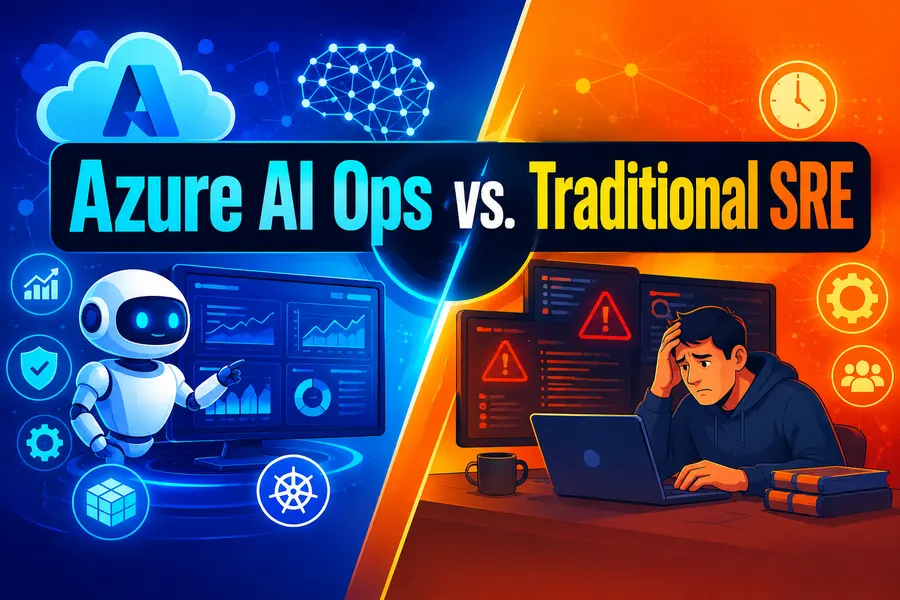
Azure AIOps vs. Traditional SRE: A Cost and Efficiency Comparison
Azure AIOps is much more cost-effective than traditional SRE. While traditional systems require scaling expensive human headcount to manage complex incidents, Azure AIOps automates root-cause analysis, drastically slashing MTTR and operational overhead.
Cloud infrastructure has become more complex than ever before. Modern businesses run applications across containers, Kubernetes clusters, hybrid clouds, edge systems, and multi-cloud environments.
As systems grow larger, managing reliability manually becomes harder and more expensive. This is where the debate between Azure AIOps and traditional Site Reliability Engineering (SRE) becomes important.
Organizations now want faster incident response, lower operational costs, fewer outages, and more automation. At the same time, engineering teams face alert fatigue, staffing shortages, and increasing infrastructure complexity.
Artificial intelligence is changing how cloud operations work, and Microsoft Azure AIOps is becoming one of the most discussed solutions in enterprise infrastructure management.
Let’s explore the real differences between Azure AIOps and traditional SRE. Compare their costs, operational efficiency, scalability, automation capabilities, staffing needs, and long-term business impact.
What Is Azure AIOps?
Azure AIOps refers to the use of artificial intelligence, machine learning, predictive analytics, and automation within Microsoft Azure cloud operations. The goal is to improve system reliability while reducing manual operational effort.
Traditional monitoring tools mainly detect problems after they occur. AI Ops attempts to predict problems before they create outages. It analyzes telemetry data, infrastructure logs, application behavior, security events, and system performance patterns continuously.
Azure AIOps combines several technologies together:
- AI-driven observability
- Automated incident management
- Intelligent alert correlation
- Predictive anomaly detection
- Self-healing infrastructure
- Root cause analysis automation
- Cloud optimization recommendations
Instead of relying completely on engineers to manually investigate issues, AI systems help detect patterns that humans may miss.
For example, if database latency slowly increases every Tuesday during high traffic periods, Azure AI models can identify the trend before a failure happens. The system may automatically scale resources or recommend remediation actions.
This changes operations from reactive to predictive.
What Is Traditional SRE?
Site Reliability Engineering, commonly called SRE, originated at Google. Traditional SRE is a reliability engineering approach where human experts manage systems, resolve incidents, and ensure uptime through manual monitoring, troubleshooting, and structured operational practices.
Traditional SRE combines software engineering principles with IT operations practices to maintain system reliability.
SRE teams are responsible for:
- Monitoring systems
- Handling incidents
- Managing uptime
- Reducing outages
- Improving deployment reliability
- Capacity planning
- Performance optimization
- Disaster recovery
Traditional SRE relies heavily on human expertise. Engineers review alerts, investigate incidents, analyze logs, and manually perform remediation tasks.
This approach works well for smaller systems or highly customized infrastructure environments. However, cloud-native architectures now generate enormous amounts of telemetry data every minute. Human teams often struggle to process all this information efficiently.
As infrastructure scales, traditional SRE becomes more expensive because companies need larger teams, 24/7 on-call rotations, and complex monitoring setups.
Why Businesses Are Moving Toward AIOps
Businesses are embracing AI Ops to streamline IT operations, automate incident response, and enhance efficiency.
AIOps leverage machine learning and predictive analytics, reduces downtime, improves scalability, and empowers organizations to achieve smarter, faster digital transformation.
Several industry trends are driving the shift toward AI-powered operations.
Infrastructure Complexity Is Exploding
Modern applications no longer run on a single server. Enterprises now operate:
- Kubernetes clusters
- Microservices architectures
- Hybrid cloud systems
- Serverless functions
- Multi-region deployments
- Edge computing networks
Each component generates logs, metrics, traces, and alerts continuously.
A single outage may involve dozens of interconnected services. Human teams often cannot investigate quickly enough.
AI Ops platforms help correlate these signals automatically.
Alert Fatigue Is Becoming a Major Problem
Alert fatigue is a growing challenge as traditional monitoring systems flood teams with duplicate and false alerts. This overload reduces focus, delays response, and increases risk, making smarter AI‑driven monitoring essential for effective incident management.
Engineers can become overwhelmed.
This creates several problems:
- Slower incident response
- Missed critical alerts
- Burnout among SRE teams
- Increased downtime
Azure AIOps reduces noise by grouping related alerts together and prioritizing critical events intelligently.
Instead of receiving 500 separate alerts, teams may receive one correlated incident report.
Downtime Costs Are Increasing
Cloud outages now directly affect revenue, customer trust, and business continuity.
Even short outages can cost enterprises millions of dollars.
AIOps platforms aim to reduce:
- Mean Time to Detect (MTTD)
- Mean Time to Resolve (MTTR)
- Human error
- Operational delays
Faster recovery means lower financial impact.
Core Differences Between Azure AI Ops and Traditional SRE
Azure AIOps leverages automation, machine learning, and predictive analytics to manage cloud reliability, while traditional SRE relies on human engineers, manual monitoring, and structured practices. AIOps reduces alert fatigue and accelerates autonomous incident response.
Reactive vs Predictive Operations
Traditional SRE is usually reactive.
An incident happens first. Then engineers investigate and respond.
Azure AIOps is predictive.
It attempts to detect abnormal behavior before failures occur.
This difference is extremely important.
Predictive systems can reduce outages instead of simply responding to them faster.
For example:
Traditional SRE workflow:
- Server crashes
- Alert triggers
- Engineer investigates
- Team applies fix
Azure AIOps workflow:
- AI detects memory usage trend
- Predicts possible failure
- Automatically scales resources
- Outage never happens
Preventing outages is more valuable than responding quickly after failure.
Human-Centered vs AI-Assisted Operations
Traditional SRE depends heavily on human expertise.
Engineers:
- Analyze logs manually
- Investigate incidents
- Tune monitoring systems
- Create remediation scripts
Azure AIOps automates many of these tasks.
The AI system:
- Correlates alerts automatically
- Detects anomalies
- Suggests root causes
- Executes remediation workflows
This reduces repetitive operational work.
Human engineers focus more on architecture and strategic reliability improvements.
Monitoring Intelligence
Traditional monitoring tools usually rely on static thresholds.
Example:
- CPU above 90%
- Memory usage above 80%
- Disk latency above fixed value
AI Ops systems use behavioral analysis instead.
They learn normal operational patterns over time.
This enables dynamic anomaly detection.
For example, a sudden 20% increase in traffic may be normal during peak business hours but suspicious at midnight.
AI models understand the context better than static rules.
Cost Comparison: Azure AIOps vs Traditional SRE
One of the biggest reasons businesses adopt AI Ops is cost reduction. However, the financial comparison is more complex than many marketing claims suggest.
Infrastructure Monitoring Costs
Traditional SRE environments often require multiple monitoring tools.
Organizations may use separate platforms for:
- Logs
- Metrics
- Traces
- Security events
- Incident management
- Visualization dashboards
This increases licensing costs.
Azure AIOps consolidates many functions into integrated cloud-native systems.
Benefits include:
- Lower tool fragmentation
- Reduced maintenance overhead
- Unified observability
- Better automation integration
However, AI-powered observability platforms can initially appear expensive due to advanced analytics processing.
The long-term savings usually come from operational efficiency.
Labor Costs and Staffing
Traditional SRE teams are expensive.
Experienced reliability engineers are among the highest-paid technical professionals.
Large enterprises may require:
- 24/7 incident response teams
- Multiple escalation layers
- Dedicated monitoring engineers
- Capacity planning specialists
As infrastructure grows, staffing costs increase significantly.
Azure AIOps reduces some manual workload through automation.
This allows smaller teams to manage larger systems.
For example:
- One AI-assisted operations team may manage infrastructure that previously required multiple SRE shifts.
- Automated remediation reduces nighttime incident escalations.
- AI-driven diagnostics reduce investigation time.
This does not eliminate SRE jobs.
Instead, it changes the nature of the work.
Engineers spend less time firefighting and more time improving systems.
Downtime Reduction and Financial Impact
Downtime is often the largest hidden operational cost.
A major outage can affect:
- Revenue
- Customer trust
- Compliance
- Brand reputation
- Employee productivity
Traditional SRE teams may still require time to:
- Detect problems
- Gather logs
- Identify root causes
- Coordinate remediation
Azure AIOps reduces this delay through automation.
Faster detection and automated response significantly lower outage duration.
This creates indirect financial savings that are often larger than infrastructure cost reductions.
Azure AIOps vs Traditional SRE: Operational Efficiency Comparison
Efficiency is not only about automation. It also includes scalability, accuracy, speed, and workload distribution.
Azure AIOps boosts operational efficiency with automation, predictive analytics, and reduced alert fatigue, while traditional SRE depends on manual monitoring and human intervention. AI Ops accelerates incident response, scalability, and reliability compared to conventional engineering practices.
Incident Detection Speed
Traditional systems rely on predefined alerts.
AI Ops platforms continuously analyze:
- Behavioral patterns
- Historical incidents
- Infrastructure dependencies
- User activity trends
This improves detection accuracy.
AI systems can identify subtle anomalies humans may miss.
Root Cause Analysis
Root cause analysis is one of the most time-consuming parts of incident management.
Traditional workflows often involve:
- Reviewing logs manually
- Comparing timelines
- Cross-checking services
- Escalating across teams
Azure AI Ops accelerates this process using correlation engines.
The system identifies:
- Related services
- Infrastructure dependencies
- Probable failure origins
This dramatically reduces troubleshooting time.
Self-Healing Infrastructure
One of the most important differences is self-healing capability.
Traditional SRE environments usually require human intervention.
AI Ops platforms can automatically:
- Restart failed services
- Scale workloads
- Rebalance traffic
- Apply remediation playbooks
This reduces operational delays.
Self-healing infrastructure becomes especially valuable during nighttime incidents or global deployments.
Scalability Comparison
Cloud scale creates major operational challenges.
Traditional SRE teams often struggle when:
- Services multiply rapidly
- Kubernetes clusters expand
- Microservices increase dependencies
AI Ops scales better because machine learning systems can process enormous telemetry volumes continuously.
This becomes critical in:
- Enterprise cloud operations
- Large SaaS platforms
- E-commerce systems
- Financial infrastructure
- AI workloads
As environments grow, manual operations become increasingly inefficient.
Azure AIOps Advantages
Better Signal-to-Noise Ratio
AI systems reduce alert noise significantly.
Instead of flooding teams with thousands of notifications, incidents are grouped intelligently.
This improves focus and reduces fatigue.
Faster Mean Time to Resolution
Automated diagnostics and remediation reduce MTTR.
Faster recovery improves:
- Customer experience
- Business continuity
- Service reliability
Improved Resource Optimization
AI-powered systems optimize:
- Compute usage
- Storage allocation
- Auto-scaling behavior
- Workload balancing
This reduces cloud waste.
Cloud cost optimization becomes increasingly important as infrastructure spending grows.
Continuous Learning
Traditional rule-based systems require constant manual tuning.
AI Ops improves over time as models learn operational patterns.
The platform becomes smarter with more telemetry data.
Challenges and Limitations of Azure AIOps
Despite its benefits, AI Ops is not perfect. Many organizations underestimate implementation complexity.
AI Models Require Quality Data
Poor telemetry data reduces AI effectiveness.
If logs are incomplete or inconsistent:
- Anomaly detection becomes unreliable
- Correlation accuracy decreases
- False positives increase
Good observability architecture remains essential.
Automation Risks
Automated remediation can create problems if poorly configured.
Examples:
- Incorrect auto-scaling
- Restart loops
- Over-aggressive failover actions
Human oversight is still necessary.
Initial Implementation Costs
AI Ops adoption requires investment in:
- Cloud-native observability
- Telemetry pipelines
- Integration workflows
- AI model training
- Operational restructuring
Small organizations may not immediately see cost savings.
Skills Gap
AI Ops changes operational skill requirements.
Teams now need knowledge of:
- Machine learning operations
- Automation frameworks
- Cloud-native architecture
- AI-driven observability
Training becomes important.
When Traditional SRE Still Works Better
Traditional SRE works better when human judgment, contextual decision‑making, and manual oversight are essential for complex systems, unpredictable incidents, and nuanced reliability challenges beyond automated AI Ops capabilities.
Traditional SRE remains valuable in several situations.
Highly Customized Infrastructure
Some organizations use unique infrastructure environments with highly specialized workflows.
AI models may struggle with unusual architectures.
Human expertise becomes more reliable.
Strict Compliance Environments
Industries like:
- Healthcare
- Government
- Defense
- Banking
may require human approval for operational changes.
Fully autonomous remediation may not be acceptable.
Smaller Infrastructure Environments
Small companies may not need enterprise-grade AI Ops platforms.
Traditional SRE practices can remain more cost-effective for:
- Smaller workloads
- Limited cloud deployments
- Simple application architectures
The Rise of Hybrid AI-Assisted SRE
The rise of hybrid AI‑assisted SRE blends automation with human expertise, reducing alert fatigue and improving reliability. This model enhances operational efficiency, accelerates incident response, and balances machine learning insights with contextual decision‑making for resilient systems.
Most enterprises are not replacing SRE teams entirely. Instead, they are adopting hybrid operational models.
In this model:
- AI handles repetitive operational tasks
- Humans oversee strategic decisions
- Engineers validate automated remediation
- AI accelerates diagnostics
This combination often produces the best results.
The future is likely not “AI replacing SRE.”
The future is “AI-enhanced SRE.”
Azure AIOps Tools and Services
Several Azure services support AI-driven operations.
Azure Monitor
Azure Monitor provides:
- Metrics
- Logs
- Application telemetry
- Observability dashboards
It acts as the central monitoring platform.
Microsoft Sentinel
Uses AI for:
- Security analytics
- Threat detection
- Incident correlation
Security operations increasingly overlap with reliability engineering.
Azure Machine Learning
Allows enterprises to build custom predictive operational models.
Examples include:
- Failure prediction
- Capacity forecasting
- Performance anomaly detection
Azure Arc
Helps manage:
- Hybrid infrastructure
- Multi-cloud environments
- Distributed systems
This becomes important as enterprises expand beyond single-cloud architectures.
AI Ops and Kubernetes Operations
AI Ops enhances Kubernetes operations by automating monitoring, scaling, and incident response. It reduces alert fatigue, improves reliability, and leverages machine learning insights, while traditional Kubernetes management relies heavily on manual oversight and human intervention.
Kubernetes environments generate massive operational complexity.
Common issues include:
- Pod failures
- Resource contention
- Scaling problems
- Service mesh latency
Traditional SRE teams often spend significant time troubleshooting containers manually.
Azure AIOps improves Kubernetes reliability through:
- Predictive scaling
- Intelligent scheduling analysis
- Automated remediation
- Container anomaly detection
As Kubernetes adoption grows, AI-assisted operations become increasingly valuable.
The Future of AI Ops in 2026 and Beyond
AI Ops emphasizes autonomous incident response, predictive analytics, and hybrid SRE models. Businesses will adopt AI‑driven operations to reduce downtime, enhance scalability, and achieve smarter, resilient digital transformation.
AI Ops is evolving rapidly. Several important trends are emerging.
Generative AI for Cloud Operations
Generative AI systems are beginning to assist with:
- Incident summaries
- Root cause explanations
- Remediation recommendations
- Operational documentation
This improves team productivity.
Autonomous Infrastructure
Future systems may automatically:
- Tune performance
- Optimize costs
- Prevent outages
- Reconfigure workloads
The concept of self-managing infrastructure is becoming realistic.
AI Copilots for SRE Teams
AI copilots will increasingly assist engineers during incidents.
They may provide:
- Suggested fixes
- Dependency analysis
- Historical incident comparisons
- Automated troubleshooting workflows
This reduces cognitive load during critical outages.
Multi-Cloud AI Operations
Enterprises increasingly use multiple cloud providers.
Future AI Ops platforms will focus heavily on:
- Cross-cloud observability
- Unified operational intelligence
- Vendor-neutral automation
Hybrid cloud management will become a central operational challenge.
Which Is Better: Azure AI Ops or Traditional SRE?
There is no universal answer.
The best choice depends on:
- Infrastructure scale
- Operational maturity
- Budget
- Compliance requirements
- Automation readiness
However, industry direction is clear.
AI-assisted operations are becoming essential for large-scale cloud infrastructure.
Traditional SRE alone struggles to keep pace with modern telemetry volumes and operational complexity.
Organizations that combine:
- Strong SRE practices
- Intelligent automation
- AI-driven observability
- Human oversight
will likely achieve the best balance between reliability, efficiency, and cost.
Read Here: How to Implement Agentic SRE on AWS: Step-by-Step Guide
Final Thoughts
Azure AI Ops represents a major shift in cloud operations. It moves infrastructure management from reactive troubleshooting toward predictive and autonomous reliability engineering.
Traditional SRE remains valuable, especially for strategic thinking, architectural judgment, and complex operational decision-making. But manual operations alone are becoming harder to sustain at enterprise scale.
The future is not about replacing engineers with AI.
The future is about reducing operational noise, automating repetitive tasks, improving reliability, and allowing engineers to focus on innovation instead of constant firefighting.
Businesses that adopt AI-assisted reliability engineering early may gain important advantages:
- Lower operational costs
- Faster incident response
- Reduced downtime
- Better scalability
- Improved customer experience
As cloud infrastructure continues evolving, AI Ops is likely to become a core component of modern enterprise operations strategy.
Read Here: Benefits of Agentic AI in Business: Unlocking Scalability and Reliability
FAQs: Azure AI Ops vs. Traditional SRE
1. Why is Azure AIOps considered more cost-effective in 2026?
Azure AIOps reduces costs by automating routine incident investigation and remediation. Instead of hiring expensive human headcount to handle alert fatigue, organizations use AI to manage scaling workloads, drastically lowering long-term operational overhead.
2. What is the main driver of high costs in traditional SRE?
Human labor is the primary cost driver. Traditional SRE scales linearly with infrastructure growth, requiring more engineers to manage alerts, perform manual root-cause analysis, and maintain complex operational runbooks 24/7.
3. Doesn’t the cost of Azure AI tokens outweigh human labor costs?
No. While Azure AI token and API costs are recurring, they are a fraction of enterprise SRE salaries. The massive savings from reduced MTTR and minimized production downtime easily offset the cloud AI consumption fees.
4. How does Azure AIOps improve incident response efficiency?
AIOps uses machine learning and Copilot for Azure to instantly correlate telemetry, analyze logs, and identify root causes. This eliminates hours of manual human troubleshooting, slashing Mean Time to Resolution by up to 70%.
5. Does Azure AIOps completely replace human SRE teams?
No, it shifts their focus. Azure AIOps automates low-level tier-1 and tier-2 incidents, allowing your human SREs to stop firefighting and focus on high-value architectural improvements, system reliability, and proactive platform engineering.
6. What specific Azure tools are used in Azure AIOps?
Azure AIOps integrates Azure Monitor, Log Analytics, and Azure Advisor with Copilot for Azure. These tools combine continuous system observability with advanced generative AI reasoning to discover and remediate infrastructure anomalies autonomously.
7. How does traditional SRE compare in MTTR?
Traditional SRE has a much higher MTTR. Human teams must manually log into dashboards, parse through massive datasets, and coordinate across communication silos to diagnose complex, distributed system failures under intense pressure.
8. Is Azure AIOps suitable for small businesses with limited budgets?
Yes, because it offers pay-as-you-go pricing. Smaller teams can leverage enterprise-grade incident response capabilities without hiring a massive 24/7 engineering rotation, maximizing their operational budget from day one.
9. What is the hidden cost of staying with traditional SRE?
The hidden costs are prolonged downtime, developer burnout, and high employee turnover. Slow manual incident resolution damages customer retention, while constant alert fatigue causes expensive SRE talent to leave the company.
10. How should an enterprise start transitioning to Azure AIOps?
Start small by enabling Copilot for Azure inside Azure Monitor. Use AI initially for read-only log analysis and anomaly detection, then gradually implement autonomous remediation scripts as your team’s operational trust grows.